
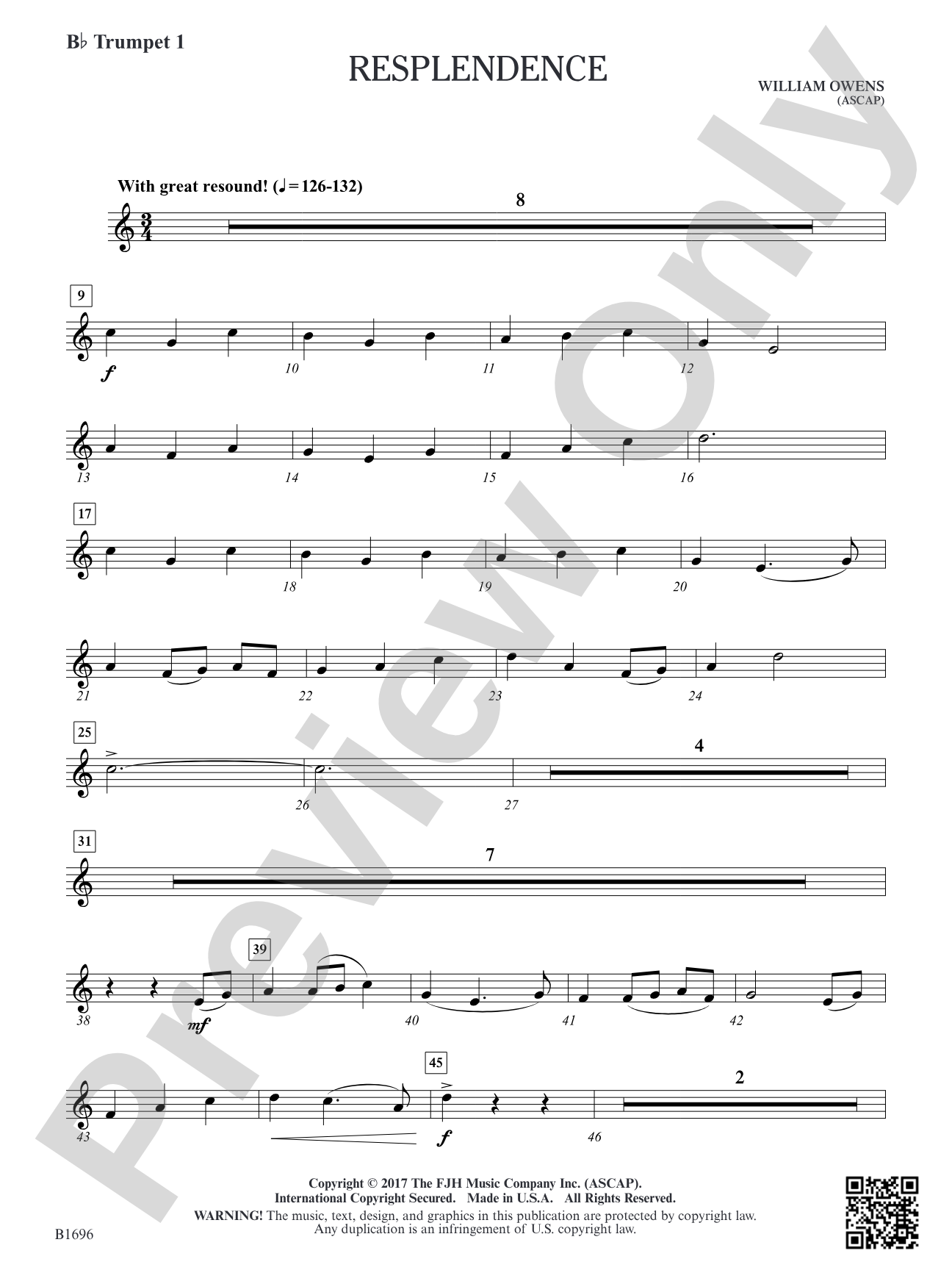

Resplendence: B-flat Trumpet 1
By William Owens
Grade: 1.5;2
Item: 98-PC-DB1696_T1
$7.00
Pickup currently not available
Description
With brilliant woodwind passages, colorful percussion and a strong melodic statement, this exciting work draws inspiration from the music of the early Greek Orthodox Church. The music is largely characterized by its brisk, free-flowing quality. As the melodic content passes through several sections of the ensemble, many variations in style and tonal color can be heard. Outstanding!


Don't just read it, hear it, play along with it, and watch your students grow with it. In MakeMusic Cloud, Resplendence: B-flat Trumpet 1 comes alive with professional accompaniment, adjustable tempo, and built-in practice tools that turn solo practice into real progress.
Open in the Player
Jump straight in and assign it today.
Start Your Free Trial
Open this title and explore the full library in minutes.
Sample Audio
1
Audio File
--:--
0:00
0:00
Sample Video
Additional Details
Series:
FJH Developing Band
Publisher:
The FJH Music Company, Inc.
SKU:
98-PC-DB1696_T1
More about this title
About the Composer: William Owens
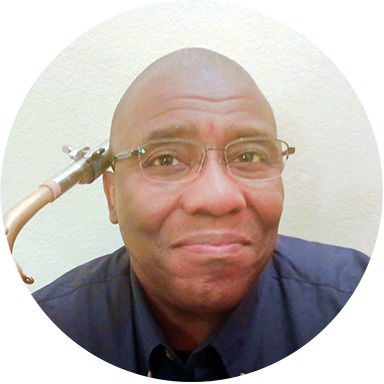
William Owens brings three decades of classroom experience to his prolific output as a composer for young musicians. A native of Gary, Indiana, and a 1985 graduate of VanderCook College of Music, he has established himself as a trusted voice in band literature through over 300 published works since 1993. His compositions for concert band, string orchestra, and small ensemble are recognized on required lists across the country and have become foundational repertoire in many programs.
Owens' approach to writing for developing ensembles reflects his background as a bandmaster and clinician. His work has earned commissions from institutions including South Plains College, Phi Beta Mu International, and the American Bandmasters Association, along with recognition as a Distinguished Alumnus and recipient of the Texas Bandmasters Association's Meritorious Achievement Award. He resides in Fort Worth, Texas.
Why we love this
Owens understands the balance young bands need: accessible writing that doesn't feel simplistic. The interplay between woodwind color and percussion texture gives every section meaningful material, and the freely flowing character allows students to hear how melodic content transforms as it moves through the ensemble. This is the kind of piece that sounds more sophisticated than its grade level because the orchestration and harmonic language do the heavy lifting.
What to expect
Resplendence unfolds with a luminous quality, drawing from the rich harmonic language of Orthodox liturgy but expressed through brisk, flowing passages that never feel heavy. Brilliant woodwind conversations pass over shifting percussion colors, creating moments of brightness punctuated by subtle harmonic turns that reward careful listening.
Who it's for
Young concert bands at the early intermediate level (grades 1.5 to 2) that are ready for music with real harmonic and textural sophistication. This works equally well for festival preparation or concert programming when you want an opener or centerpiece that shows growth without overreaching.
How to get the most out of it
- Shape the woodwind passages with attention to balance; the clarity of these lines matters more than volume
- Let the melodic statements breathe freely rather than pushing strict tempo, which honors the piece's connection to early liturgical music
- Use the varied tonal colors as rehearsal landmarks; identifying where the mood shifts helps the ensemble internalize form and forward motion
- Give the percussion section clear cues for their colorful moments; they're not accompaniment here, but part of the tonal conversation
How to use it
Program this as a concert opener to establish energy and sophistication, or pair it with slower, more introspective works to create programming contrast. It also makes an excellent festival selection when you want a piece that's both achievable and competitive, one that impresses adjudicators without requiring advanced technique.
Skills your students will build
- Tracking melodic lines across different instrumental sections
- Balancing multiple tonal colors within a single ensemble texture
- Responding to free-flowing phrasing without losing rhythmic precision
- Understanding how harmonic and orchestrational choices create musical character