
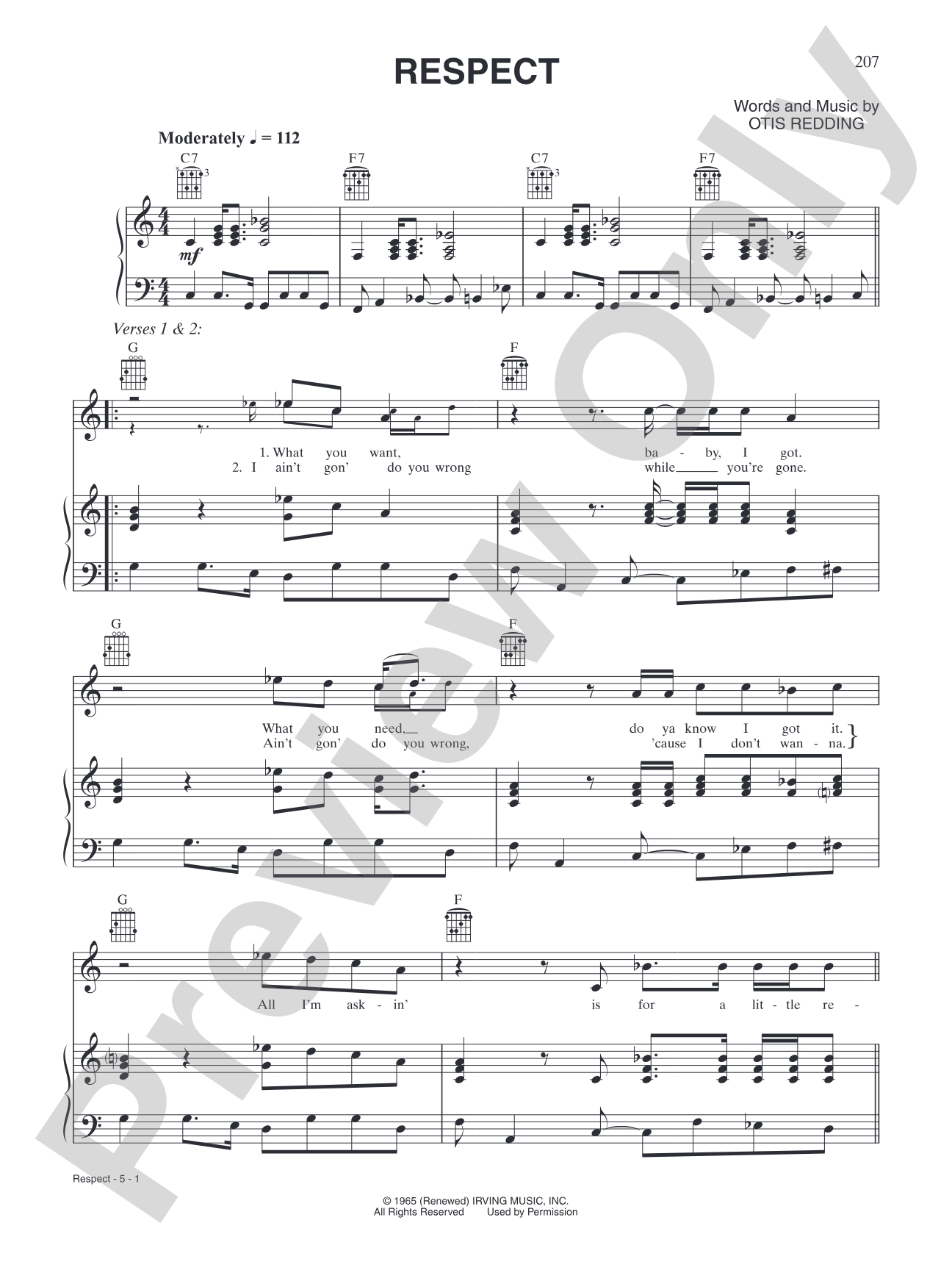

Respect: Piano/Vocal/Chords
Item: 00-PS-0011394
$3.99
One moment…
Related Items
Rolling Stone Sheet Music Classics, Volume 1: 1950s-1960s: Piano/Vocal/Chords Book |
$24.95
|
View |
Description
Sixty of the best songs of the early rock era, all chosen from Rolling Stone magazine's 500 Greatest Songs of All Time list. The songs are from the 1950s to the '60s, arranged for piano/vocal/chords. Many of these great songs were previously available only as "old-time" sheet music editions that did not accurately portray the classic recordings that made them famous. In preparing this songbook, Alfred Music took great care to revisit those recordings, replacing incorrect arrangements with new ones that allow pianists and singers to perform the songs in the style that landed them on the Rolling Stone 500. Also available: Rolling Stone Sheet Music Classics, Volume 2: 1970s--1990s. Similar editions are available arranged for easy guitar TAB, wind, and string instruments. Songs vary per instrument.
Titles: All Along the Watchtower * All I Have to Do Is Dream * Be-Bop-A-Lula * Blowin' in the Wind * Blueberry Hill * Both Sides Now * The Boxer * Brown Eyed Girl * Crazy * Crying * Earth Angel * Eight Miles High * Everyday People * For What It's Worth * Gimme Shelter * Gimme Some Lovin' * Gloria * Good Vibrations * Great Balls of Fire * (Your Love Keeps Lifting Me) Higher and Higher * Hit the Road Jack * Honky Tonk Women * Hoochie Coochie Man * Hound Dog * House of the Rising Sun * I Can See for Miles * I Want To Hold Your Hand * Jumpin' Jack Flash * The Letter * Like a Rolling Stone * Mr. Tambourine Man * Mustang Sally * My Generation * My Girl * The Night They Drove Old Dixie Down * Paint It Black * People Get Ready * Piece of My Heart * Respect * Rock Around the Clock * Ruby Tuesday * Runaway * (I Can't Get No) Satisfaction * Save the Last Dance for Me * Soul Man * Sound of Silence * Stand By Me * Summertime Blues * Sunshine of Your Love * Sympathy for the Devil * Times They Are A-Changin' * The Weight * What'd I Say * When a Man Loves a Woman * Whipping Post * White Room * A Whiter Shade of Pale * Whole Lotta Shakin' Goin On * You Can't Always Get What You Want * You Send Me.


Titles: All Along the Watchtower * All I Have to Do Is Dream * Be-Bop-A-Lula * Blowin' in the Wind * Blueberry Hill * Both Sides Now * The Boxer * Brown Eyed Girl * Crazy * Crying * Earth Angel * Eight Miles High * Everyday People * For What It's Worth * Gimme Shelter * Gimme Some Lovin' * Gloria * Good Vibrations * Great Balls of Fire * (Your Love Keeps Lifting Me) Higher and Higher * Hit the Road Jack * Honky Tonk Women * Hoochie Coochie Man * Hound Dog * House of the Rising Sun * I Can See for Miles * I Want To Hold Your Hand * Jumpin' Jack Flash * The Letter * Like a Rolling Stone * Mr. Tambourine Man * Mustang Sally * My Generation * My Girl * The Night They Drove Old Dixie Down * Paint It Black * People Get Ready * Piece of My Heart * Respect * Rock Around the Clock * Ruby Tuesday * Runaway * (I Can't Get No) Satisfaction * Save the Last Dance for Me * Soul Man * Sound of Silence * Stand By Me * Summertime Blues * Sunshine of Your Love * Sympathy for the Devil * Times They Are A-Changin' * The Weight * What'd I Say * When a Man Loves a Woman * Whipping Post * White Room * A Whiter Shade of Pale * Whole Lotta Shakin' Goin On * You Can't Always Get What You Want * You Send Me.
Respect: Piano/Vocal/Chords isn't in MakeMusic Cloud just yet...but it could be. Let us know you'd like to see it, and you'll help shape what comes next. In the meantime, start a free trial and dive into thousands of interactive titles your students can play along with today.
Request This Title
Tell us you want it.
Start Your Free Trial
Explore everything that's ready to play right now.
Sample Audio
No sample audio found.
Sample Video
No sample videos found.
Additional Details
Series:
Rolling Stone Magazine
Publisher:
Alfred Music
Page Count:
320
SKU:
00-PS-0011394
More about this title
About the Composer: Otis Redding
Otis Redding stands as one of the most influential voices in soul and R&B music, with a recording career that fundamentally shaped popular music in the 1960s. His powerful delivery and emotional authenticity made him a crossover artist whose work influenced rock, pop, and soul musicians across generations. Though his life was cut short, his legacy includes some of the most covered and reinterpreted songs in American music.
For music educators, Redding's work represents a crucial bridge between blues, gospel, and rock traditions. His songs demonstrate how authentic emotional expression translates across genres and how strong melodic writing can endure across decades of reinterpretation.
Why we love this
This collection gives you sixty canonical rock recordings in arrangements that actually match what listeners know and love. Rather than relying on decades-old sheet music with harmonic shortcuts and simplified voicings, Alfred Music went back to the original recordings and rebuilt these pieces to capture their authentic sound. For pianists and singers who want to perform rock standards with historical accuracy and style, this is the reference edition.
What to expect
These songs carry the raw energy of early rock and roll alongside the soulful sophistication of '60s pop and soul. From the swagger of "Great Balls of Fire" to the yearning of "Crazy" to the social urgency of "Blowin' in the Wind," the collection spans styles and moods while maintaining the vitality that made these tracks endure. Playing and singing them connects you to a foundational moment in popular music.
Who it's for
Pianists and singers preparing rock standards for recitals, auditions, or performance ensembles will find trusted arrangements grounded in the actual recordings. Voice teachers accompanying students, pianists building a repertoire of iconic songs, and singers exploring early rock will all benefit from charts that honor the original versions rather than oversimplifying them.
How to get the most out of it
- Study the original recordings alongside the charts. The piano voicings and rhythmic feels in these arrangements reflect specific production choices from the '50s and '60s; hearing them side by side locks in the style.
- Pay attention to the chord symbols and rhythmic notation. Many of these songs use blues progressions or modal harmony that may feel different from pop ballads; the symbols guide you through those shifts.
- Balance the vocal line against the piano part. These arrangements support singing without overwhelming it; find the dynamic that lets both coexist.
- Adjust tempo based on the era and recording style. A mid-'60s soul tune has a different pocket than a '50s rockabilly number; let the original inspire your tempo choices.
How to use it
Use individual songs from this collection as recital repertoire or as part of a thematic program celebrating rock history. Voice students can draw from it for audition material or performance classes; pianists preparing for music theater or pop-influenced repertoire exams will find solid, accurate versions here. A mixed recital pairing classical repertoire with a carefully chosen rock standard from this book makes a compelling statement about musical breadth.
Skills your students will build
- Reading and interpreting chord symbols in blues and rock progressions
- Accompanying singers in popular music styles from the '50s and '60s
- Understanding the relationship between recorded arrangements and written notation
- Performing swing eighths, shuffle rhythms, and other era-specific rhythmic feels
- Balancing melody and accompaniment in vocal music