
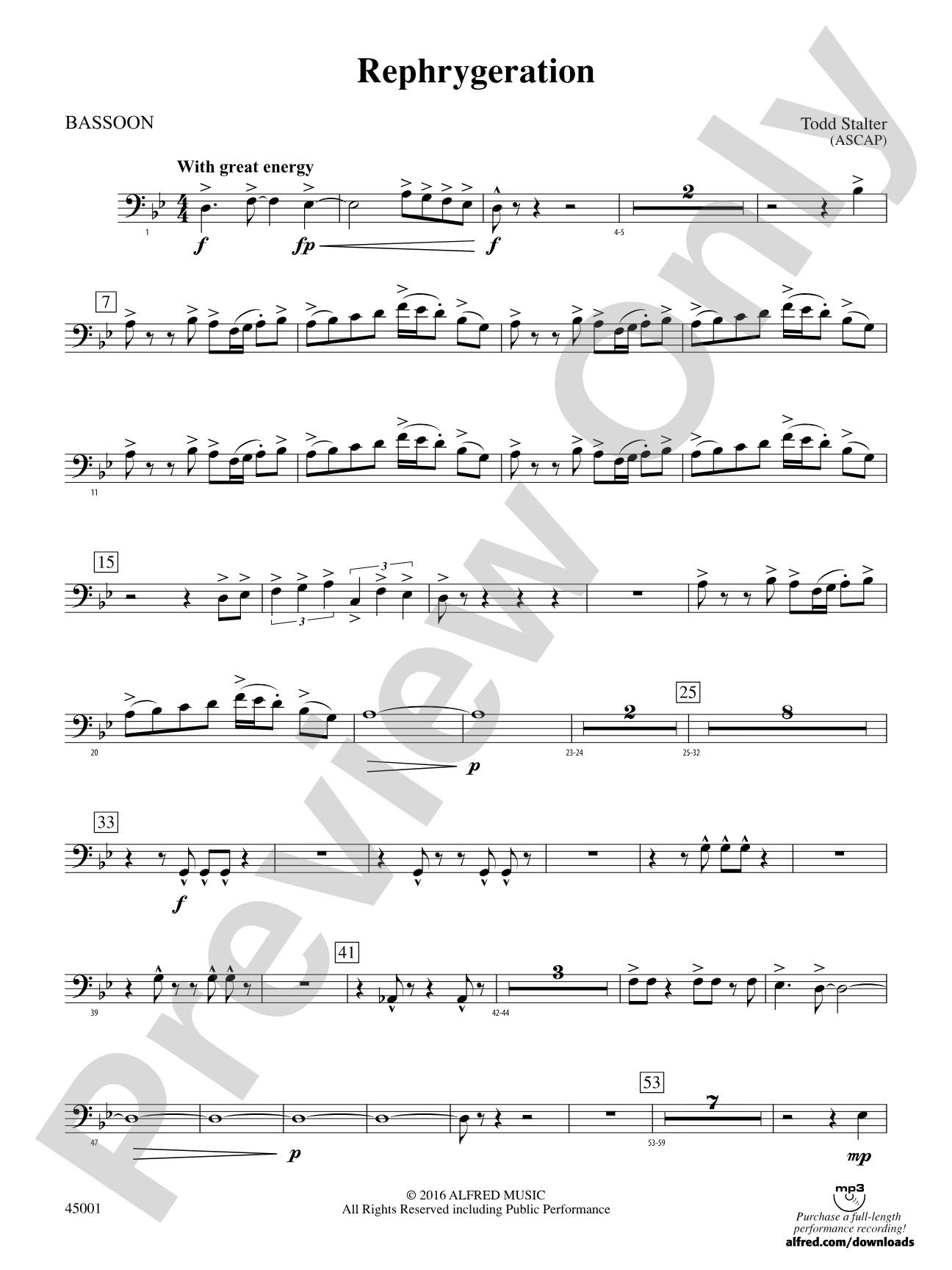

Rephrygeration: Bassoon
By Todd Stalter
Grade: 4 (Medium Difficult)
Item: 00-PC-0017466_B1
$3.00
Pickup currently not available
Description
A dynamic concert opener or closer cast almost entirely in the Phrygian mode. The half steps that make this scale mode so unique are celebrated both in a melodic and harmonic sense, with aggressive low brass figures, crisp and rhythmic percussion, and winding passages in the woodwind. (2:50)


Don't just read it, hear it, play along with it, and watch your students grow with it. In MakeMusic Cloud, Rephrygeration: Bassoon comes alive with professional accompaniment, adjustable tempo, and built-in practice tools that turn solo practice into real progress.
Open in the Player
Jump straight in and assign it today.
Start Your Free Trial
Open this title and explore the full library in minutes.
Sample Audio
1
Audio File
--:--
0:00
0:00
Sample Video
Additional Details
Series:
Alfred Concert Band
Publisher:
Alfred Music
Page Count:
274
SKU:
00-PC-0017466_B1
More about this title
About the Composer: Todd Stalter

Todd Stalter spent 34 years leading the band program at Eureka High School in Illinois, where he built one of the state's most respected ensembles. His marching band earned 16 Class 1A state championships, while his concert band consistently achieved Superior ratings at IHSA competitions. Beyond his home program, he has conducted All-State bands in Georgia and Delaware, adjudicated extensively across the Midwest, and presented clinics on composition and music education at major state conferences.
As a composer, Stalter's works for band and string orchestra circulate nationally and appear on festival and contest lists throughout the United States. Several of his pieces are featured in the GIA publication "Teaching Music Through Performance in Band." He holds degrees from Illinois State University in music education and trumpet performance, where he studied conducting with Dr. Stephen K. Steele.
Why we love this
Stalter writes with genuine understanding of what makes a concert band sound cohesive and exciting. The Phrygian mode isn't treated as an exotic color here; instead, it drives the piece's backbone through aggressive low brass figures and rhythmic precision, giving your ensemble something substantive to execute rather than merely colorful to execute. A Grade 4 opener or closer that actually demands musicianship rather than just volume.
What to expect
Immediate and assertive. The Phrygian mode creates an almost Spanish or Middle Eastern undertone, but Stalter deploys it with enough rhythmic drive and low brass weight that it reads as contemporary and muscular rather than exotic. The piece feels like controlled intensity, with crisp percussion work and winding woodwind passages cutting against dark harmonic foundations.
Who it's for
Concert bands at the Grade 4 level seeking repertoire that combines modern harmonic language with strong pedagogical foundation. Directors looking for a substantial opener or closer that will engage audiences and challenge students to handle modal harmony and rhythmic precision without overshooting their ability range.
How to get the most out of it
- Balance the harmonic tension created by the half steps in the Phrygian mode. These intervals want to sound intentional and weighty, not accidental; ensure your brass section commits fully to the characteristic sound rather than softening around it.
- Shape the rhythmic figures in the woodwind passages so they don't blur into runs. Each winding line should feel purposeful and distinct, supporting the overall architecture rather than becoming ornamental.
- Lock the low brass and percussion together as the harmonic and rhythmic anchor. The aggressive figures are what give this piece its character, so clarity and confidence in those sections will elevate everything above them.
How to use it
Program this as a concert opener to establish energy and harmonic sophistication right away, or position it as a finale that leaves the audience with a distinctive modal sound in their ears. At 2:50, it's substantial enough to justify its Grade 4 difficulty without eating significant concert time, making it ideal for mixed-repertoire programs that need both showpiece material and solid musical substance.
Skills your students will build
- Reading and performing music in Phrygian mode with harmonic awareness
- Executing rhythmic precision in mixed-meter and syncopated passages
- Balancing aggressive brass figures against woodwind melodic lines
- Sustaining ensemble cohesion through harmonically unconventional progressions