Repetition: Lead Sheet Digital Sheet Music

Repetition: Lead Sheet Digital Sheet Music

Neal Hefti, Charlie Parker

Item: 00-PS-0009263

Digital Download
$1.99
Description

Repetition: Lead Sheet Digital Sheet Music isn't in MakeMusic Cloud just yet...but it could be. Let us know you'd like to see it, and you'll help shape what comes next. In the meantime, start a free trial and dive into thousands of interactive titles your students can play along with today.

Sample Audio
No sample audio found.
Sample Video
Additional Details
SKU: 00-PS-0009263

More about this title

About the Artist: Charlie Parker

Charlie Parker (1920-1955) transformed jazz through his revolutionary approach to melody, harmony, and improvisation. His innovations in bebop established new standards for harmonic complexity and improvisational depth that continue to shape jazz pedagogy and practice today.

Why we love this

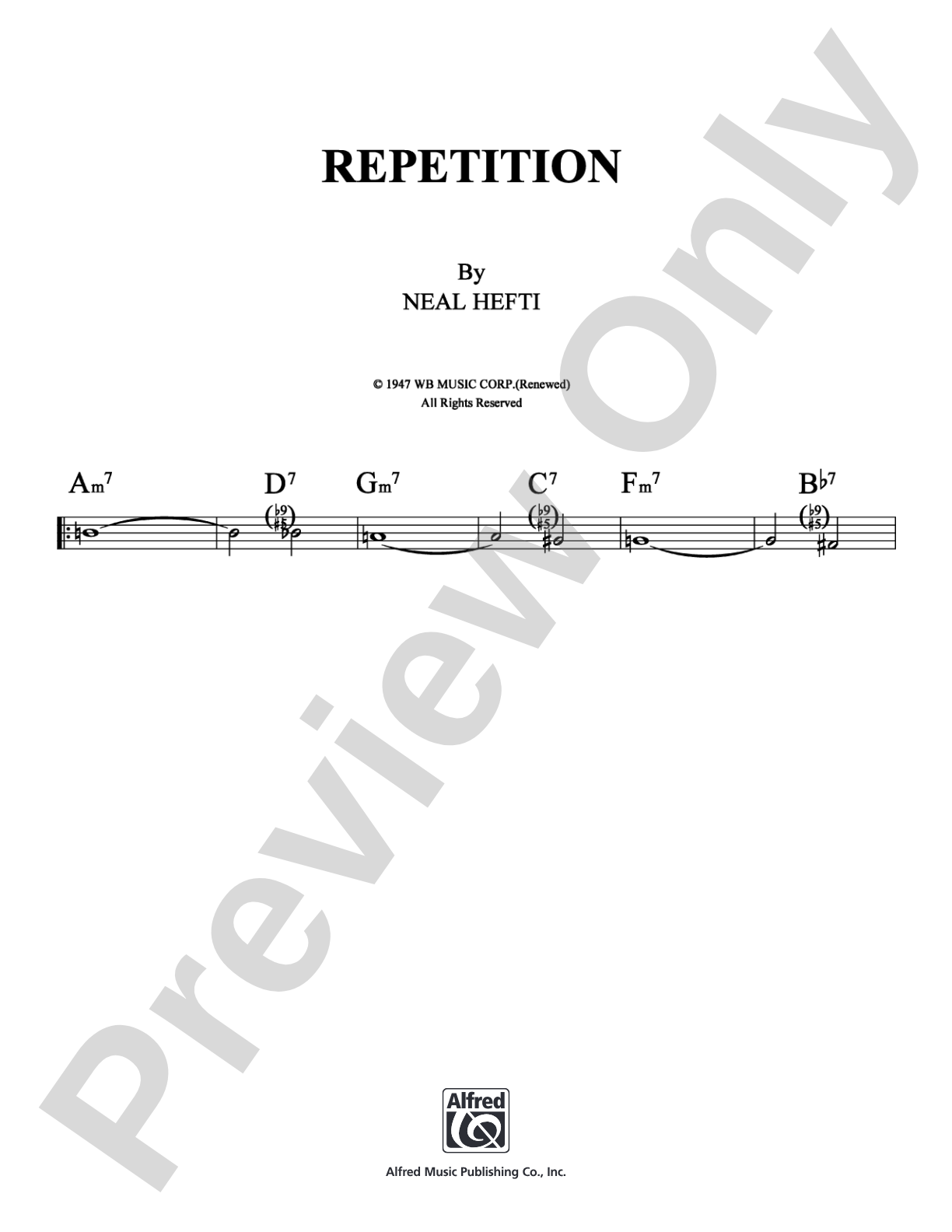
Repetition is a Parker composition that demonstrates his genius for building melodic momentum through strategic restatement. The lead sheet format gives students direct access to the harmonic and melodic architecture that made Parker's writing so influential, making it an essential resource for jazz musicians studying bebop melody and structure.

What to expect

Energetic and propulsive, with Parker's characteristic angular lines and forward momentum. The tune captures the restless, exploratory spirit of bebop, demanding precision in articulation and a quick harmonic mind from anyone tackling the melody or improvising over the changes.

Who it's for

Jazz musicians preparing for small group performance or jam session study, as well as students learning bebop composition and reharmonization. High school and college jazz ensembles use this tune to develop familiarity with classic bebop heads and standards.

How to get the most out of it

  • Map out the harmonic movement before improvising; Parker's changes move quickly, and understanding the chord progression is essential to staying grounded during a solo.
  • Practice stating the head cleanly and with swing feel; the written melody sets the stage for everything that follows in performance.
  • Listen to Parker's original recording to absorb his phrasing and sense of time; transcription study will inform your approach to the tune's rhythmic flow.
  • Build your improvisation by targeting chord tones on strong beats, especially over the faster harmonic sequences typical of bebop writing.

How to use it

Feature this tune as a jazz combo showcase or small group feature in a jazz concert, where it can anchor an evening of bebop standards. It also works well in a jazz history unit, pairing the lead sheet with listening and analysis of Parker's recorded version.

Skills your students will build

  • Reading and performing bebop melodic language
  • Navigating chord changes at tempo
  • Improvising over rapid harmonic movement
  • Understanding the relationship between written melody and harmonic structure in bebop composition
  • Developing swing feel and articulation in jazz context

You May Also Like