Rent Party Blues: Piano Digital Sheet Music

Rent Party Blues: Piano Digital Sheet Music

Johnny Hodges, Duke Ellington

Item: 00-PS-0008197

Digital Download
$3.99
Description

Rent Party Blues: Piano Digital Sheet Music isn't in MakeMusic Cloud just yet...but it could be. Let us know you'd like to see it, and you'll help shape what comes next. In the meantime, start a free trial and dive into thousands of interactive titles your students can play along with today.

Sample Audio
No sample audio found.
Sample Video
Additional Details
SKU: 00-PS-0008197

More about this title

About the Artist: Duke Ellington

Duke Ellington (1899-1974) stands as one of the most consequential composers in American music. His career spanned five decades, during which he wrote thousands of compositions ranging from three-minute jazz standards to extended concert works, all while leading one of the most disciplined and innovative orchestras in jazz history. His harmonic sophistication, orchestration genius, and prolific output fundamentally shaped how jazz developed as a serious art form.

Ellington's approach to composition was inseparable from his ensemble. He wrote for specific musicians, understanding their voices and capabilities with surgical precision. This practice meant that his works often contained intricate voicings and unexpected harmonic turns that required careful listening and skilled interpretation. His influence extended far beyond jazz circles, earning him respect from classical composers and establishing the orchestra as a legitimate vehicle for American musical expression.

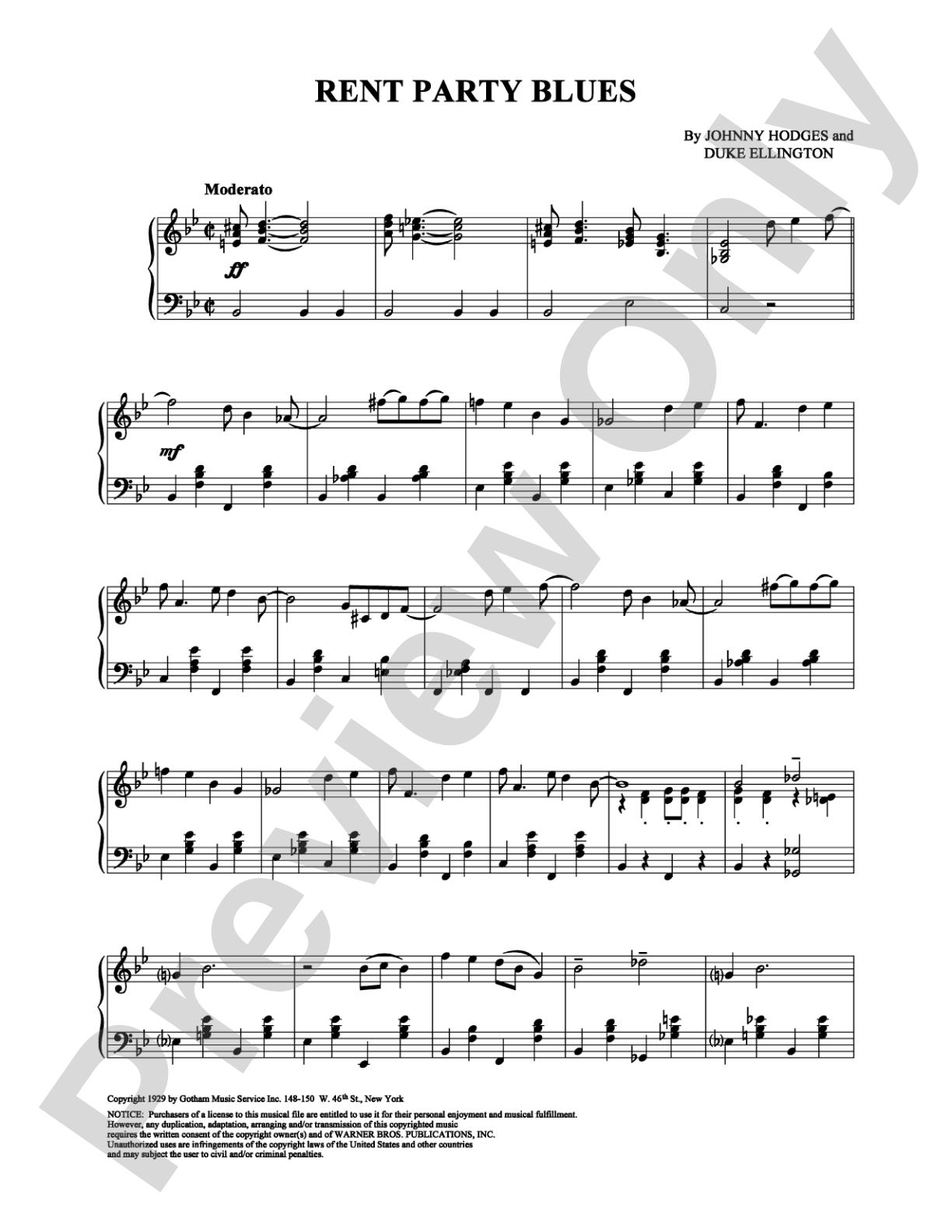
Why we love this

Rent Party Blues captures the stride piano tradition with Ellington's characteristic harmonic wit. This piece gives pianists a chance to explore authentic jazz vocabulary from someone who understood both the blues vernacular and advanced compositional craft, making it equally valuable for students approaching jazz standards seriously and for performers seeking repertoire that combines accessibility with real musical substance.

What to expect

Rent Party Blues evokes the warmth and rhythmic vitality of early jazz piano traditions, rooted in the informal house parties where pianists gathered in Harlem during the 1920s. The piece has a conversational quality, with the melody dancing over a propulsive left hand foundation that never relents. There's a wry sophistication here, a blues sensibility tempered by Ellington's innate harmonic sensibility that keeps the piece from ever feeling predictable.

Who it's for

This piece suits intermediate to advanced pianists with some jazz experience or strong ear training skills. It works well for students exploring the standards repertoire, pianists preparing recital material that bridges classical and jazz traditions, and ensemble accompanists building their jazz vocabulary.

How to get the most out of it

  • Anchor the left hand stride pattern with a steady, unhurried pulse; Ellington's blues pieces depend on rock-solid rhythmic foundation rather than flashy tempo.
  • Listen closely to the harmonic movement beneath the melody and let it shape your phrasing; Ellington often packed unexpected chords into deceptively simple passages.
  • Balance the linear quality of the right hand against the rhythmic drive of the left; neither should overshadow the other.
  • Research stride piano technique if you're new to the idiom; the left hand work here is central to the piece's character and requires dedicated practice.

How to use it

Program this in a jazz or American music themed concert, or pair it with other stride and boogie-woogie repertoire to show the lineage of early jazz piano styles. It also works as a recital opener or closer, offering pianists a chance to demonstrate stylistic range and comfort with jazz idioms without requiring an ensemble.

Skills your students will build

  • Stride piano left hand technique (alternating bass and chord patterns)
  • Jazz harmony and voice leading in a blues context
  • Rhythmic independence between hands
  • Swing eighth-note phrasing and jazz articulation
  • Interpreting jazz notation and understanding implied accompaniment patterns

You May Also Like