
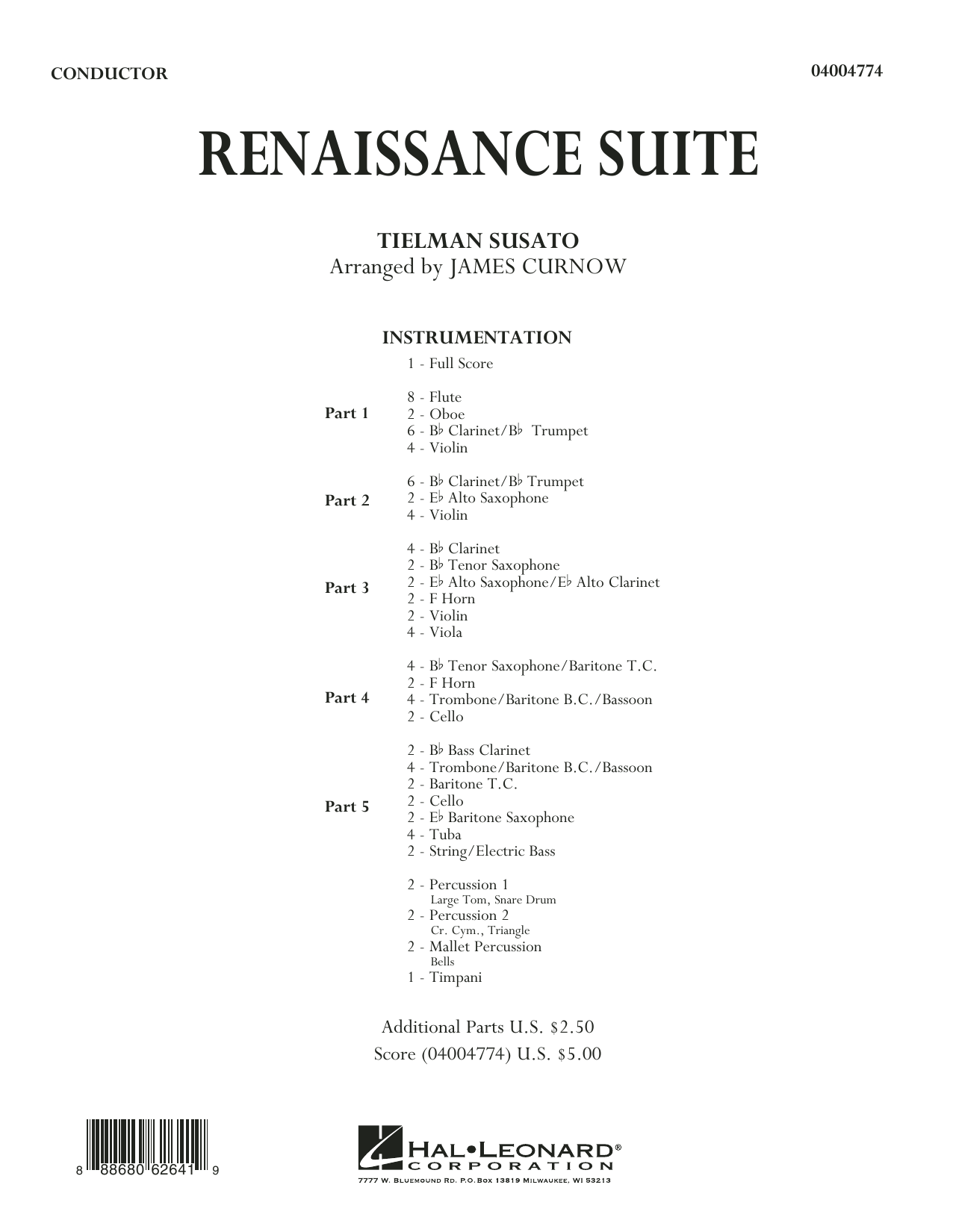

Renaissance Suite: Flex Ensemble Conductor Score & Parts
As performed by Tielman Susato / Arranged by James Curnow
Grade: 2-3
Item: 35-PK00337384
$75.00
Pickup currently not available
Buy Extra Parts (Digital PDF Download)
Parts Added to Cart!
Description
James Curnow's "Renaissance Suite" for full band continues to be a popular choice for contest and festival. Here is a version carefully adapted for flexible instrumentation that features these distinctive 16th-century dances by Susato. I. "Las Mourisque" (Basse Danse), II. "Mille regretz" (Pavane), and III. "La bataille" (Pavane). Dur: 6:30


Renaissance Suite: Flex Ensemble Conductor Score & Parts isn't in MakeMusic Cloud just yet...but it could be. Let us know you'd like to see it, and you'll help shape what comes next. In the meantime, start a free trial and dive into thousands of interactive titles your students can play along with today.
Request This Title
Tell us you want it.
Start Your Free Trial
Explore everything that's ready to play right now.
Sample Audio
No sample audio found.
Sample Video
No sample videos found.
Additional Details
Publisher:
Hal Leonard
SKU:
35-PK00337384
More about this title
About the Artist: Tielman Susato
Tielman Susato (c. 1510–after 1561) was a Flemish composer and instrumentalist whose dance collections defined the sound of 16th-century European courts. Based in Antwerp, he published some of the era's most widely performed secular music, capturing the rhythmic vitality and melodic grace that made Renaissance dances essential to courtly life.
Susato's works survive as a window into how music actually functioned in performance contexts beyond the church. His dances appear across hundreds of arrangements and adaptations because their directness and charm transcend centuries. For music educators, Susato represents a composer whose catalog offers genuine historical authenticity without sacrificing playability.
Why we love this
Curnow's adaptation strips away the barrier between historical music and the ensemble you actually have on any given Tuesday. The original suite proves itself at major contests, and this flexible version delivers that same driving pulse and clear formal structure without forcing you into instrumentation logistics. Three connected movements give students a genuine arc to inhabit rather than separate showpiece moments.
What to expect
Crisp, ordered, and alive with courtly dignity. These dances move with purpose and grace, their melodies clean enough that the ear follows without effort. There's a formality here that younger musicians rarely encounter yet can grasp immediately; the music doesn't ask for dramatic gesturing, just respect for its clarity and forward motion.
Who it's for
Ensembles in grades 2 and 3 that need repertoire combining historical substance with realistic instrumentation flexibility. Directors programming festivals, contests, or concerts where 16th-century music serves curricular goals without demanding specialized instrumentation.
How to get the most out of it
- Anchor the dance character through rhythmic precision rather than tempo extremes. Renaissance dances live in their metric clarity; let the ensemble sit comfortably on the beat and the style emerges naturally.
- Balance the soprano line against inner voices so the melodic flow reads through the texture. These dances depend on conversational interplay between voices, not soloistic dominance.
- Treat each movement as its own short story. The shift from Basse Danse to Pavane carries weight; allow a clear breath between sections to let the form register with listeners.
How to use it
Slot this into a concert exploring historical styles alongside Baroque or Classical selections to show students how musical language evolved. The six-and-a-half-minute duration fits comfortably as a standalone piece or pairs efficiently with contrasting contemporary works. For contests, its Grade 2-3 accessibility combined with legitimate artistic substance often opens judges' ears to younger ensembles.
Skills your students will build
- Reading and executing Renaissance rhythmic notation (minims, semiminims, breves)
- Performing with stylistic awareness of articulation and phrasing in dances
- Balancing multiple melodic lines within a homophonic texture
- Understanding form through three connected but distinct movements
- Adapting to flexible instrumentation by reading transpositions and cue lines