
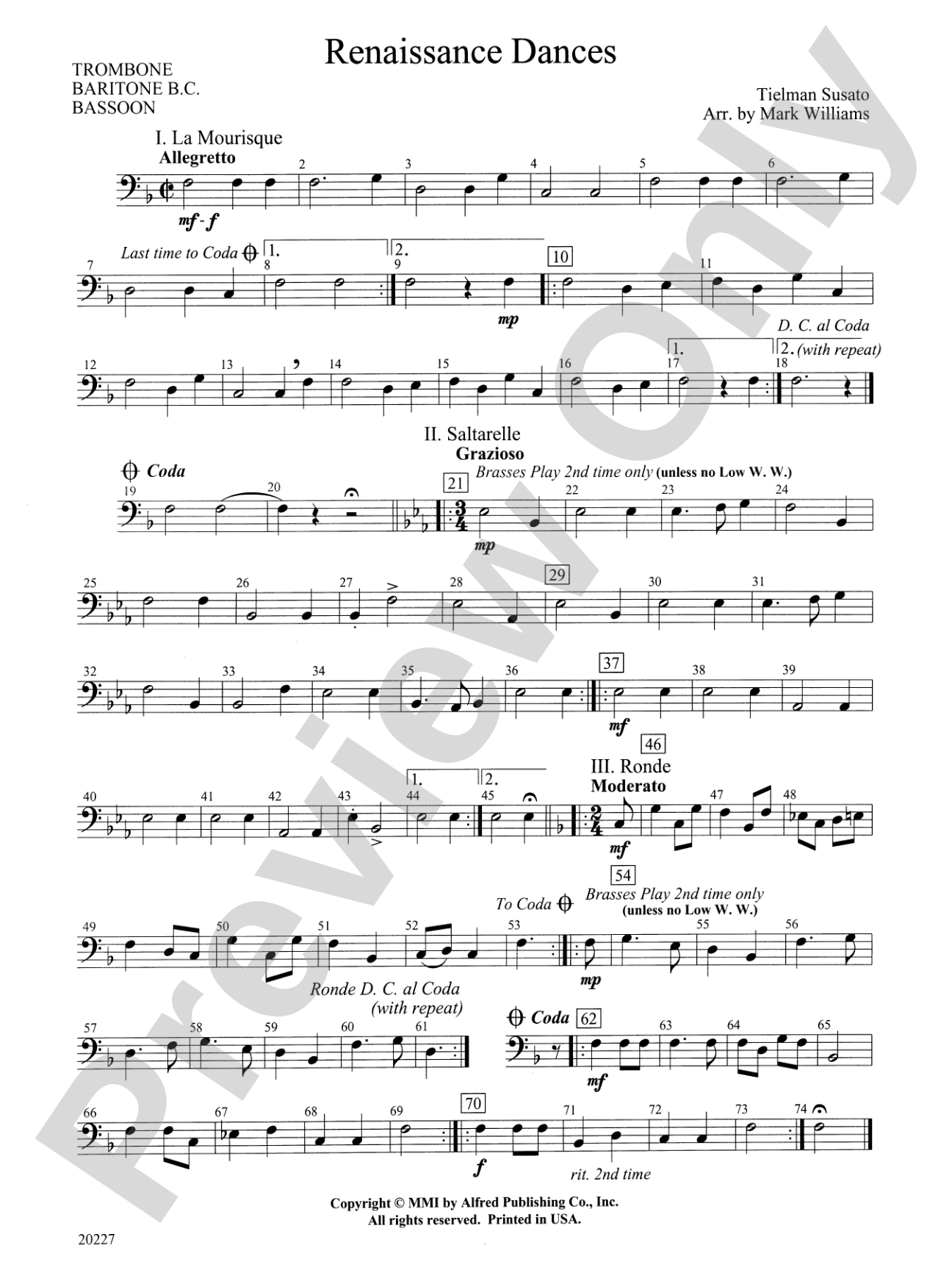

Renaissance Dances: 1st Trombone
Featuring: La Mourisque / Saltarelle / Ronde
By Tielman Susato / arr. Mark Williams
Grade: 1.5 (Easy)
Item: 00-PC-0000360_TN1
$3.00
Pickup currently not available
Description
Take your band back in time with this well-crafted arrangement by Mark Williams of an exquisite set of dances by Renaissance composer Tielman Susato. The three dances, "La Mourisque," "Saltarelle" and "Ronde," serve as an excellent introduction to Renaissance style. Correlated with Accent on Achievement, Book 2, page 14.


Don't just read it, hear it, play along with it, and watch your students grow with it. In MakeMusic Cloud, Renaissance Dances: 1st Trombone comes alive with professional accompaniment, adjustable tempo, and built-in practice tools that turn solo practice into real progress.
Open in the Player
Jump straight in and assign it today.
Start Your Free Trial
Open this title and explore the full library in minutes.
Sample Audio
1
Audio File
--:--
0:00
0:00
Sample Video
No sample videos found.
Additional Details
Series:
Accent on Achievement
Publisher:
Alfred Music
Page Count:
124
SKU:
00-PC-0000360_TN1
More about this title
About the Composer: Tielman Susato
Tielman Susato (c. 1510-c. 1561) was a Franco-Flemish composer and publisher working in Antwerp during the mid-16th century. His instrumental dances and motets circulated widely throughout Europe and remain among the most accessible Renaissance works for modern ensembles. Susato's gift for memorable melodies and straightforward harmonic writing made his music popular in his own time and continues to engage young musicians today.
As a publisher, Susato issued some of the earliest printed collections of instrumental dance music, helping preserve styles that might otherwise have been lost. His dances reflect the social music of Renaissance courts and civic celebrations, offering performers a direct connection to how Renaissance musicians actually sounded and moved.
Why we love this
Mark Williams has captured the buoyant character of Susato's originals while writing idiomatically for young band musicians. The three dances progress logically in style and energy, making them engaging for both ensemble and audience without oversimplifying the Renaissance aesthetic. This is an ideal way to introduce students to period music within their technical reach.
What to expect
These three dances transport the ensemble into a Renaissance court or town square, where music accompanied courtiers and common folk alike. The melodies have the clarity and directness of period instruments, yet the band voicing gives them warmth and depth. Moving from the stately La Mourisque through the spirited Saltarelle to the rounded Ronde creates a musical journey that feels both celebratory and elegantly restrained.
Who it's for
This arrangement suits concert bands at the Grade 1.5 level who are ready to explore music beyond the standard teaching band repertoire. It works equally well for bands preparing for contest or festival programs and for those seeking stylistically diverse material that doesn't demand advanced technical ranges or complex rhythmic reading.
How to get the most out of it
- Shape each dance with period-appropriate phrasing. Renaissance dances typically had cleaner phrase breaks and less legato than Romantic repertoire; allow the rhythmic clarity of the original style to emerge through articulation.
- Balance the inner voices carefully in the harmonic sections. Many of the dances feature charming counter-melodic material that shouldn't disappear under the main theme.
- Use the recorded accompaniment (if available separately) to hear how these dances sit historically; this can inform the style and tempo relationships between the three pieces.
- Treat the rhythmic figures with precision rather than weight. The energy of Renaissance dance comes from rhythmic accuracy and textural clarity, not dynamic heaviness.
How to use it
Program the three dances as a suite to open a concert or festival performance, establishing a sophisticated yet accessible opening that sets a positive tone. Alternatively, use individual dances as intermission pieces or as contrast within a concert of mixed-era works. The Grade 1.5 difficulty makes them suitable for early-season programming when consolidated technique may still be developing.
Skills your students will build
- Articulation control and stylistic phrasing in Renaissance idiom
- Ensemble balance between melodic and harmonic voices
- Rhythmic accuracy and precision in moderate tempos
- Awareness of historical style and period-appropriate performance practice
- Reading and executing conductor cues across multiple dance forms