
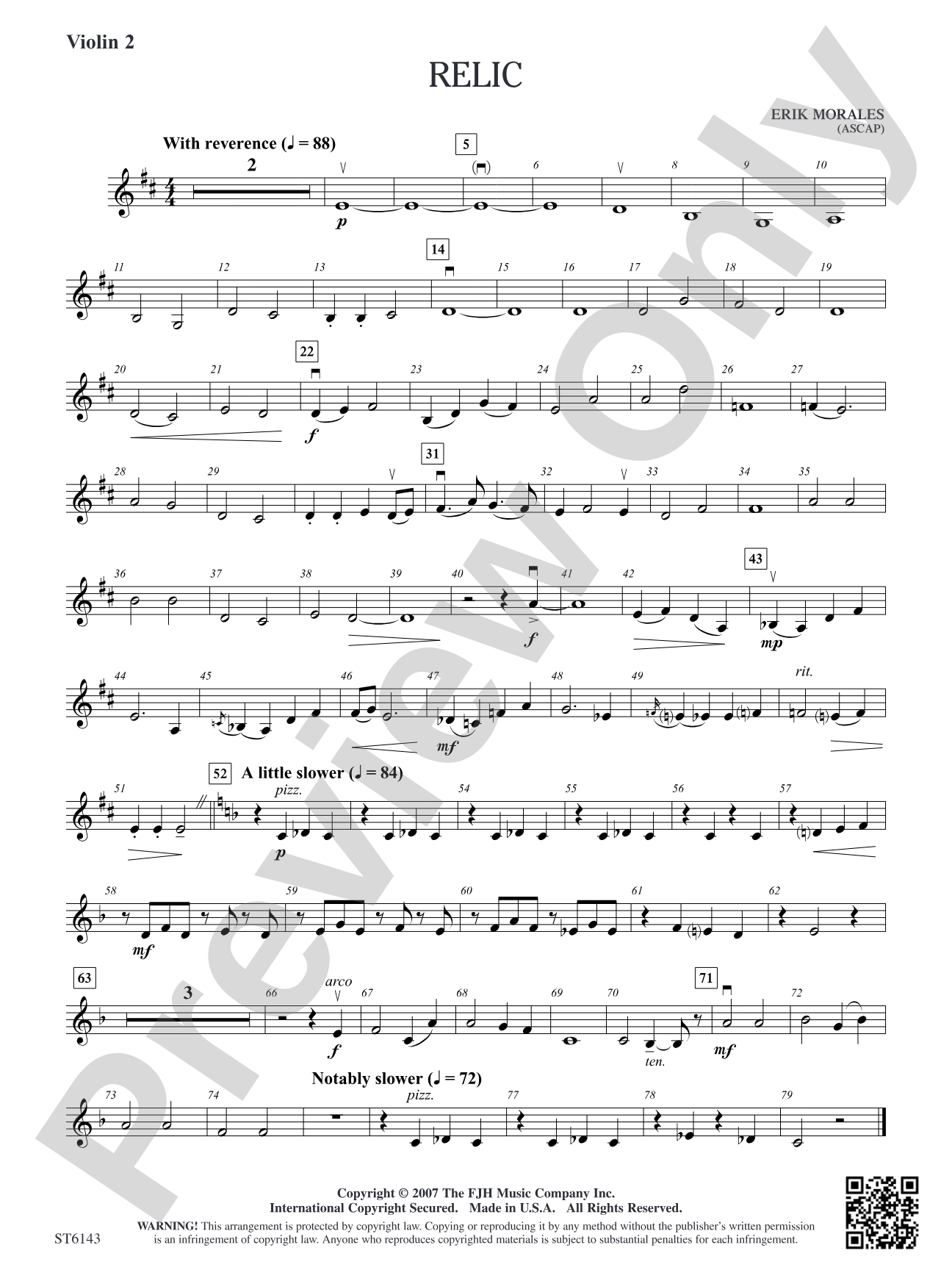

Relic: Violin 2
By Erik Morales
Grade: 3
Item: 98-PC-DST6143_VN2
$7.00
Pickup currently not available
Description
This lyrical work is a musical portrait of a person experiencing for the first time the awe and grandeur of an ancient European cathedral.


Relic: Violin 2 isn't in MakeMusic Cloud just yet...but it could be. Let us know you'd like to see it, and you'll help shape what comes next. In the meantime, start a free trial and dive into thousands of interactive titles your students can play along with today.
Request This Title
Tell us you want it.
Start Your Free Trial
Explore everything that's ready to play right now.
Sample Audio
1
Audio File
--:--
0:00
0:00
Sample Video
No sample videos found.
Additional Details
Series:
FJH String Orchestra
Publisher:
The FJH Music Company, Inc.
SKU:
98-PC-DST6143_VN2
More about this title
About the Composer: Erik Morales

Erik Morales was born in New York City in 1966 and has built a prolific career spanning classical, jazz, and commercial music. His catalog of over 150 published works demonstrates a sustained commitment to both artistic merit and pedagogical value, with compositions and arrangements for wind ensembles, orchestras, jazz groups, and chamber combinations performed internationally. He studied composition at Florida International University and earned his bachelor's degree from the University of Louisiana, Lafayette in 1989, beginning his professional life as an arranger for his high school band director in south Florida in 1985.
Morales has made particularly significant contributions to trumpet literature, earning first-place performances at the 2006 and 2008 National Trumpet Competitions and premiering his Concerto for Trumpet in C and Piano at the 2009 International Trumpet Guild conference. His consortium-commissioned Concerto for Two Trumpets premiered at the 2013 ITG conference. In 2016, he was inducted into the Louisiana Association for Jazz Education's Hall of Fame. Since 2002, his educational works for wind, jazz, and string ensembles have circulated worldwide, establishing him as a trusted voice in music for learning musicians.
Why we love this
Morales crafts a narrative arc that young string players can feel in their fingers and hear in the ensemble sound. The lyrical writing sits comfortably within Grade 3 technique while avoiding the generic; instead, you get genuine harmonic color and melodic shape that rewards careful ensemble listening. This is the kind of piece that reminds students why they play strings in the first place.
What to expect
Stepping into something immense and hushed. The music unfolds with the contemplative wonder of encountering ancient stone and light, building from quiet reverence into moments of grandeur. There's a sense of time expanding, of multiple voices joining in shared amazement at something larger than oneself.
Who it's for
String orchestra directors seeking repertoire that introduces younger players to programmatic thinking without overwhelming their technical grasp. This piece engages Grade 3 ensembles with authentic musical storytelling, making it ideal for students ready to move beyond exercises into pieces with genuine expressive intent.
How to get the most out of it
- Shape the melodic lines with long-term phrasing rather than note-to-note articulation; let the cathedral's vastness unfold through sustained, connected bowing.
- Balance the divisi passages carefully so inner voices support rather than overwhelm the primary melody.
- Experiment with subtle tempo flexibility during the emotional peaks to deepen the sense of awe without losing ensemble cohesion.
- Use dynamic contrast sparingly and deliberately; the grandeur comes from harmonic movement and voice independence, not volume alone.
How to use it
Program this as a centerpiece for a concert devoted to descriptive or cultural themes, pairing it with other works that explore place and emotion. It also works beautifully in a spring concert showcasing ensemble growth, since the programmatic element and lyrical demands demonstrate how far young string players have come by mid-to-late year.
Skills your students will build
- Reading and responding to programmatic context in orchestral music
- Sustaining lyrical lines with consistent tone and intonation across phrase lengths
- Balancing melodic and harmonic voices within the ensemble texture
- Managing crescendo and diminuendo across full orchestra sections
- Ensemble listening and response to conductorial shaping of tempo and dynamic