
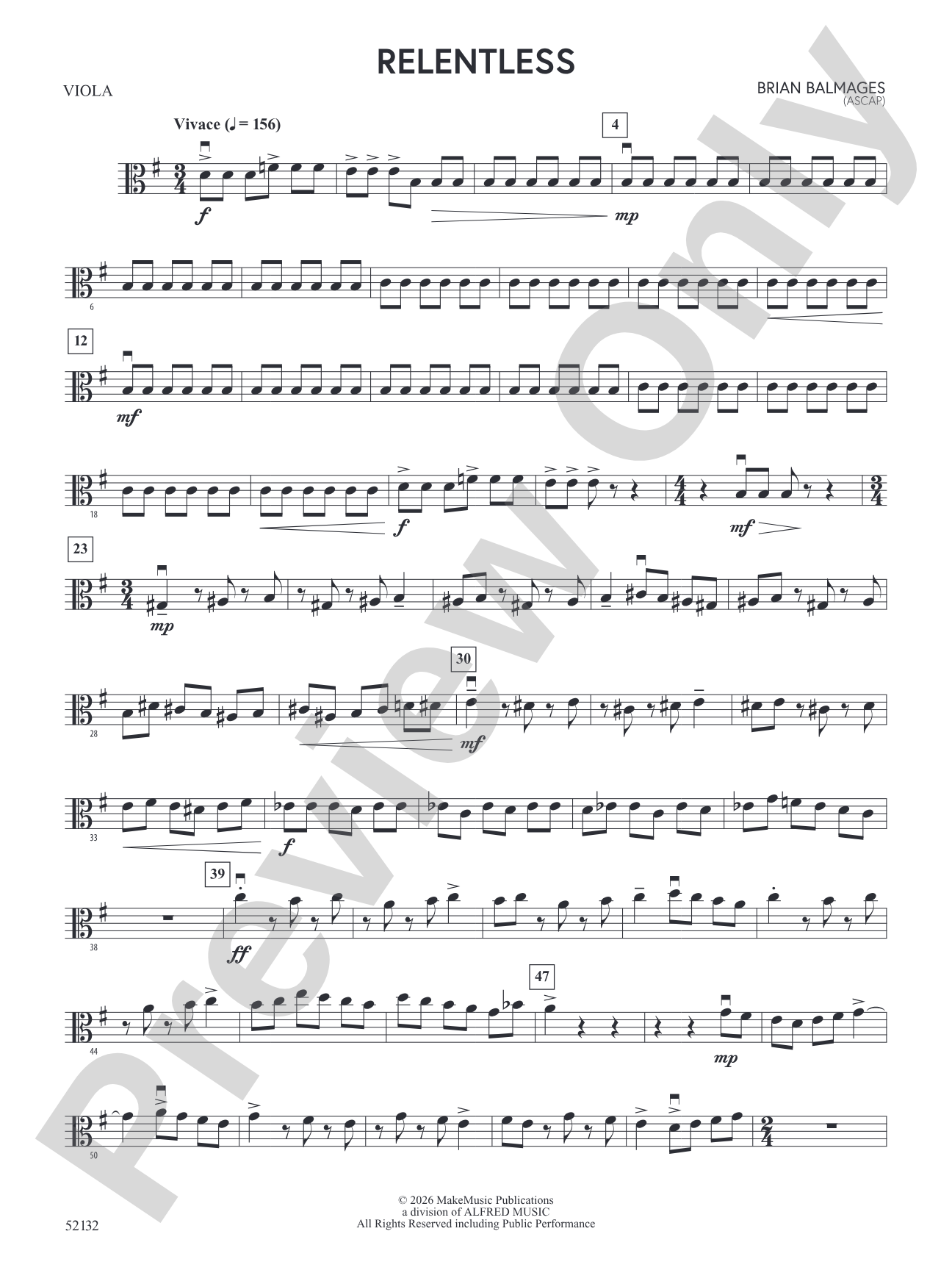

Relentless: Viola
By Brian Balmages
Grade: 3.5
Item: 00-PC-0019851_VA1
$3.00
Pickup currently not available
Description
Experience the high-energy drive of this virtuosic work by Brian Balmages! Relentless is characterized by a constant, driving rhythmic pulse and perpetual motion that will keep everyone on the edge of their seats. A lyrical melody provides a momentary, deceptive contrast before the music builds to a powerful and intensely dramatic conclusion. An exhilarating experience for performers and audiences alike! (3:15)


Don't just read it, hear it, play along with it, and watch your students grow with it. In MakeMusic Cloud, Relentless: Viola comes alive with professional accompaniment, adjustable tempo, and built-in practice tools that turn solo practice into real progress.
Open in the Player
Jump straight in and assign it today.
Start Your Free Trial
Open this title and explore the full library in minutes.
Sample Audio
1
Audio File
--:--
0:00
0:00
Sample Video
Additional Details
Series:
MakeMusic Symphony Strings
Publisher:
MakeMusic Publications
SKU:
00-PC-0019851_VA1
More about this title
About the Composer: Brian Balmages

Brian Balmages has established himself as a composer and conductor whose work crosses orchestral, band, and chamber music with equal fluency. His compositions have premiered in major concert halls including Carnegie Hall, the Kennedy Center, and the Sydney Opera House, performed by ensembles ranging from professional orchestras to school groups. He received the A. Austin Harding Award from the American School Band Directors Association and won the 2020 NBA William D. Revelli Composition Contest for Love and Light. His music was performed at the 2013 Presidential Inaugural Prayer Service, and he has received commissions from major universities.
As a conductor, Balmages maintains regular engagements with all-state, regional, university, and professional ensembles worldwide, including notable guest appearances at the Midwest Clinic, Western International Band Clinic, and numerous state ASTA conferences. He holds alumni distinctions from James Madison University and the University of Miami, where he was commissioned to compose for a presidential inauguration. Currently, he serves as Director of MakeMusic Publications and Digital Education for Alfred and MakeMusic.
Why we love this
Balmages understands how to sustain energy without sacrificing musicality. The contrast between the relentless driving pulse and the lyrical interlude gives your ensemble both a technical challenge and a moment to breathe, making this an ideal concert opener or contest selection that leaves audiences genuinely moved rather than simply exhausted.
What to expect
Relentless lives up to its title. A constant, driving rhythmic heartbeat propels the piece forward with infectious energy, creating momentum that pulls the listener in. The unexpected shift to lyrical writing offers respite before the music surges again toward an intensely dramatic climax that leaves both performers and audience breathless.
Who it's for
String orchestras at the advanced Grade 3.5 level looking for a high-impact contest or festival selection with genuine musical depth. This work suits ensembles that have the technical stability to maintain rhythmic precision through perpetual motion figures while maintaining expressive control.
How to get the most out of it
- Lock the rhythmic foundation early in rehearsal. Precision in the perpetual motion texture matters more than volume; intonation suffers when players rush or lag behind the pulse.
- Shape the lyrical melody as a true contrast, not just a slower section. Encourage singers of the line to phrase across bar lines and resist the temptation to rely on the driving accompaniment underneath.
- Build the final dramatic section gradually. Mark key moments where intensity increases in rehearsal so players understand the arc and avoid peaking too early.
- Use dynamics to clarify texture layers. The constant pulse can easily obscure inner voices; bring out countermelodies and harmonic shifts through deliberate balance adjustments.
How to use it
This work functions brilliantly as a concert opener, especially when paired with a quieter, reflective piece that follows. Its three-minute-fifteen-second duration and immediate energy make it ideal for festival competitions where you need to make a strong first impression or for a program that showcases your ensemble's rhythmic sophistication and dynamic range.
Skills your students will build
- Maintaining rhythmic precision through extended perpetual motion passages
- Balancing sustained pulse accompaniment with prominent melodic lines
- Contrasting performance styles (driving versus lyrical)
- Building and shaping climactic sections through incremental dynamic increases
- Ensemble cohesion under fast-moving harmonic changes