Rejoice, the Lord Is King Sheet Music Preview

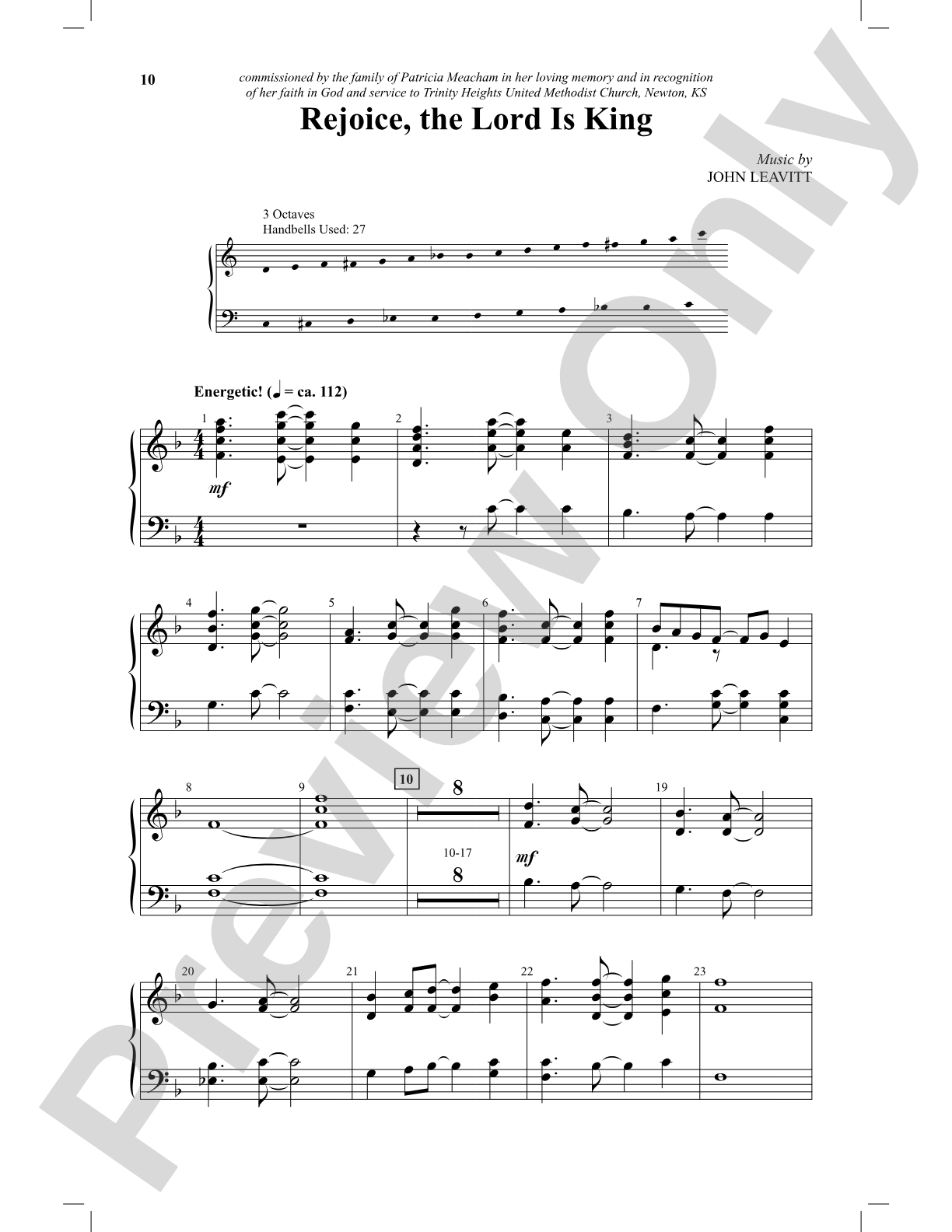
Rejoice, the Lord Is King: Handbells

Text by Charles Wesley, music by John Leavitt

Item: 31-PS-0012733

Digital Download
$2.50

One moment…

Description
This energetic setting of a familiar Wesley text enables us to hear these timeless words with fresh ears and renewed hearts. The more hymn-like middle section provides a refreshing contrast as we contemplate God's kingdom that "cannot fail." With or without the optional handbell part, this anthem is sure to strike a note of high celebration!

Rejoice, the Lord Is King: Handbells isn't in MakeMusic Cloud just yet...but it could be. Let us know you'd like to see it, and you'll help shape what comes next. In the meantime, start a free trial and dive into thousands of interactive titles your students can play along with today.

Sample Audio
No sample audio found.
Sample Video
Additional Details
Series: Jubilate Music
SKU: 31-PS-0012733
Instrumentation: Piano & Handbells

More about this title

About the Composer: John Leavitt

John Leavitt has established himself as a composer and arranger whose work appears regularly in choral programs across North America. His catalog spans sacred and secular genres, with particular strength in accessible yet musically sophisticated settings that work well in both church and concert contexts. Leavitt's approach balances singability with harmonic interest, making his pieces natural choices for choirs seeking repertoire that engages both performers and audiences.

Why we love this

Leavitt respects the Wesley text without feeling bound by it. The opening section captures genuine exuberance through rhythmic drive and bright voicing, while the hymn-like middle section genuinely earns its reflective moment rather than feeling like an obligatory contrast. The optional handbell part adds textural sparkle without becoming the reason to program the piece, giving you flexibility based on what your ensemble can manage.

What to expect

The opening radiates confidence and joy through crisp rhythmic writing and ascending melodic gestures that feel celebratory without being saccharine. The shift to the middle section brings genuine warmth as the hymn-like setting invites contemplation of the Wesley text's theological substance. The return to the energetic opening feels like a natural affirmation rather than a forced recap.

Who it's for

This piece works for intermediate to advanced high school choirs, college choirs, and church choirs with solid vocal blend and basic part independence. The SATB writing is straightforward enough that groups don't need extensive rehearsal time to achieve musicality, yet it offers enough harmonic color to reward careful attention. Handbells are optional, so you can program this whether or not your ensemble includes handbell musicians.

How to get the most out of it

  • Bring out the rhythmic vitality in the opening section by keeping the quarter-note pulse clear in the piano part; this anchors the choir's energy without requiring aggressive dynamics.
  • Shape the middle hymn-like section with gentle legit singing and allow the harmonic movement to breathe; resist the urge to maintain the opening's tempo here.
  • If you include handbells, balance their articulation so they enhance rather than dominate the choral texture; they work best when they punctuate key harmonic moments rather than doubling sustained notes.
  • Return to the opening material with renewed confidence after the middle section; this recapitulation feels strongest when the choir sings with slightly more conviction than they did initially.

How to use it

This works beautifully as a closing anthem for a service or concert, especially when paired with more introspective pieces earlier in the program. Its familiar text and accessible musical language make it equally at home in a church setting or a secular concert program focused on spiritual themes. The contrast between sections gives you a complete emotional arc without requiring an extended piece, making it efficient programming for a mixed choral recital.

Skills your students will build

  • Singing through rhythmic complexity while maintaining clarity of text
  • Balancing ensemble blend across phrase lengths and dynamic changes
  • Responding to contrasting musical sections with appropriate tonal adjustment
  • Coordinating with optional instrumental reinforcement without depending on it

You May Also Like