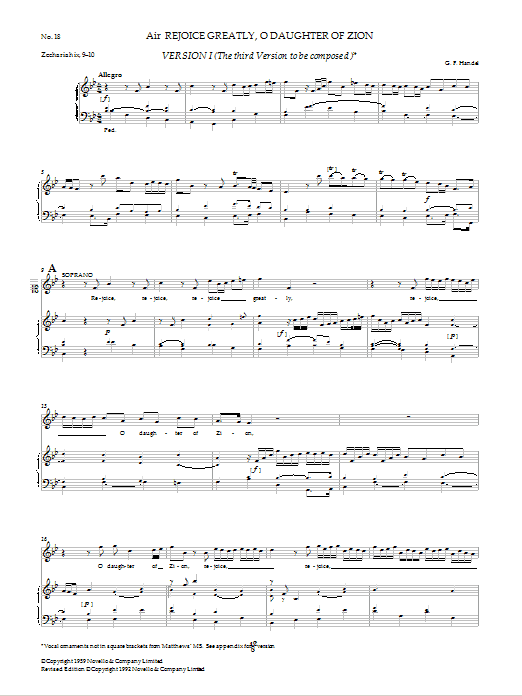
Rejoice Greatly, O Daughter Of Zion (Version I) Sheet Music Preview

Rejoice Greatly, O Daughter Of Zion (Version I): SATB Choral Octavo

As performed by George Frideric Handel

Item: 35-DS00148085

Digital Download
$2.99
Description

Rejoice Greatly, O Daughter Of Zion (Version I): SATB Choral Octavo isn't in MakeMusic Cloud just yet...but it could be. Let us know you'd like to see it, and you'll help shape what comes next. In the meantime, start a free trial and dive into thousands of interactive titles your students can play along with today.

Sample Audio
No sample audio found.
Sample Video
Additional Details
Publisher: Hal Leonard
Page Count: 6
SKU: 35-DS00148085

More about this title

About the Artist: George Frideric Handel

George Frideric Handel (1685–1759) was a German-born composer who spent most of his career in England, where he became the dominant figure in opera and oratorio. His compositional genius lay in creating memorable melodies and dramatic vocal lines that served both virtuosic soloists and ensemble singers. Handel's influence on choral music remains substantial; his oratorios, particularly Messiah, established the English choral tradition that endures in schools and churches today.

As a teacher, Handel's legacy matters because his music rewards singers with clear, singable lines and dramatic purpose. His vocal writing balances technical interest with accessibility, making his pieces valuable for developing both musicianship and confidence in young singers.

Why we love this

This aria from Messiah carries theatrical energy without requiring operatic technique, giving mixed choirs a chance to perform Baroque vocal writing that actually sits well in four-part harmony. The soaring melodic line and harmonic clarity make it work equally well as a concert opener or a feature within a larger program; soloists and ensemble singers alike find satisfaction in the text expression and musical architecture.

What to expect

Baroque jubilation in its clearest form. The piece radiates optimism through its buoyant rhythmic energy and soaring soprano melody, yet the harmonic foundation feels sturdy and grounded. There's an inherent ceremonial quality that invites singers to inhabit both joy and dignity simultaneously.

Who it's for

Mixed choirs (SATB) with singers who can handle a moderately demanding soprano line and maintain ensemble balance. It works for high school and community choirs, collegiate groups, and church choirs looking to program Baroque repertoire that is both accessible and musically substantial.

How to get the most out of it

  • Shape the opening phrase with a natural arch; resist the impulse to front-load dynamics. Let the melody breathe into its highest points rather than pushing from the beginning.
  • Balance the inner voices so they support rather than bury the soprano line. The alto, tenor, and bass parts are written to enhance, not compete with, the melody.
  • Articulate consonants cleanly on "greatly" and "daughter" to clarify the text without disrupting the legato flow of the melodic line.
  • Work the text expression intentionally. "Rejoice greatly" asks for genuine joy, which translates through vowel brightness and a lifted sound quality.

How to use it

Consider this as an opening statement for a classical or sacred music concert; it establishes repertoire and tone immediately. It also pairs naturally with other Baroque or oratorio excerpts for a thematic program, or stands alone as a choral feature that fills the programmatic need for a brief, high-impact selection.

Skills your students will build

  • Baroque articulation and phrasing conventions
  • Balancing the soprano line against SATB accompaniment
  • Sustaining legato through rhythmic clarity
  • Text expression in a non-English language context
  • Harmonic listening within classical four-part voice leading

You May Also Like