
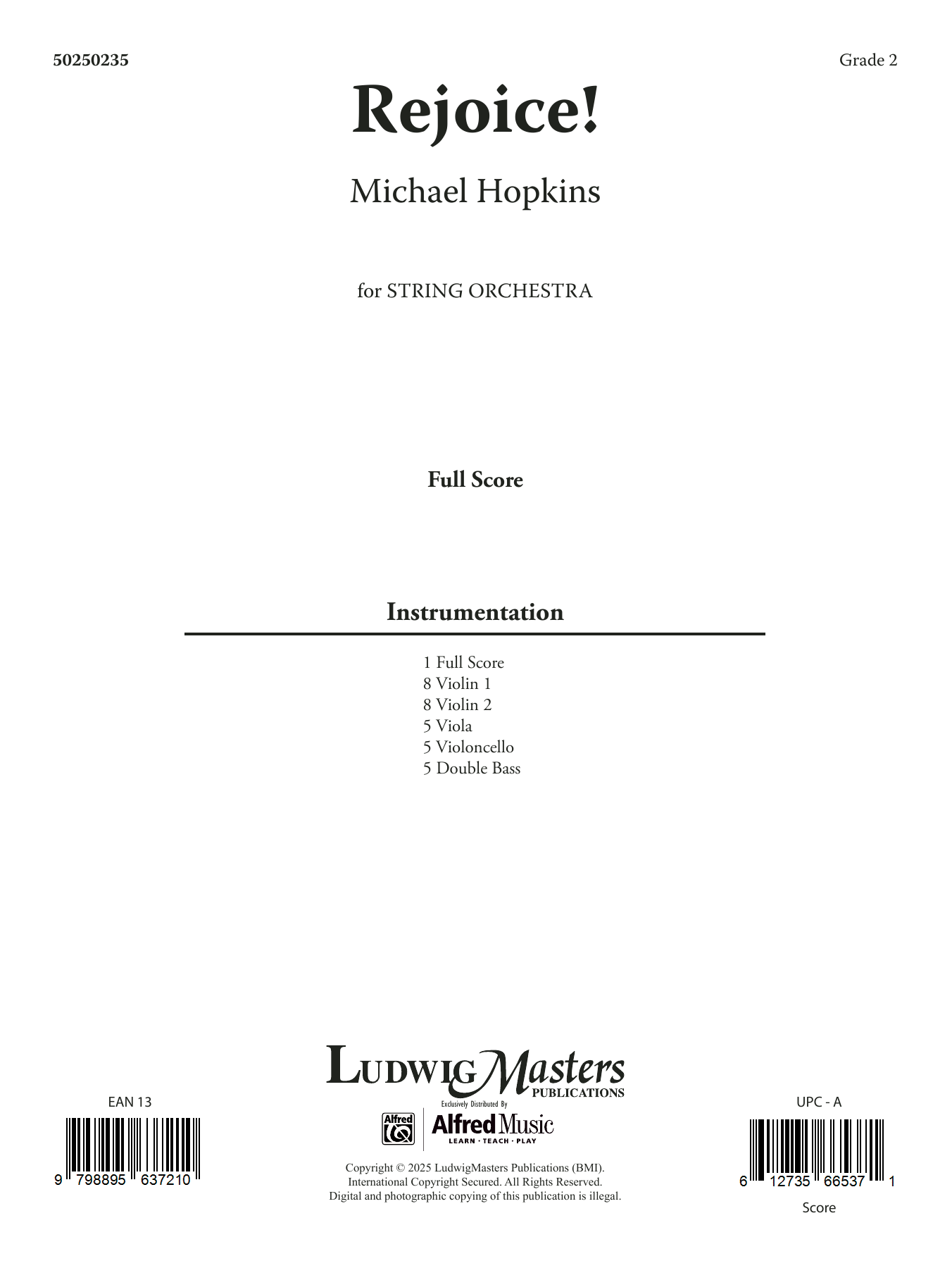

Rejoice!: String Orchestra Conductor Score & Parts
By Michael Hopkins
Grade: 2
Item: 35-PK01699082
$55.00
Pickup currently not available
Buy Extra Parts (Digital PDF Download)
| Product | Price | Quantity |
|---|---|---|
| Rejoice! - Full Score | $7.00 | |
| Rejoice! - Violin 1 | $2.50 | |
| Rejoice! - Violin 2 | $2.50 | |
| Rejoice! - Viola | $2.50 | |
| Rejoice! - Cello | $2.50 | |
| Rejoice! - Bass | $2.50 |
Parts Added to Cart!
Description
Rejoice! was composed for the 10th anniversary of the Rockford, MI public schools orchestra program. The music is fast and celebratory with high energy throughout. This is a great piece for working on crisp articulations, off the string bow strokes, and contrasts between legato and staccato. The staccato eighth notes should be performed off the string. Quarter notes should be played with slight separation to give the music a dance-like celebratory character.


Discover MakeMusic Cloud: thousands of interactive titles your students can play along with today.
Sample Audio
No sample audio found.
Sample Video
No sample videos found.
Additional Details
Publisher:
Hal Leonard
SKU:
35-PK01699082
More about this title
About the Composer: Michael Hopkins
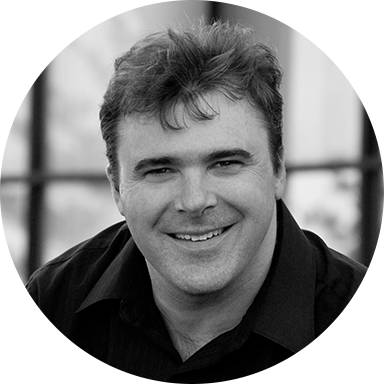
Michael Hopkins leads the music education program at the University of Michigan, where he specializes in string pedagogy, orchestra methods, and the intersection of music and psychology. His career spans three decades of conducting university and secondary orchestras across Colorado, Michigan, and Vermont, and he founded the Burlington Chamber Orchestra while building a national reputation as a clinician and researcher.
Hopkins has shaped string education through both scholarly work and practical composition. He has presented over 60 sessions at national conferences, published research in major music education journals, and authored The Art of String Teaching, a foundational text for string teachers at every level. His published compositions and arrangements number over 70 works for orchestra, each designed with the classroom musician in mind.
Why we love this
Rejoice! captures the energy of a celebration without losing musical substance. Hopkins knows exactly what Grade 2 orchestras can do technically, so he writes music that demands clean execution of articulation and bow control while keeping the momentum relentless and the mood infectious. Your students will feel like they're making something genuinely festive, not just playing a showpiece.
What to expect
Rejoice! radiates unforced celebration. The fast tempo and high energy never feel strained; instead, they propel the orchestra forward with the brightness of a festival or ceremonial occasion. There's a dance-like lift to the rhythm, created by the careful balance between moments of crisp separation and flowing legato lines.
Who it's for
Grade 2 string orchestras building confidence in articulation and rhythmic precision. Directors programming anniversary celebrations, spring concerts, or any program that needs a piece with genuine joy and musical substance without excessive technical demands.
How to get the most out of it
- Isolate the staccato eighth notes in rehearsal as off the string passages. Have your section leaders demonstrate the bounce and height needed, then rotate through small groups until the articulation is uniform across the section.
- Shape the quarter note figures with intentional separation. This isn't detached playing; it's the rhythmic spacing that gives the piece its dance character. A clear lift after each note opens up the texture.
- Balance the contrast between legato and staccato sections by adjusting bow pressure and contact point. Legato lines should feel sustained even at this tempo; staccato should spring and release.
- Keep the overall tempo steady from rehearsal one. This piece thrives on momentum and clarity, so lock in the pulse early and let the rhythmic drive carry your players through the energy shifts.
How to use it
This works beautifully as an opening number for a concert where you want to set an upbeat tone, or as a finale that leaves the audience with genuine enthusiasm. Pair it with a contrasting slow piece to highlight the dynamic range of your ensemble and show what young orchestras can accomplish across different tempos.
Skills your students will build
- Off the string bow strokes and controlled staccato articulation
- Contrast between legato and staccato phrasing in a single movement
- Crisp articulation and rhythmic clarity at fast tempos
- Maintaining ensemble cohesion and uniform articulation across sections
- Stylistic interpretation of a celebratory concert piece