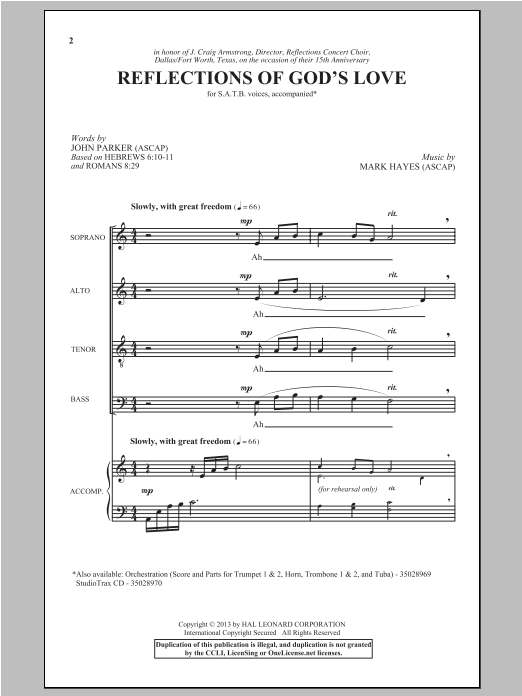
Reflections Of God's Love Sheet Music Preview

Reflections Of God's Love: SATB Choral Octavo

As performed by John Parker / Arranged by Mark Hayes

Item: 35-DS00261882

Digital Download
$2.99
Description

Reflections Of God's Love: SATB Choral Octavo isn't in MakeMusic Cloud just yet...but it could be. Let us know you'd like to see it, and you'll help shape what comes next. In the meantime, start a free trial and dive into thousands of interactive titles your students can play along with today.

Sample Audio
No sample audio found.
Sample Video
Additional Details
Publisher: Hal Leonard
Page Count: 9
SKU: 35-DS00261882

More about this title

About the Artist: John Parker

John Parker

John Parker brings deep roots in sacred music to his work as a composer and conductor. Trained at Louisiana College and Northwestern State University, where he earned degrees in vocal performance and choral conducting respectively, Parker has established himself as a prolific voice in American choral writing with over 600 published compositions. His work spans church and school settings, reflecting his conviction that quality music serves both artistic and spiritual purposes.

Based in Austin, Texas, Parker combines his compositional work with active leadership in worship and music ministry. He has distinguished himself beyond the score through his work as a choral clinician, lecturer, and author, including the practical resource "How to Start a Fine Arts Academy in Your Church." His varied experience in both educational and ecclesiastical contexts informs his approach to writing music that serves real ensembles and real communities.

Why we love this

Mark Hayes's arrangement captures the contemplative warmth that defines Parker's compositional voice while making the piece accessible for mixed choirs at a manageable technical level. The nine-page octavo format respects both rehearsal time and the piece's emotional depth, avoiding the bloat that sometimes accompanies faith-based choral writing. Directors will find the text and musical setting genuinely support each other, with Hayes's part writing clear enough for developing singers yet interesting enough to keep experienced ensembles engaged.

What to expect

The piece invites contemplation rather than celebration. Warm harmonic colors create an intimate soundscape where each syllable of text feels considered, making space for singers and listeners to encounter both the music and its meaning without rushing past either.

Who it's for

This arrangement serves choirs preparing for Epiphany services or concerts centered on faith and reflection. It works equally well for secular concert choirs seeking repertoire with spiritual depth and school ensembles wanting accessible yet meaningful music.

How to get the most out of it

  • Establish the harmonic foundation through warm-up work on the chord progressions; a pianist playing blocked chords before adding melodic elements helps singers hear where their lines sit within the larger harmony.
  • Shape the phrasing across full phrase arcs rather than within individual measures, particularly in passages where the text unfolds contemplatively; this prevents the piece from feeling static despite its reflective nature.
  • Balance the ensemble so no single voice part dominates; the piece works best when all four parts share equal prominence, allowing the text to emerge as a unified message.

How to use it

Place this near the close of a concert program, perhaps following more energetic or varied material, where its sustained meditation can settle the audience. It also pairs naturally with other reflective works in a winter or Epiphany service, or stands alone as a brief moment of focused liturgical music.

Skills your students will build

  • Balancing four independent melodic lines while maintaining vertical harmonic awareness
  • Singing sustained passages with consistent tone and breath control
  • Expressing textual meaning through dynamic shaping and phrasing
  • Intonation within close-voiced harmonic contexts
  • Responding to conducted phrasing and ensemble cues

You May Also Like