
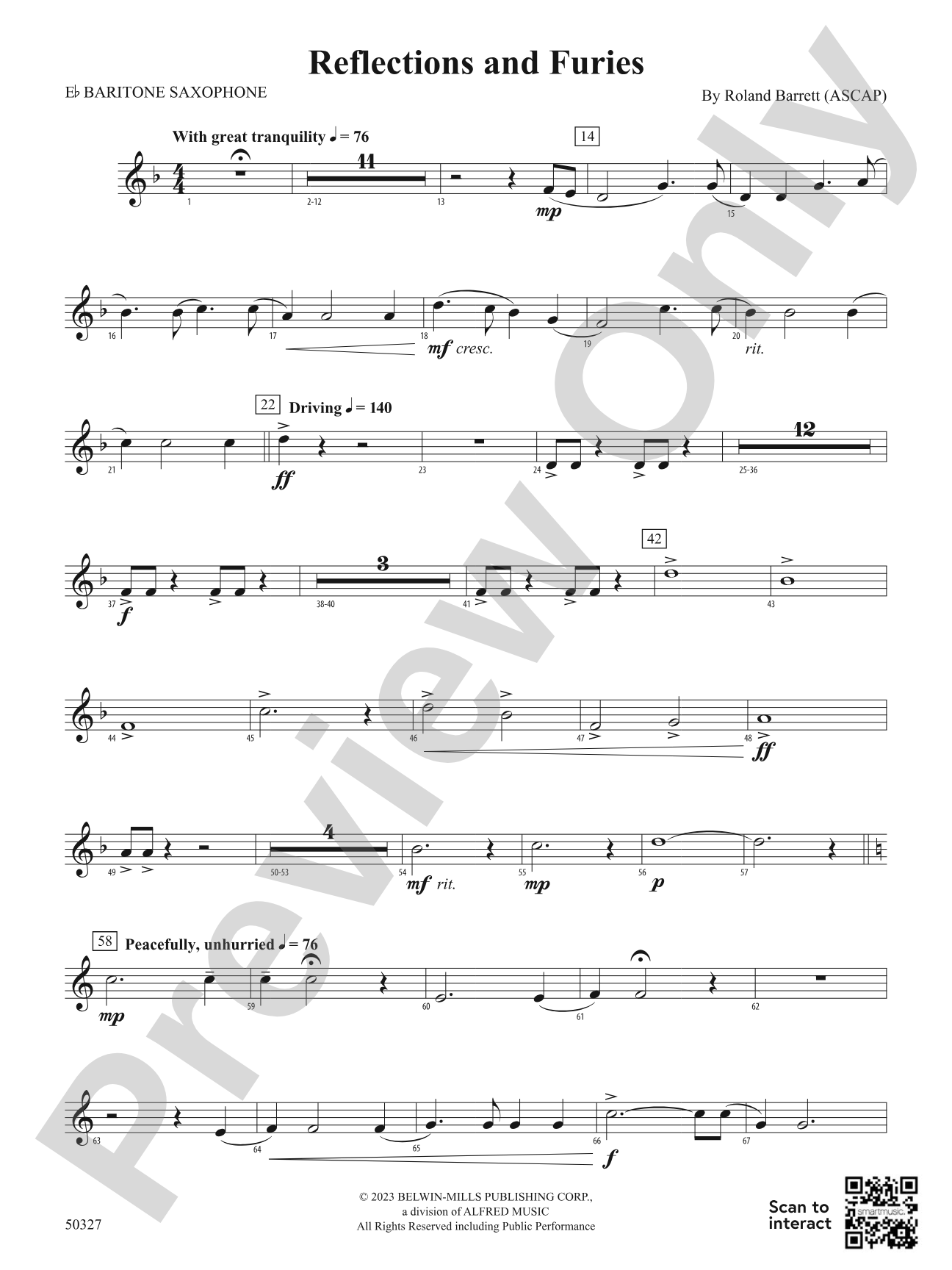

Reflections and Furies: E-flat Baritone Saxophone
By Roland Barrett
Grade: 2.5
Item: 00-PC-0019051_BTX
$3.00
Pickup currently not available
Description
From the pen of veteran band composer Roland Barrett, Reflections and Furies presents an alternating combination of quiet-contemplative and high-energy passages, offering ensembles an excellent opportunity to work on the performance of contrasting styles. (4:10)


Don't just read it, hear it, play along with it, and watch your students grow with it. In MakeMusic Cloud, Reflections and Furies: E-flat Baritone Saxophone comes alive with professional accompaniment, adjustable tempo, and built-in practice tools that turn solo practice into real progress.
Open in the Player
Jump straight in and assign it today.
Start Your Free Trial
Open this title and explore the full library in minutes.
Sample Audio
1
Audio File
--:--
0:00
0:00
Sample Video
Additional Details
Series:
Belwin Young Band
Publisher:
Alfred Music
SKU:
00-PC-0019051_BTX
More about this title
About the Composer: Roland Barrett

Roland Barrett has shaped musicians across two decades as a composer, theorist, and arranger. Since joining the University of Oklahoma's faculty in 2001, he has taught 20th century music theory and composition at both undergraduate and graduate levels while continuing to arrange for the Pride of Oklahoma marching band.
Barrett's catalog exceeds two hundred published works for symphonic band, chamber ensembles, and marching band. His compositions have been programmed by the Dallas Wind Symphony, All-State Honor Bands, and regional ensembles nationwide. His music has appeared on NPR and received performances at the Midwest Band and Orchestra Convention, the National Trumpet Competition, and the International Trumpet Guild convention. He is a multiple recipient of the ASCAP Plus award.
Why we love this
Barrett captures something real here: the conductor's challenge of balancing introspection with intensity. Rather than treating contrasting styles as isolated sections, he designs them as interconnected musical ideas that build ensemble awareness of tone color and dynamic control. This is the kind of piece that reveals what your band actually hears in the moment.
What to expect
The piece moves like an inner monologue interrupted by moments of release. Quiet passages invite listeners into a space of stillness and refinement, then shift abruptly into driving rhythmic energy that feels earned rather than chaotic. The arc creates genuine emotional stakes for a young ensemble.
Who it's for
This score works for Grade 2 and early Grade 3 ensembles seeking substantive concert or contest material that doesn't rely on technical complexity. Directors managing mixed-ability bands will find the contrasting sections give stronger readers something to shape while providing accessible rhythmic content for developing players.
How to get the most out of it
- Shape the contemplative passages with long-phrase thinking. Young musicians often break quiet music into too many breaths; encourage the section to breathe as one unit across entire phrases.
- Establish a steady prep tempo before the energetic sections arrive. The shift from reflection to fury demands clarity in your conducting gesture so the band understands the new pulse immediately.
- Balance ensemble blend during the high-energy passages by spotting exposed parts. At this grade level, clarity of articulation often suffers when volume rises; mark individual parts that need extra rehearsal attention.
- Mark dynamic transitions in parts before rehearsal. Flag the shift from ppp to ff so students know when to prepare their air support and embouchure adjustments.
How to use it
Program this as a mid-season contest or festival entry when your band has built basic listening skills and dynamic control. It also pairs well on a concert program with lyrical or slow repertoire, since the contemplative section can stand alone musically while the energetic passages give the full ensemble a moment to shine.
Skills your students will build
- Sustained phrasing across longer melodic lines without excessive breathing
- Dynamic contrast and control (managing soft playing without losing tone quality, building energy without overshooting)
- Responding to significant stylistic shifts within a single piece
- Listening for balance and blend when texture changes
- Tempo stability during transitions between contrasting material