
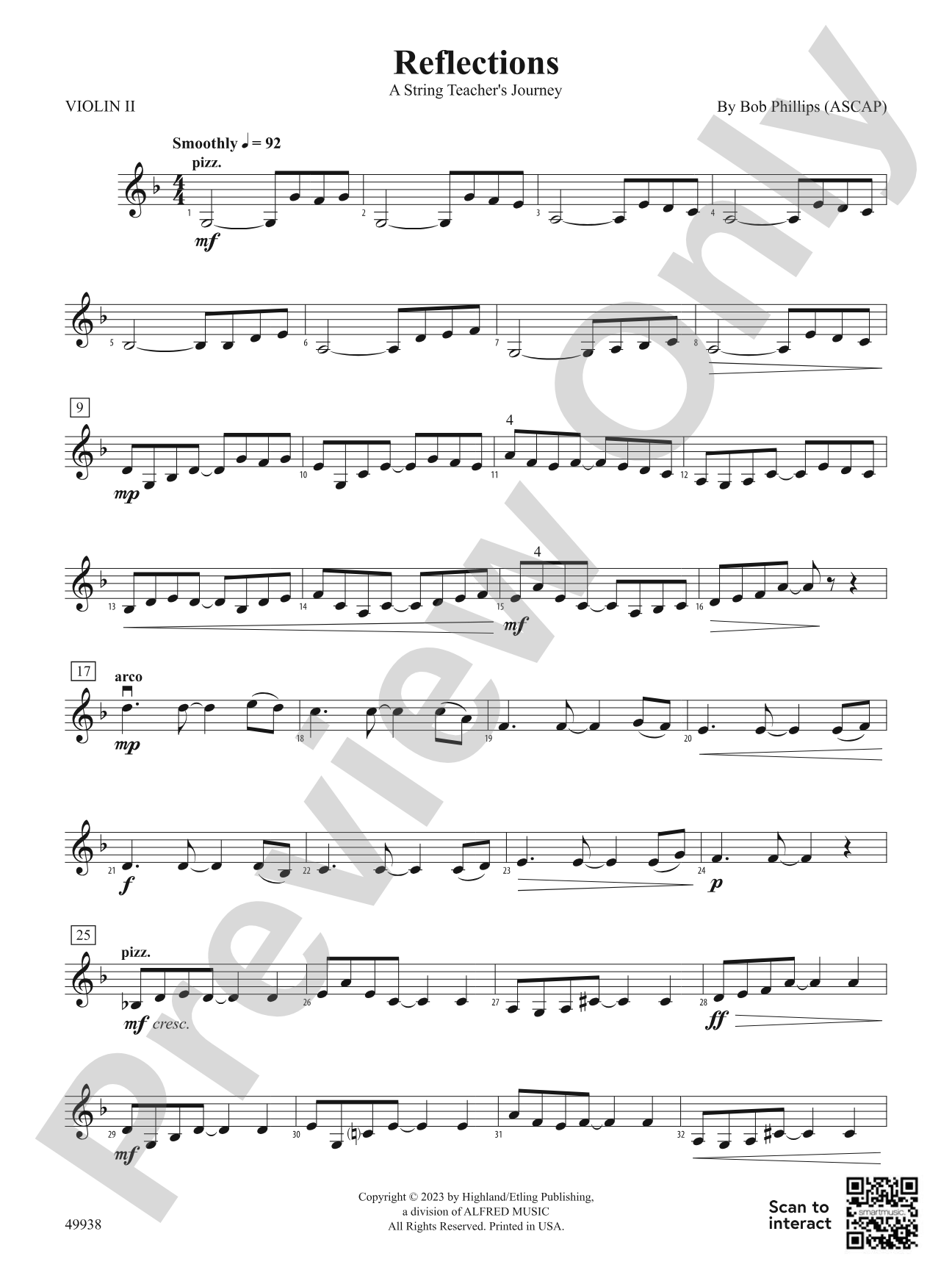

Reflections: 2nd Violin
A String Teacher's Journey
By Bob Phillips
Grade: 3.5
Item: 00-PC-0019022_VN2
$3.00
Pickup currently not available
Description
This stunningly beautiful lyric piece by Bob Phillips will inspire your students to play with emotion. The opening section in F major features divisi cello parts and basses in a soaring syncopated melody with pizzicato accompaniment. The rhythmically exciting middle section features the upper strings. Reflections concludes with the opening cello melody played by the upper strings, now in the key of C. (4:45)


Don't just read it, hear it, play along with it, and watch your students grow with it. In MakeMusic Cloud, Reflections: 2nd Violin comes alive with professional accompaniment, adjustable tempo, and built-in practice tools that turn solo practice into real progress.
Open in the Player
Jump straight in and assign it today.
Start Your Free Trial
Open this title and explore the full library in minutes.
Sample Audio
1
Audio File
--:--
0:00
0:00
Sample Video
Additional Details
Series:
Highland/Etling String Orchestra
Publisher:
Alfred Music
SKU:
00-PC-0019022_VN2
More about this title
About the Composer: Bob Phillips

Bob Phillips is a composer and string pedagogue who has shaped music education through innovative large-group instruction and genre-crossing arrangements. Since 1953, he has authored over 25 instructional series (including all six levels of Sound Innovations and the Philharmonic eclectic styles collections) and composed more than 200 works for orchestras and bands. His pieces are performed annually by thousands of string students worldwide, and his work has earned ASCAP recognition and regular performance slots at the Midwest Clinic.
Over 27 years in Saline, Michigan, Phillips built a string program that grew to more than 700 students and became a national model for both classical and genre-diverse repertoire. He founded the Saline Fiddlers Philharmonic, which performed internationally and at the White House, while also conducting all-state orchestras, youth symphonies, and honor ensembles across the country. His instructional DVDs and clinics have reached thousands of teachers seeking to deepen their students' musicianship across multiple styles.
Why we love this
Phillips writes with genuine understanding of what makes string students engaged and emotionally invested. The arc from intimate cello writing to bright upper-string textures gives every section of your orchestra a moment to shine, and the key change in the final section creates a sense of renewal that students feel immediately.
What to expect
Reflections opens with a contemplative warmth as the cellos and basses establish a gently syncopated foundation beneath pizzicato textures. The middle section erupts with rhythmic energy from the upper strings before the piece settles into a transcendent final statement of its opening melody, now transformed by a move to C major and the shimmer of violin color.
Who it's for
Grade 3.5 string orchestras ready to tackle lyrical writing with some rhythmic complexity. This work suits programs seeking repertoire that balances technical challenge with genuine musicality, and it performs well in contests and festivals where emotional depth matters.
How to get the most out of it
- Shape the opening cello melody with a long, connected bow stroke; the syncopated pizzicato accompaniment should feel conversational rather than mechanical, allowing the soaring line to breathe above it.
- Balance the middle section's rhythmically active upper strings carefully so excitement doesn't overshadow clarity; consider a slightly quicker bow speed to articulate the figures without sacrificing tone quality.
- Prepare the return to the opening melody in C major by securing absolute ensemble unison in the upper strings; this restatement carries the emotional weight of the entire piece and demands precise intonation.
How to use it
Program this as a centerpiece in a concert section that showcases lyrical string writing, where it can stand beside other emotional anchors without competing for the same musical territory. It also makes an excellent festival entry for orchestras looking to balance technical execution with interpretive depth, or pair it with a contrasting energetic piece to highlight the breadth of your ensemble's capabilities.
Skills your students will build
- Sustaining long-lined melodic phrases across multiple string sections
- Coordinating pizzicato accompaniment with arco solos
- Playing syncopated rhythms with clarity and precision
- Balancing divisi cello parts while maintaining tonal unity
- Executing smooth key modulation and intonation shifts between F major and C major