
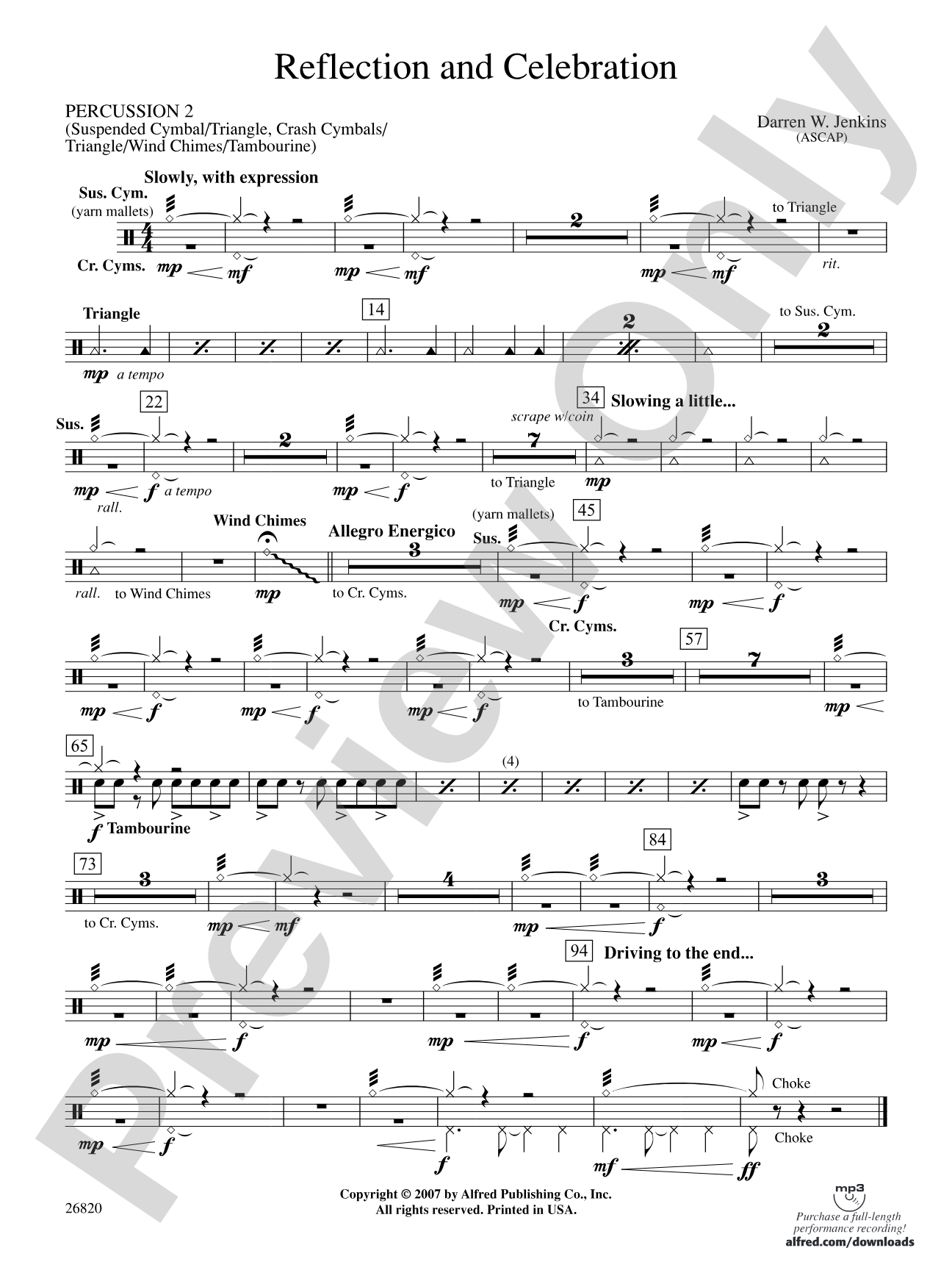

Reflection and Celebration: 2nd Percussion
By Darren W. Jenkins
Grade: 2 (Medium Easy)
Item: 00-PC-0001258_PC2
$3.00
Pickup currently not available
Description
Reflection and Celebration has two main sections. The first is slower and meant to represent the pensiveness of a history of trials and tribulations in which every person must endure. The second section is faster and is meant to represent the joy and festivity associated with celebrating an important occasion, as well as aspiration of a bright and promising future. This title is available in MakeMusic Cloud.


Don't just read it, hear it, play along with it, and watch your students grow with it. In MakeMusic Cloud, Reflection and Celebration: 2nd Percussion comes alive with professional accompaniment, adjustable tempo, and built-in practice tools that turn solo practice into real progress.
Open in the Player
Jump straight in and assign it today.
Start Your Free Trial
Open this title and explore the full library in minutes.
Sample Audio
1
Audio File
--:--
0:00
0:00
Sample Video
No sample videos found.
Additional Details
Series:
Young Symphonic
Publisher:
Alfred Music
Page Count:
126
SKU:
00-PC-0001258_PC2
More about this title
About the Composer: Darren W. Jenkins

Darren W. Jenkins holds a Master of Music in Composition from the University of Kansas, where he studied with composer James Barnes, and a Bachelor of Music in Music Education from Washburn University. His career spans elementary and secondary band direction across Kansas, including roles at Lawrence Public Schools, Hayden High School in Topeka, and currently as Assistant Director of Bands at Olathe South High School.
An award-winning composer and active clinician, Jenkins has established himself as a voice in contemporary band repertoire. His compositions are performed and recorded by ensembles throughout the United States and internationally, reflecting his deep understanding of both pedagogical needs and artistic expression at the secondary level.
Why we love this
Jenkins structures this piece to accomplish two substantial musical goals in a single work: introspection followed by affirmation. The moderate difficulty level means your band can handle genuine emotional content without struggling with the mechanics, leaving interpretive energy for the actual performance. This is the kind of piece that stays with audiences because it respects both the gravity of reflection and the authenticity of celebration.
What to expect
The opening invites quiet contemplation, acknowledging life's difficult passages with steady, understated expression. Then the energy shifts entirely: brightness floods in, rhythms quicken, and the ensemble celebrates forward momentum and possibility with genuine musical joy.
Who it's for
Concert bands at the Grade 2 level seeking repertoire that addresses meaningful occasions with musical substance. Band directors preparing for graduation, academic celebrations, or festivals will find a piece that sounds mature without requiring advanced technique.
How to get the most out of it
- Shape the first section through dynamic control and phrase breathing rather than tempo fluctuation. The pensiveness emerges from careful voicing and sustained lines, not from rushing or dragging.
- Mark clear sectional cues between the two main sections in parts so ensemble members understand the architectural shift. The transition from introspection to festivity requires confident reorientation.
- Balance the faster section's energy with precision in articulation and rhythmic unity. Brightness doesn't require sloppiness; clarity makes the joy land harder.
- Listen across the ensemble for transparent harmonies in slower passages. Grade 2 writing here likely features block chords or simple doublings that reveal any balance issues immediately.
How to use it
Program this for graduation ceremonies, awards assemblies, or spring concerts where the two-part structure mirrors your concert arc. Its inherent narrative also works beautifully as the centerpiece of a concert program that pairs lighter repertoire before and after, using this piece's emotional weight as the anchor.
Skills your students will build
- Sustaining long lines and controlling phrase shape without tempo variation
- Executing articulation clarity and rhythmic precision at faster tempos
- Balancing individual voice independence in slower, harmonically simple sections
- Responding to dramatic tonal and tempo contrasts within a single composition
- Interpreting emotional intent through dynamic and textural choices