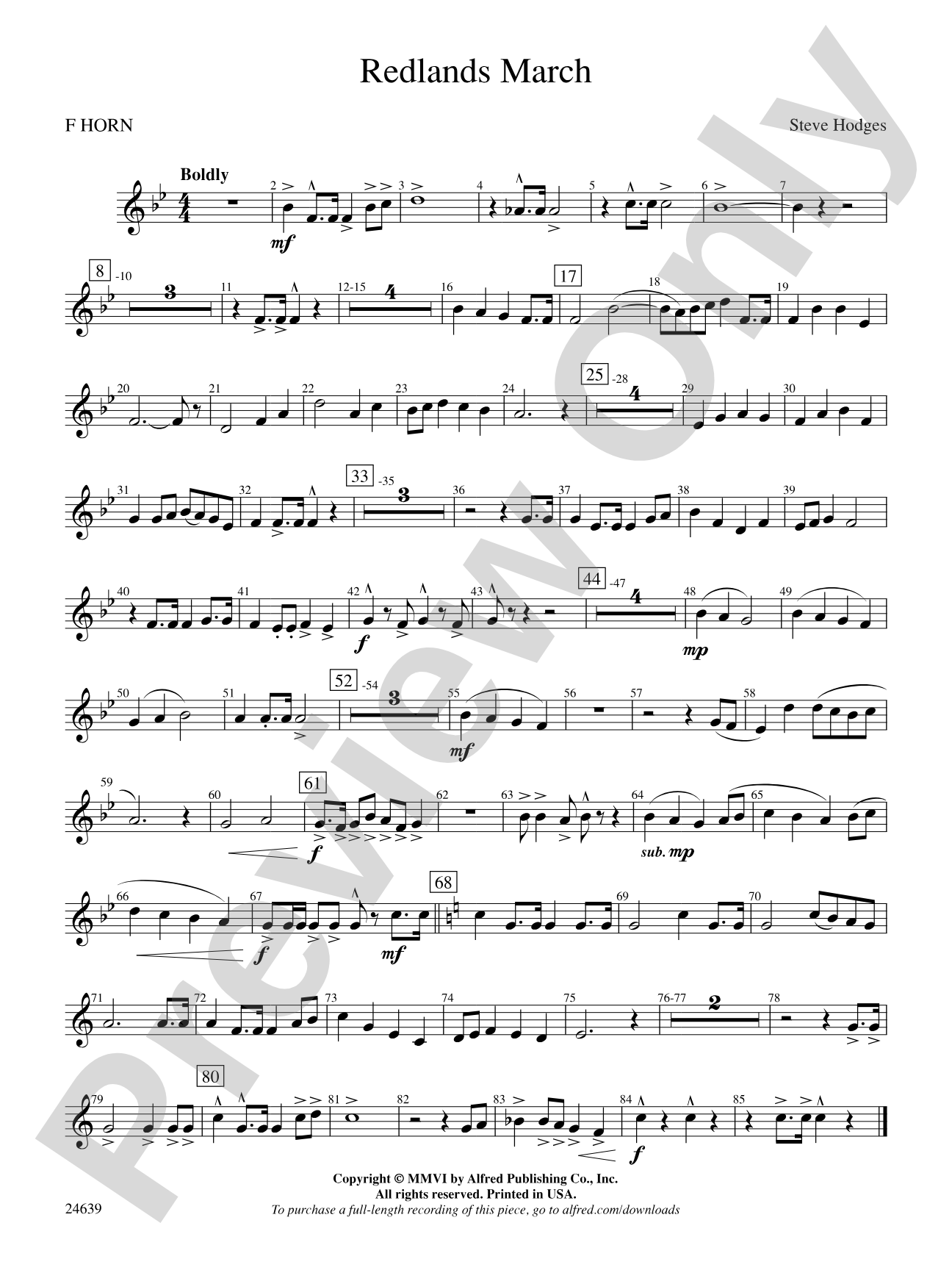
Redlands March: 1st F Horn Sheet Music Preview

Redlands March: 1st F Horn

By Steve Hodges

Grade: 1.5 (Easy)

Item: 00-PC-0000807_H1

Digital Download
$3.00
Description
A dynamic introduction leads to a stirring trumpet duet that opens this regal march by Steve Hodges. Everyone is involved in the melodic content throughout the piece and they will enjoy the unique treatment of the standard march trio and 'dogfight' sections. A great way to open or close a concert!

Don't just read it, hear it, play along with it, and watch your students grow with it. In MakeMusic Cloud, Redlands March: 1st F Horn comes alive with professional accompaniment, adjustable tempo, and built-in practice tools that turn solo practice into real progress.

Sample Audio
0:00
0:00
Sample Video
Additional Details
Series: Challenger Band Series
Publisher: Alfred Music
Page Count: 126
SKU: 00-PC-0000807_H1

More about this title

About the Composer: Steve Hodges

Steve Hodges

Steve Hodges holds degrees from Western Oregon University (Bachelor of Science) and Central Washington University (Master of Music Education). His four-decade career in public school music education spanned all levels of band, choir, and ensemble direction, giving him deep insight into what works in the rehearsal room.

Since 1986, Hodges has composed over 120 concert band works published by Alfred Music, along with choral arrangements for Staff Music and Shawnee Press. His music has traveled internationally and appeared at festivals, state conventions, and honor bands across Virginia, Iowa, British Columbia, Oregon, Washington, and North Carolina. His compositions have also been licensed by TBS and ESPN. As an ASCAP member, Hodges continues to live in The Dalles, Oregon, where he remains active in community music and watches his grandchildren discover his pieces in their own school band programs.

Why we love this

Redlands March proves that accessibility and sophistication aren't mutually exclusive. At Grade 1.5, every section gets substantial melodic material to play, which keeps engagement high across all players while the march form itself teaches harmonic progression naturally. The unconventional treatment of the trio and 'dogfight' sections sets this apart from standard repertoire at this level, giving your students something fresh to rehearse.

What to expect

Redlands March unfolds with ceremonial grandeur from its dynamic opening through an elegant trumpet duet. The regal character balances brightness and warmth, with the unique trio and 'dogfight' sections injecting personality and forward momentum that set this march apart from conventional ones.

Who it's for

This march sits perfectly for bands building beyond first-year fundamentals but not yet ready for Grade 2 repertoire. The Grade 1.5 level makes it accessible for developing players while the compositional craft keeps experienced ensembles engaged.

How to get the most out of it

  • Balance the opening trumpet duet against the supporting harmony; the dynamic introduction should set the stage without overwhelming the soloists.
  • Shape the march melody through all sections rather than treating it as background material. Since every part carries meaningful content, each player needs to understand where their line fits in the larger phrase.
  • Give the trio section breathing room. The unique treatment Hodges provides here deserves clarity in part preparation so the compositional intent comes through in performance.
  • Build momentum through the 'dogfight' section with clean articulation and tight rhythmic ensemble work; the excitement of this passage comes from precision, not volume.

How to use it

Program this to open a concert and establish a strong tone for the performance, or close with it to leave the audience with a satisfying final impression. It works equally well as a cornerstone of a Grade 1.5 concert or mixed-level festival program where ensembles at different ability levels perform together.

Skills your students will build

  • March form and sectional architecture (intro, A section, trio, 'dogfight,' return)
  • Balanced duet playing and accompanying harmonic support
  • Phrasing and articulation across different musical characters
  • Ensemble precision and rhythmic alignment in faster passage work

You May Also Like