
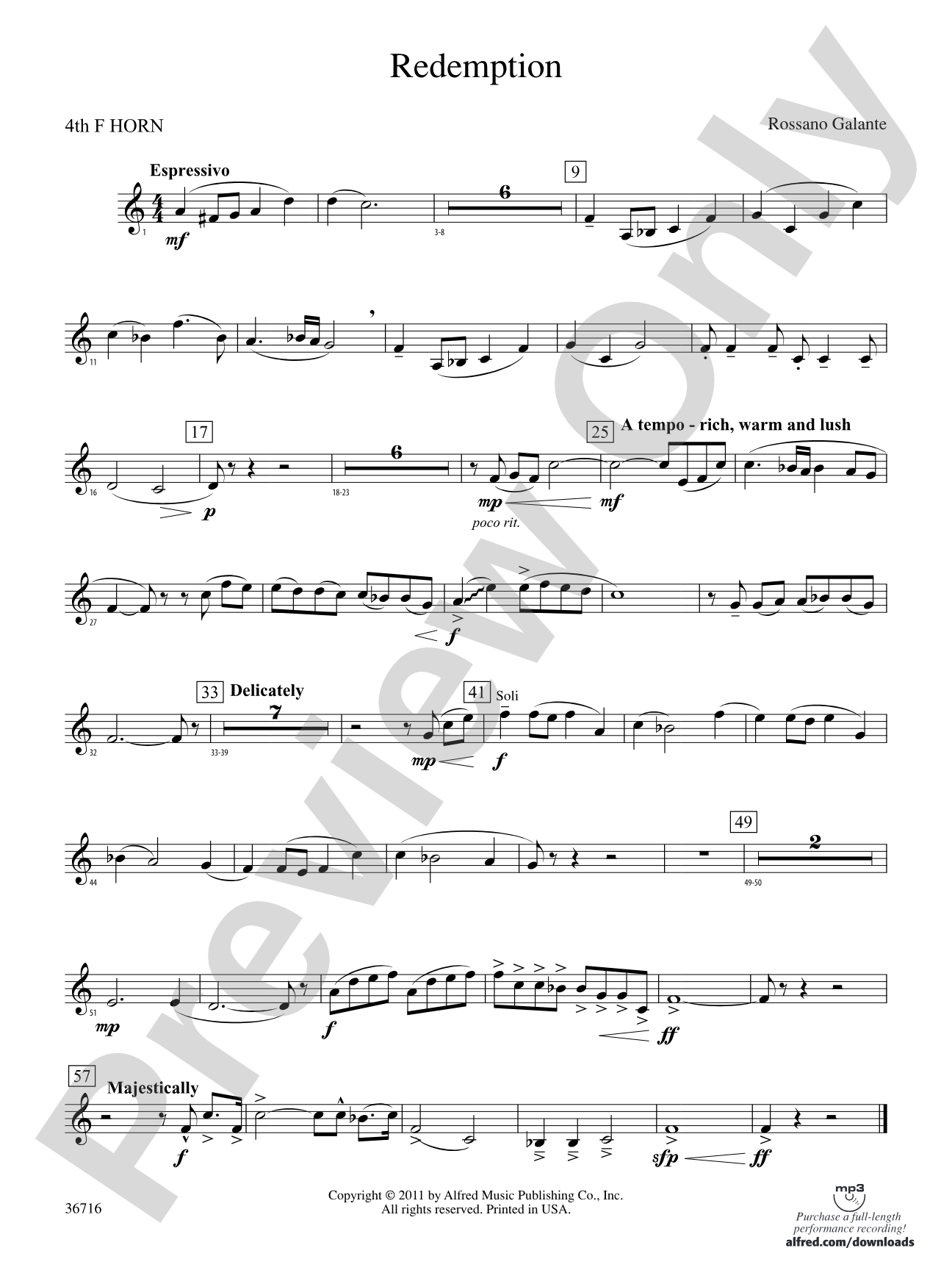

Redemption: 4th F Horn
By Rossano Galante
Grade: 3.5 (Medium)
Item: 00-PC-0015144_H4
$3.00
Pickup currently not available
Description
Redemption is a lyrical, lush, romantic composition that captures the euphoria one experiences after being saved from emotional crisis. Sweeping melodic lines and rich scoring will catapult your ensemble and audiences to emotional ecstasy. This title is available in MakeMusic Cloud.


Don't just read it, hear it, play along with it, and watch your students grow with it. In MakeMusic Cloud, Redemption: 4th F Horn comes alive with professional accompaniment, adjustable tempo, and built-in practice tools that turn solo practice into real progress.
Open in the Player
Jump straight in and assign it today.
Start Your Free Trial
Open this title and explore the full library in minutes.
Sample Audio
1
Audio File
--:--
0:00
0:00
Sample Video
No sample videos found.
Additional Details
Series:
Alfred Concert Band
Publisher:
Alfred Music
Page Count:
138
SKU:
00-PC-0015144_H4
More about this title
About the Composer: Rossano Galante

Rossano Galante grew up in Buffalo, New York, and earned his Bachelor of Arts in Trumpet Performance from SUNY Buffalo in 1992. That same year, he was selected as one of nineteen international students admitted to the University of Southern California's prestigious Film Scoring Program, where he studied under the late Jerry Goldsmith, Academy Award winner for The Omen.
Since relocating to California in 1999, Galante has established himself as a composer and orchestrator for major film studios, collaborating with Oscar-nominated composers Marco Beltrami, Christophe Beck, Brian Tyler, and Christopher Lennertz. His orchestration credits span over eighty studio productions, from blockbuster franchises like The Avengers and Fast X to intimate dramas like A Quiet Place. Beyond his film work, Galante maintains an active career as a concert composer, having published more than 68 pieces for concert band and orchestra through Alfred, Schirmer, Hafabra, C.L. Barnhouse, and other major publishers.
Why we love this
Galante brings his orchestral sensibility from decades of film scoring directly into this concert band work. The lush, sweeping melodic architecture feels cinematic without becoming overwrought; instead, it gives student ensembles a legitimate emotional canvas to work with. At Grade 3.5, the scoring balances accessibility with genuine sophistication, making this a standout choice for groups seeking repertoire that sounds and feels mature.
What to expect
Redemption unfolds like a cathartic journey, beginning from emotional weight and gradually opening into moments of luminous relief. The sweeping lines create an almost orchestral grandeur within the concert band medium; listeners experience the euphoria of resolution without ever losing sight of the struggle that preceded it.
Who it's for
Concert bands at the Grade 3 to 3.5 level who are ready for music that asks them to sustain long phrases and balance complex voicing. This work suits groups preparing for concert performances, festivals, or competitions where judges reward mature musicianship and emotional commitment over technical display.
How to get the most out of it
- Shape the long melodic lines with careful phrase planning across entire sections rather than bar-by-bar. Mark breath points and discuss where the phrase builds and where it settles.
- Balance the inner voices thoughtfully; the richness of the scoring depends on supporting parts being present without overshadowing the primary melody. Use sectional rehearsals to ensure clarinet, alto sax, and trombone lines maintain their independence.
- Invest in the quiet passages. This piece moves between moments of intensity and restraint; the softer dynamics carry emotional weight and demand steady intonation and ensemble focus.
- Let the percussion provide color and dimension rather than punctuation. The instrumentation supports the emotional arc, so tailor attack and decay to match the band's overall phrasing intent.
How to use it
Program this as a centerpiece concert work or festival entry where it can anchor a set alongside contrasting material. Its emotional arc and sophisticated voicing pair well with either a lighter opening work or a driving closer, depending on the overall narrative you want your program to tell.
Skills your students will build
- Sustaining long, shaped melodic lines across phrases that span multiple measures
- Voicing balance in scored arrangements with multiple simultaneous melodic strands
- Intonation and blend in sustained dynamics, particularly soft passages
- Emotional communication through tempo flexibility and phrasing nuance
- Sectional independence while maintaining ensemble cohesion