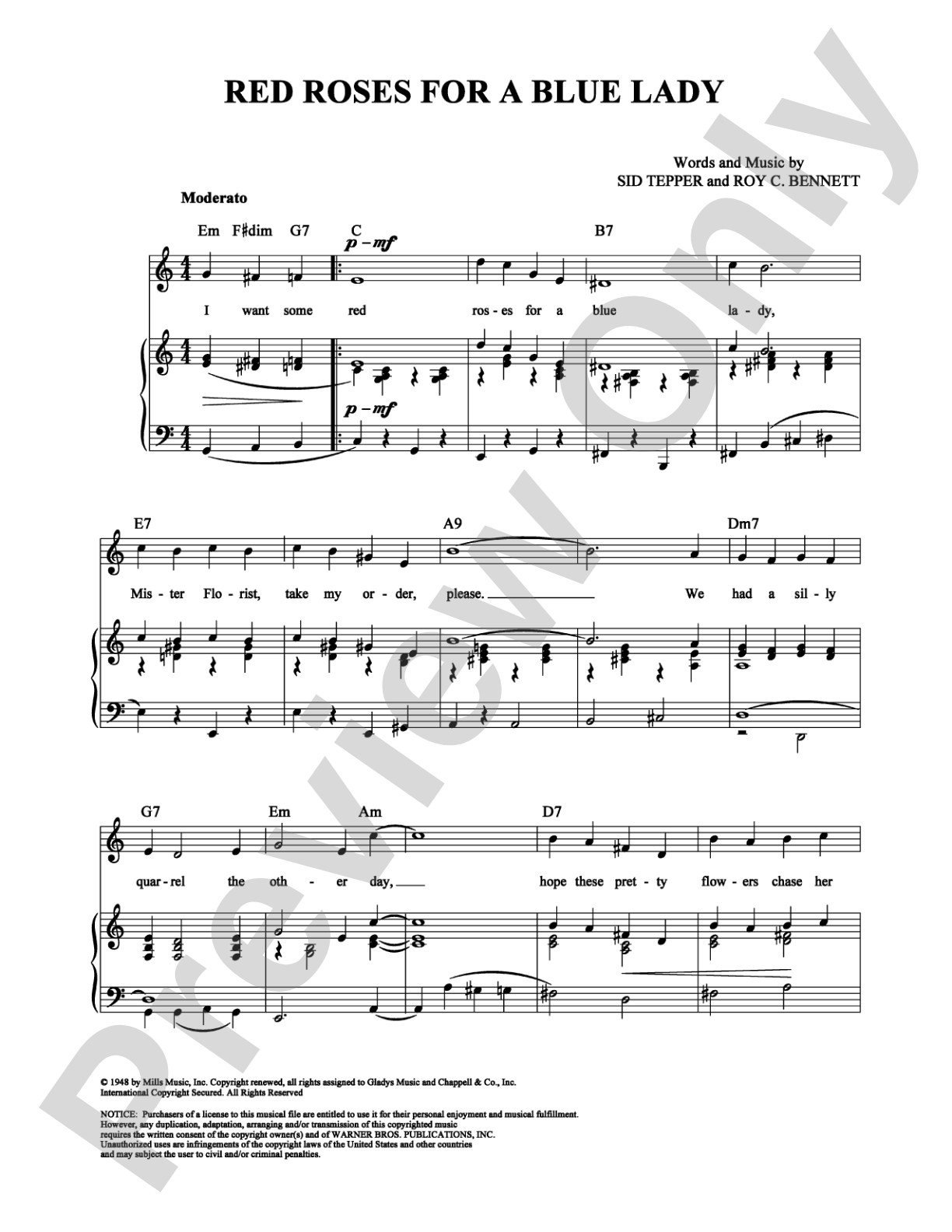
Red Roses for a Blue Lady: Piano/Vocal/Chords Digital Sheet Music

Red Roses for a Blue Lady: Piano/Vocal/Chords Digital Sheet Music

Sid Tepper, Roy C. Bennet

Item: 00-PS-0000856

Digital Download
$3.99
Description

Red Roses for a Blue Lady: Piano/Vocal/Chords Digital Sheet Music isn't in MakeMusic Cloud just yet...but it could be. Let us know you'd like to see it, and you'll help shape what comes next. In the meantime, start a free trial and dive into thousands of interactive titles your students can play along with today.

Sample Audio
No sample audio found.
Sample Video
Additional Details
SKU: 00-PS-0000856

More about this title

Why we love this

This standard sits perfectly in the pocket between jazz sophistication and popular accessibility, making it ideal for students who need to build comfort with traditional chord changes without the complexity of bebop harmony. The piano/vocal/chords format gives singers room to interpret while pianists get all the harmonic information they need to support the melody and improvise tastefully.

What to expect

Tender and nostalgic, this ballad unfolds with the understated elegance of a 1950s lounge standard. The melody is straightforward enough to sing with clarity, yet the harmonic movement beneath it carries sophistication and emotional depth, inviting both performer and listener into an intimate moment.

Who it's for

Vocalists learning the American Songbook and pianists who want to deepen their understanding of jazz-influenced comping and reharmonization. This works equally well for voice students building a solo recital, jazz ensembles adding a vocal feature, or accompanists strengthening their craft with idiomatic jazz-standard keyboard work.

How to get the most out of it

  • Balance the vocal line so it floats above the piano rather than pushing through it; this song lives in the warmth of the accompaniment, not in projection alone.
  • Use the chord symbols to explore shell voicings and rootless comping on piano, keeping the sound open and conversational rather than block-heavy.
  • Let the rubato breathe naturally with the lyric phrasing; this is a ballad that invites slight tempo flexibility between phrases.
  • Consider the vocal range and tessitura for your singer; transpose if necessary to keep the song in a comfortable zone where they can access the emotional weight of the melody.

How to use it

Program this as a solo feature in a jazz or American standards concert, pairing it with other ballads of the era for a cohesive set. It also works beautifully as a piano feature followed by a vocal entrance, or as a recital encore when you want something audience-friendly that still showcases musical maturity.

Skills your students will build

  • Reading and interpreting chord symbols in a traditional jazz-standards context
  • Shaping a lyrical melody with appropriate phrasing and breath placement
  • Voicing jazz chords with taste and restraint in accompaniment
  • Balancing melody and harmony in collaborative piano-vocal performance
  • Recognizing and executing the harmonic language of mid-century popular song

You May Also Like