
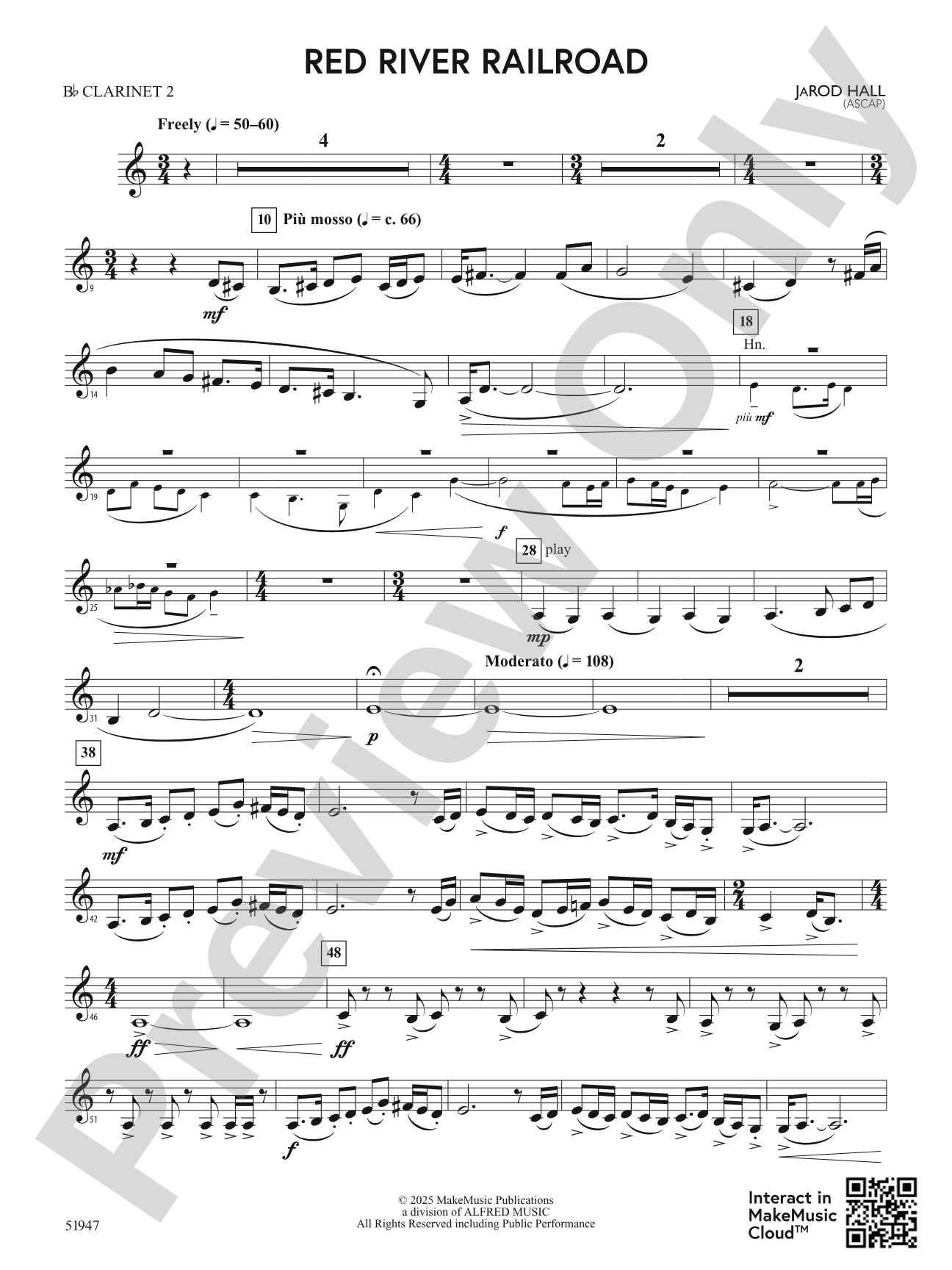

Red River Railroad: 2nd B-flat Clarinet
By JaRod Hall
Grade: 4
Item: 00-PC-0019436_C2
$3.00
Pickup currently not available
Description
Drawing inspiration from both water and steel, Red River Railroad is a programmatic work by JaRod Hall that opens with a horn solo depicting the peaceful flow of the Red River. A lively, rhythmic section follows, capturing the bustling sounds of the railroad in contrast to the tranquil river theme. A fantastic and colorful work! (4:45)


Don't just read it, hear it, play along with it, and watch your students grow with it. In MakeMusic Cloud, Red River Railroad: 2nd B-flat Clarinet comes alive with professional accompaniment, adjustable tempo, and built-in practice tools that turn solo practice into real progress.
Open in the Player
Jump straight in and assign it today.
Start Your Free Trial
Open this title and explore the full library in minutes.
Sample Audio
1
Audio File
--:--
0:00
0:00
Sample Video
Additional Details
Series:
MakeMusic Symphonic Band
Publisher:
MakeMusic Publications
SKU:
00-PC-0019436_C2
More about this title
About the Composer: JaRod Hall

JaRod Hall is a Texas composer and educator born in 1991 who holds degrees in music education from the University of North Texas and composition from Texas State University. His mentors in conducting and composition include Dr. Nicholas Williams, Dr. Caroline Beatty, and Dr. Michael Ippolito, while his performance background spans tuba and trombone across ensembles including the North Texas Wind Symphony and Texas State Symphonic Winds.
As a band director for eight years, Hall led his students to consistent sweepstakes honors at the Texas University Interscholastic League evaluations, including a landmark Citation of Excellence for his 2018 non-varsity band at Griffin Middle School in Frisco. His compositions appear on the Texas Prescribed Music List and Bandworld Top 100 list; his brass choir "Silver Fanfare" won the 2020 Dallas Winds Call for Fanfares, and "Through the Storm" received the 2021 Barbara Buehlman Prize for middle school band. He is a four-time Texas All-State Band member and performed with the 2014 Disneyland All-American College Band.
Why we love this
Red River Railroad succeeds because it trusts conductors and students to navigate genuine programmatic storytelling without oversimplifying the narrative. Hall's contrasting sections (the introspective horn solo and the kinetic railroad rhythms) give your ensemble clear dramatic anchors, while the Grade 4 scoring remains transparent enough that individual voices can shine through. A strong festival choice that rewards careful listening and intentional phrasing.
What to expect
The work opens with tranquility, a single horn voice capturing the patient flow of water before the full ensemble erupts into rhythmic vitality and forward motion. The contrast between stillness and kinetic energy creates a visceral sense of place and time. You hear both the river and the rails, and the journey between them feels earned rather than imposed.
Who it's for
Concert bands at the Grade 4 level looking for repertoire with genuine dramatic arc and instructional merit. Ensembles preparing for festivals and competitions will find a work that balances accessibility with musical sophistication. Directors seeking pieces that teach ensemble listening and intentional interpretation will value Hall's economy of gesture.
How to get the most out of it
- Shape the opening horn solo with rubato and allow it room to breathe; this passage sets the entire emotional landscape and deserves time to establish the river's gentle character before the ensemble enters.
- Lock the rhythm section (bass drum, timpani, low brass) in the bustling railroad section; the contrast depends on rock-solid ensemble pulse supporting the programmatic imagery.
- Balance the melodic voices over the rhythmic accompaniment in the middle section so listeners hear both the excitement of the railroad and any thematic material returning from the opening.
- Attend to dynamic shape across the full arc; resist playing all of the fast section at the same volume, as this dulls the sense of forward momentum and programmatic energy.
How to use it
Program Red River Railroad midway through a concert to provide emotional and textural variety, especially if paired with more abstract or heavily contrapuntal works. Its programmatic clarity and mid-length duration (4:45) make it ideal for a festival slot, and the opening solo offers a natural staging moment for a featured performer.
Skills your students will build
- Responding to programmatic cues and translating musical imagery into ensemble expression
- Rhythmic precision in marked, driven passages contrasted with rubato and phrase shaping
- Dynamic control across contrasting sections (lyrical versus energetic)
- Balance and blend when supporting a solo line with ensemble accompaniment
- Listening for and maintaining thematic connections across formal sections