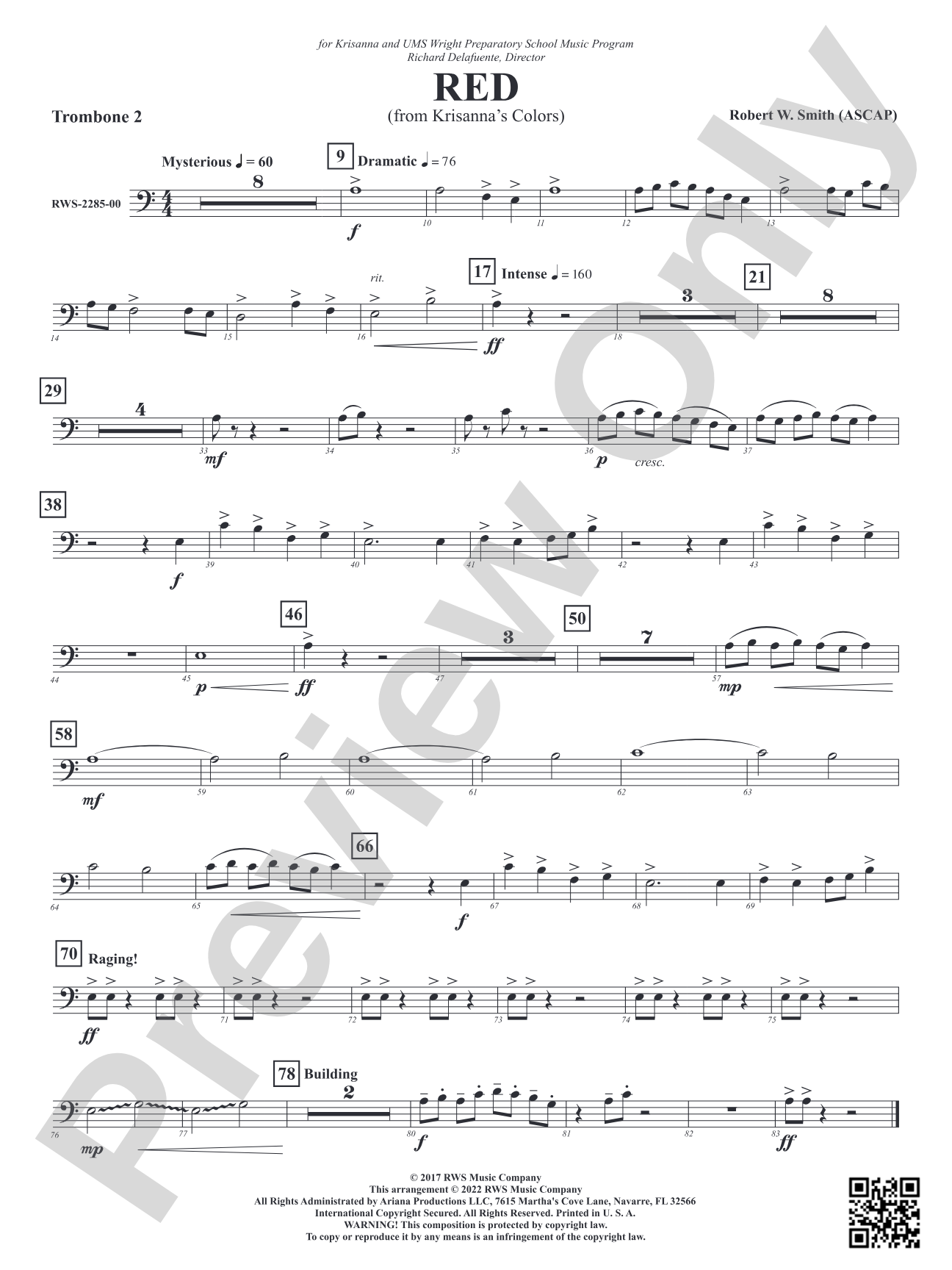
Red - From Krisanna's Colors: 2nd Trombone Sheet Music Preview

Red - From Krisanna's Colors: 2nd Trombone

From Krisanna's Colors

By Robert W. Smith

Grade: 3

Item: 98-PC-RWS2285_TN2

Digital Download
$3.99
Description
"Red" is a popular work by Robert W. Smith scored for full orchestra. As the first movement from "Krisanna's Colors", the suite is inspired by her color choices used to describe her daily emotions and moods. Beginning with somber clarinet solo and choir, the mood quickly changes to bombastic and extreme energy. You may consider programming Red (Mvt. 1) along with Blue (Mvt. 2) and Yellow (Mvt. 3) for even greater effect. An excellent choice for your concert/festival program!

Original Item#: RWS-2285-00

Red - From Krisanna's Colors: 2nd Trombone isn't in MakeMusic Cloud just yet...but it could be. Let us know you'd like to see it, and you'll help shape what comes next. In the meantime, start a free trial and dive into thousands of interactive titles your students can play along with today.

Sample Audio
0:00
0:00
Sample Video
Additional Details
Series: RWS - Concert Orchestra
Publisher: RWS Music Company
SKU: 98-PC-RWS2285_TN2

More about this title

About the Composer: Robert W. Smith

Robert W. Smith

Robert W. Smith stands among America's most recorded composers for instrumental music, with more than 400 published works spanning concert band, orchestra, and wind ensemble literature. He holds degrees from Troy State University and the University of Miami, and his compositions have traveled across six continents, performed by ensembles ranging from developing groups to professional orchestras.

Beyond the concert hall, Smith's music has appeared in Olympic broadcasts, network television productions, and ceremonial events including the opening of the Macy's Thanksgiving Day Parade. His symphonic works (The Divine Comedy and The Odyssey among them) and accessible pieces for growing ensembles have become repertoire standards, and his work as a guest conductor and clinician has taken him throughout North America, Europe, Asia, and the United Kingdom.

Why we love this

Smith captures genuine emotional arc here, moving from introspection to exuberance in a way that feels earned rather than manipulated. Grade 3 full orchestra music rarely balances accessibility with orchestral sophistication this well, and the thematic clarity means every section hears something singable and memorable.

What to expect

Red opens with quiet introspection and regret, a lone clarinet voice reflecting before a choir joins in mournful harmony. Then something ignites. The mood explodes into vivid, unrelenting energy, driven by full orchestral color and rhythmic insistence that mirrors passion at its peak.

Who it's for

Orchestra directors building festival programs or concert repertoire that demands both emotional range and student engagement. This work suits ensembles ready for Grade 3 technical demands but still developing interpretive maturity.

How to get the most out of it

  • Establish the clarinet and choir carefully in the opening; this vulnerable moment must land before the energy surge, so don't rush the tempo or underestimate the dynamic control needed.
  • Shape the transition into the bombastic section with precision. Mark clear cutoff points and entrance cues so the shift from somber to extreme reads as intentional climax rather than chaos.
  • Balance the orchestra's full sound during the high-energy passages without letting articulation blur; clarity at forte dynamics prevents heaviness at this grade level.

How to use it

Program Red alongside Blue and Yellow as a complete triptych to create a thematic arc that holds audience attention across three distinct emotional landscapes. Alternatively, open a concert with Red alone as a statement piece that announces your ensemble's range and sets an energized tone for what follows.

Skills your students will build

  • Sustaining lyrical phrasing through solo and ensemble passages
  • Executing dramatic dynamic contrasts (pp to ff) with clarity and control
  • Coordinating sectional entrances during rapid mood shifts
  • Balancing transparency in full orchestra textures at Grade 3 difficulty

You May Also Like