Red Clay (arr. Mark Taylor) Sheet Music Preview

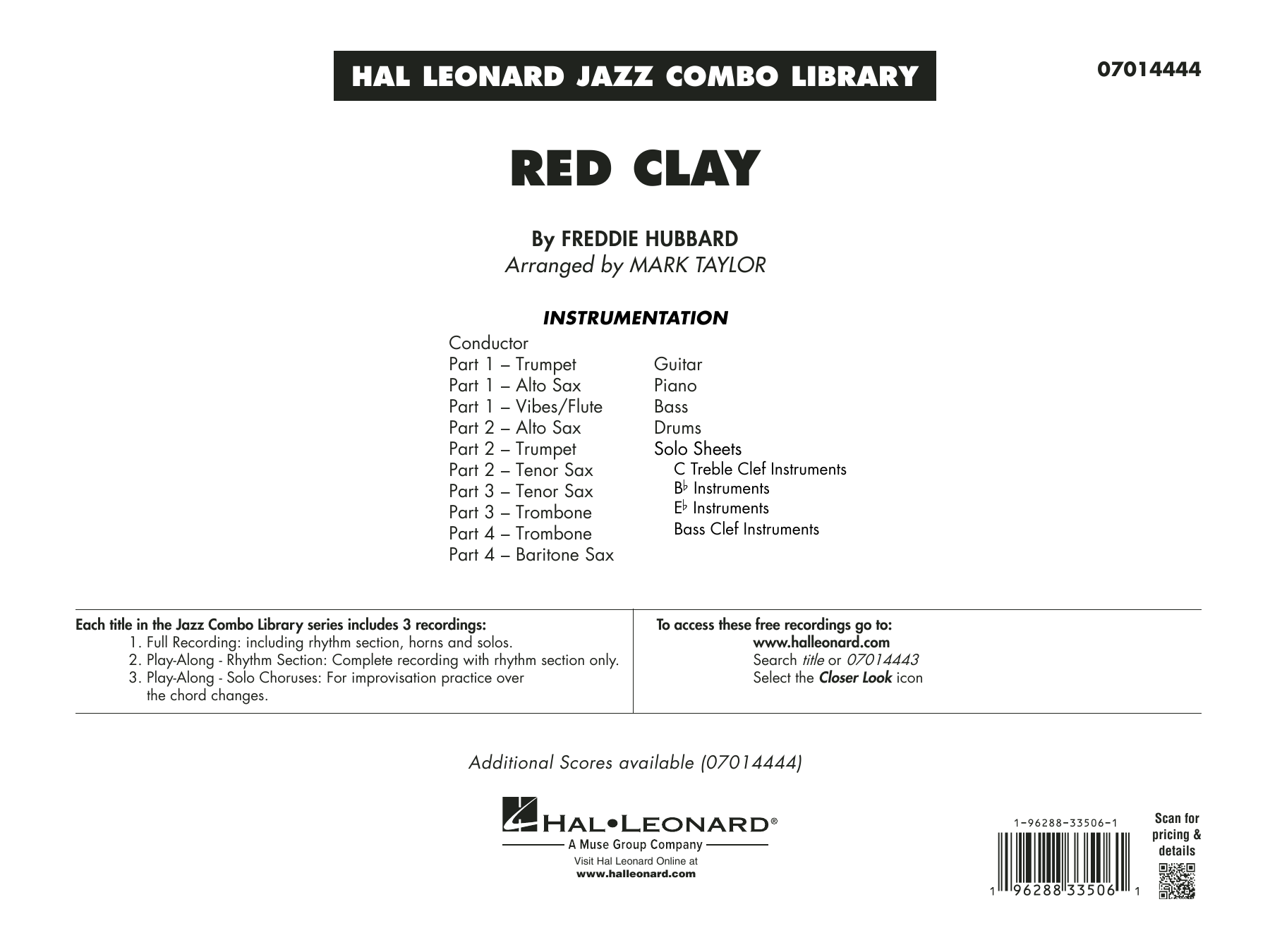
Red Clay (arr. Mark Taylor): Jazz Ensemble Conductor Score & Parts

As performed by Freddie Hubbard / Arranged by Mark Taylor

Grade: 4

Item: 35-PK01715451

Digital Download
$40.00

One moment…

Description
Red Clay (arr. Mark Taylor)

Red Clay (arr. Mark Taylor): Jazz Ensemble Conductor Score & Parts isn't in MakeMusic Cloud just yet...but it could be. Let us know you'd like to see it, and you'll help shape what comes next. In the meantime, start a free trial and dive into thousands of interactive titles your students can play along with today.

Sample Audio
No sample audio found.
Sample Video
Additional Details
Publisher: Hal Leonard
SKU: 35-PK01715451

More about this title

About the Artist: Freddie Hubbard

Freddie Hubbard stands as one of jazz's most influential trumpet voices, bridging hard bop, soul jazz, and fusion with a tone that cuts through any ensemble. His career spanning five decades established him as both a fearless improviser and a composer whose work became immediate standards, recorded by countless musicians across genres.

Why we love this

Mark Taylor's arrangement captures the groaning, soulful character of Hubbard's original without losing the improvisational space that makes the tune breathe. Grade 4 students get a genuine jazz composition that teaches melody, harmony, and rhythmic cohesion without condescension.

What to expect

Warm and introspective, with the kind of soulful restraint that defines classic soul jazz. The tune settles into your students' playing like a comfortable groove, inviting them into genuine musical conversation rather than demanding flashy execution.

Who it's for

Jazz ensembles working at the intermediate level who want authentic repertoire that respects their musical intelligence. Directors seeking repertoire beyond generic educational jazz will find a piece that builds on real jazz vocabulary while remaining accessible.

How to get the most out of it

  • Focus the ensemble on the groove pocket before addressing articulation or dynamics. This tune lives in the rhythm section's feel, and clean execution flows from there.
  • Balance the melody against the background figures. The horns need clarity without overwhelming the understated elegance of Hubbard's original writing.
  • Allow soloists room to interpret phrasing within the head. The composition's power depends on players understanding that jazz melody isn't metronomic.

How to use it

This works beautifully in a jazz concert focused on post-bop standards or as the closer in a set of more uptempo charts. Its maturity also makes it suitable for a program exploring how jazz masters approached composition with economy and emotional depth.

Skills your students will build

  • Reading jazz articulation and phrasing conventions
  • Locked ensemble rhythmic precision in swing feel
  • Balancing section harmony with forward melodic momentum
  • Interpreting chord changes in improvisation-friendly contexts
  • Listening to and supporting a featured soloist within ensemble texture

You May Also Like