
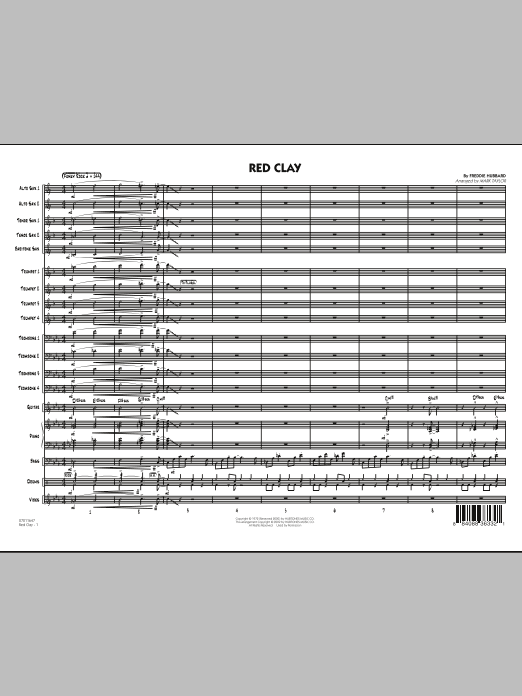

Red Clay: Jazz Ensemble Conductor Score & Parts
By Freddie Hubbard / Arranged by Mark Taylor
Grade: 4
Item: 35-PK00130253
$55.00
Pickup currently not available
Buy Extra Parts (Digital PDF Download)
| Product | Price | Quantity |
|---|---|---|
| Red Clay - Conductor Score (Full Score) | $7.50 | |
| Red Clay - Alto Sax 1 | $6.00 | |
| Red Clay - Alto Sax 2 | $6.00 | |
| Red Clay - Tenor Sax 1 | $6.00 | |
| Red Clay - Tenor Sax 2 | $6.00 | |
| Red Clay - Baritone Sax | $6.00 | |
| Red Clay - Trumpet 1 | $6.00 | |
| Red Clay - Trumpet 2 | $6.00 | |
| Red Clay - Trumpet 3 | $6.00 | |
| Red Clay - Trumpet 4 | $6.00 | |
| Red Clay - Trombone 1 | $6.00 | |
| Red Clay - Trombone 2 | $6.00 | |
| Red Clay - Trombone 3 | $6.00 | |
| Red Clay - Trombone 4 | $6.00 | |
| Red Clay - Guitar | $6.00 | |
| Red Clay - Piano | $6.00 | |
| Red Clay - Bass | $6.00 | |
| Red Clay - Drums | $6.00 | |
| Red Clay - Vibes | $6.00 | |
| Red Clay - C Solo Sheet | $6.00 | |
| Red Clay - Bb Solo Sheet | $6.00 | |
| Red Clay - Eb Solo Sheet | $6.00 | |
| Red Clay - Bass Clef Solo Sheet | $6.00 |
Parts Added to Cart!
Description
From jazz great Freddie Hubbard, here is one of his most famous tunes in a solidly written chart by Mark Taylor. With a funky rock feel and well-known riffs, your band will enjoy performing this one time and again. This also works great for soloists.


Red Clay: Jazz Ensemble Conductor Score & Parts isn't in MakeMusic Cloud just yet...but it could be. Let us know you'd like to see it, and you'll help shape what comes next. In the meantime, start a free trial and dive into thousands of interactive titles your students can play along with today.
Request This Title
Tell us you want it.
Start Your Free Trial
Explore everything that's ready to play right now.
Sample Audio
No sample audio found.
Sample Video
No sample videos found.
Additional Details
Publisher:
Hal Leonard
SKU:
35-PK00130253
More about this title
About the Composer: Freddie Hubbard
Freddie Hubbard stands among the most prolific and versatile trumpeters in jazz history. His career spanning six decades produced work across hard bop, soul jazz, fusion, and funk, and his compositional voice proved just as restless and inventive as his playing. Red Clay exemplifies his gift for writing accessible, groove-centered melodies that stick in listeners' ears while remaining sophisticated enough to reward serious performers.
Hubbard's influence on jazz education extends beyond his recordings. His compositions have become standard fare in school jazz programs because they strike a balance between authentic jazz language and teachable structures. Directors return to his tunes year after year because they energize student musicians and audiences alike.
Why we love this
Mark Taylor's arrangement captures the infectious grooves of the original without sacrificing clarity for developing ensembles. The riffs sit well across sections, the solo vehicle is generous without being daunting, and the chart respects both the tune's funk DNA and its jazz credibility. Your students will work hard on this piece not because they have to, but because they'll want to nail that groove.
What to expect
Funky and grounded, with a minor blues feel that immediately signals to students what jazz can sound like when it meets funk. The rhythm has a conversational ease that makes complex voicings feel natural rather than academic. There's a built-in swagger here, the kind students feel in their bodies when they lock into the groove.
Who it's for
Grade 4 jazz ensembles with a solid rhythm section and at least one competent soloist. The chart works for groups with mixed improvisation experience because the head is strong enough to carry the piece, and soloists can contribute at their own level. Directors seeking a high-engagement tune that sounds like a real jazz composition, not a simplified exercise.
How to get the most out of it
- Lock the hi-hat and kick drum into a tight pocket before adding horn lines. The funky feel lives or dies with your rhythm section's cohesion.
- Bring out the signature riffs in the ensemble sections by letting them breathe with space rather than driving them hard. Confidence and pocket matter more than volume.
- Encourage soloists to reference the recorded original. Hubbard's phrasing on this tune is economical and bluesy, and even young improvisers will gain something from hearing how he navigates the changes.
- Balance the rock elements with jazz sensibility in your articulation. These riffs have attitude, but they should still swing.
How to use it
This works well as a mid-season feature when your ensemble has developed enough ensemble cohesion to handle funk grooves without losing jazz articulation. Place it alongside other Hubbard compositions or within a program exploring jazz-funk fusions from the 1970s. It's also an excellent choice for a spring concert where you want to send audiences home smiling.
Skills your students will build
- Reading and executing funky rhythmic figures with precision
- Developing a blues-based jazz language for improvisation
- Locking rhythm section grooves with horn section parts
- Balancing swing eighth-notes with straight-feel rock rhythms
- Soloing over blues changes in a jazz-funk context
- Responding to section riffs with accurate ensemble articulation