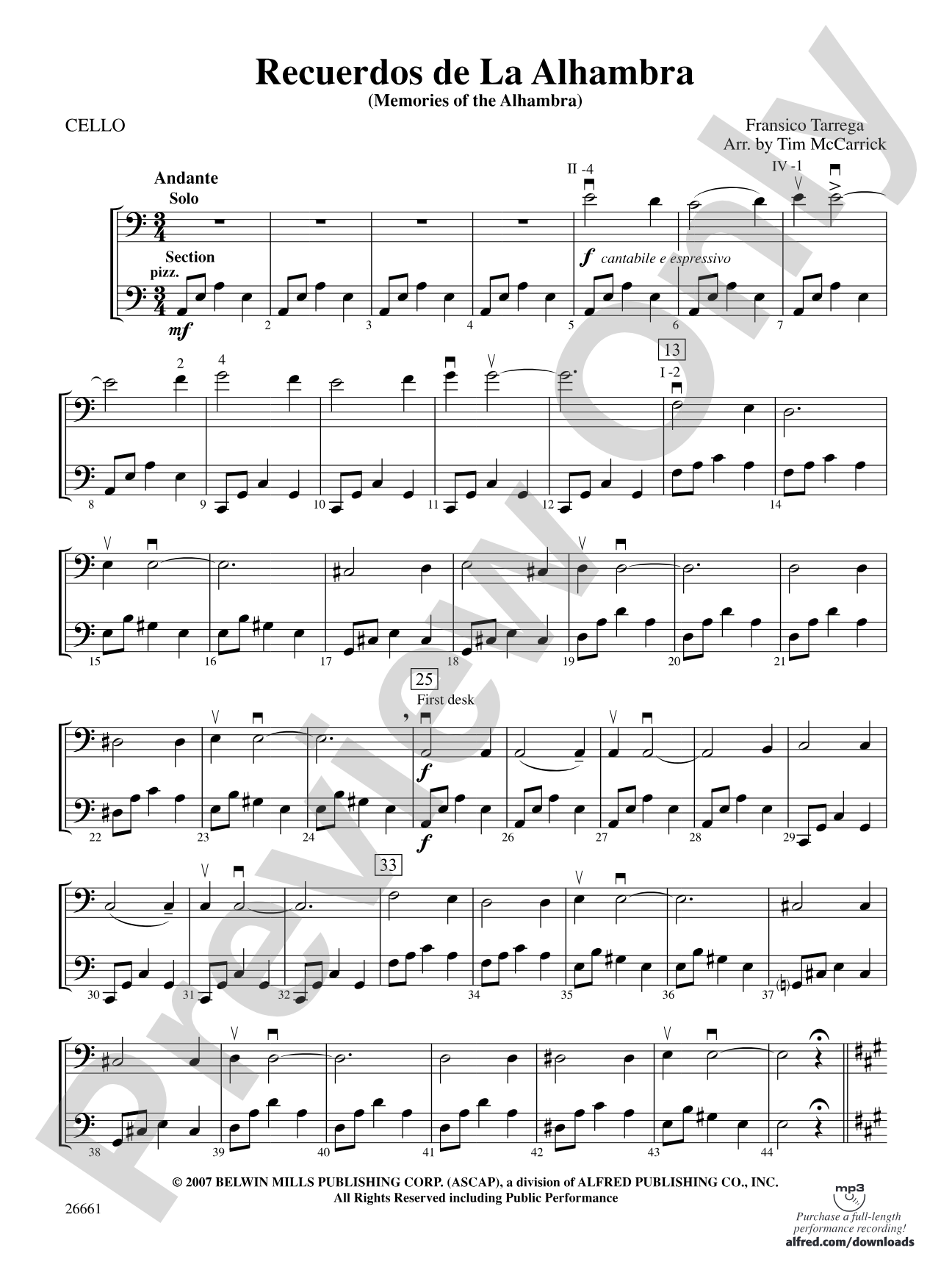
Recuerdos de la Alhambra: Cello Sheet Music Preview

Recuerdos de la Alhambra: Cello

By Francisco Tárrega / arr. Tim McCarrick

Grade: 3.5

Item: 00-PC-0001154_VC1

Digital Download
$5.99
Description
This gem from the "Father of the Classical Guitar" is one of the world's most beautiful melodies! Your violins and violas will love the opportunity to play "alla Chitarra", as they hold their instruments like a guitar and strum or pizzicato the accompaniment parts. This hauntingly lyrical piece moves from major to minor, passing the melody from high strings to low and back again. This title is available in MakeMusic Cloud.

Don't just read it, hear it, play along with it, and watch your students grow with it. In MakeMusic Cloud, Recuerdos de la Alhambra: Cello comes alive with professional accompaniment, adjustable tempo, and built-in practice tools that turn solo practice into real progress.

Sample Audio
0:00
0:00
Sample Video
Additional Details
Series: Belwin Concert String Orchestra
Publisher: Alfred Music
Page Count: 62
SKU: 00-PC-0001154_VC1

More about this title

About the Arranger: Francisco Tarrega

Francisco Tárrega (1852-1909) revolutionized classical guitar technique and repertoire during the Romantic era, establishing many of the foundational methods still taught today. His compositions and transcriptions elevated the guitar from a popular instrument to one worthy of concert halls, and his innovations in fingering and tone production remain central to guitar pedagogy.

Why we love this

This arrangement captures what makes Tárrega's original so enduring: a melody that unfolds with genuine inevitability, shifting between major and minor in ways that feel both natural and deeply moving. The "alla chitarra" technique gives string players a fresh way to think about color and texture, transforming familiar instruments into something new while staying within the technical reach of an upper-middle-level ensemble.

What to expect

Recuerdos de la Alhambra unfolds like a memory glimpsed through moonlight, familiar and strange at once. The melody drifts between major and minor keys with a languorous, almost improvisational quality, while the pizzicato accompaniment adds an intimate, almost parlor-like warmth that keeps the piece from ever feeling grandiose.

Who it's for

String orchestra directors looking for a Romantic-era work that rewards both careful listening and technical growth. Players at Grade 3.5 will find the "alla chitarra" technique accessible but novel, and the piece's emotional arc gives even developing musicians something substantive to interpret.

How to get the most out of it

  • Treat the pizzicato and strumming passages as true accompaniment rather than background; they set the harmonic and rhythmic foundation that allows the melody to breathe. Balance matters as much here as in any tutti passage.
  • Shape the melody's journey between high and low strings as a conversation. Each section should feel like it's responding to what came before, not simply restating the same musical idea.
  • Experiment with vibrato intensity in sustained passages to reflect the piece's harmonic shifts from major to minor. A subtle widening of vibrato can help listeners hear the emotional tilt without sounding exaggerated.
  • The key signature changes may initially feel disorienting to students; establish clear rehearsal landmarks and reference points so the ensemble can navigate the modulations with confidence rather than hesitation.

How to use it

Program this as a centerpiece for a concert exploring the Romantic guitar or as a contrast piece in a program mixing periods and styles. Its moderate length and Grade 3.5 difficulty make it ideal for spring or year-end concerts where your ensemble is ready to tackle more sophisticated interpretive work.

Skills your students will build

  • Sustaining lyrical phrasing across longer melodic lines
  • Playing pizzicato with rhythmic precision and tonal consistency
  • Navigating major-to-minor harmonic shifts and their expressive implications
  • Balancing melody and accompaniment textures within the same ensemble
  • Responding to key changes and tonal centers with intonation awareness

You May Also Like