
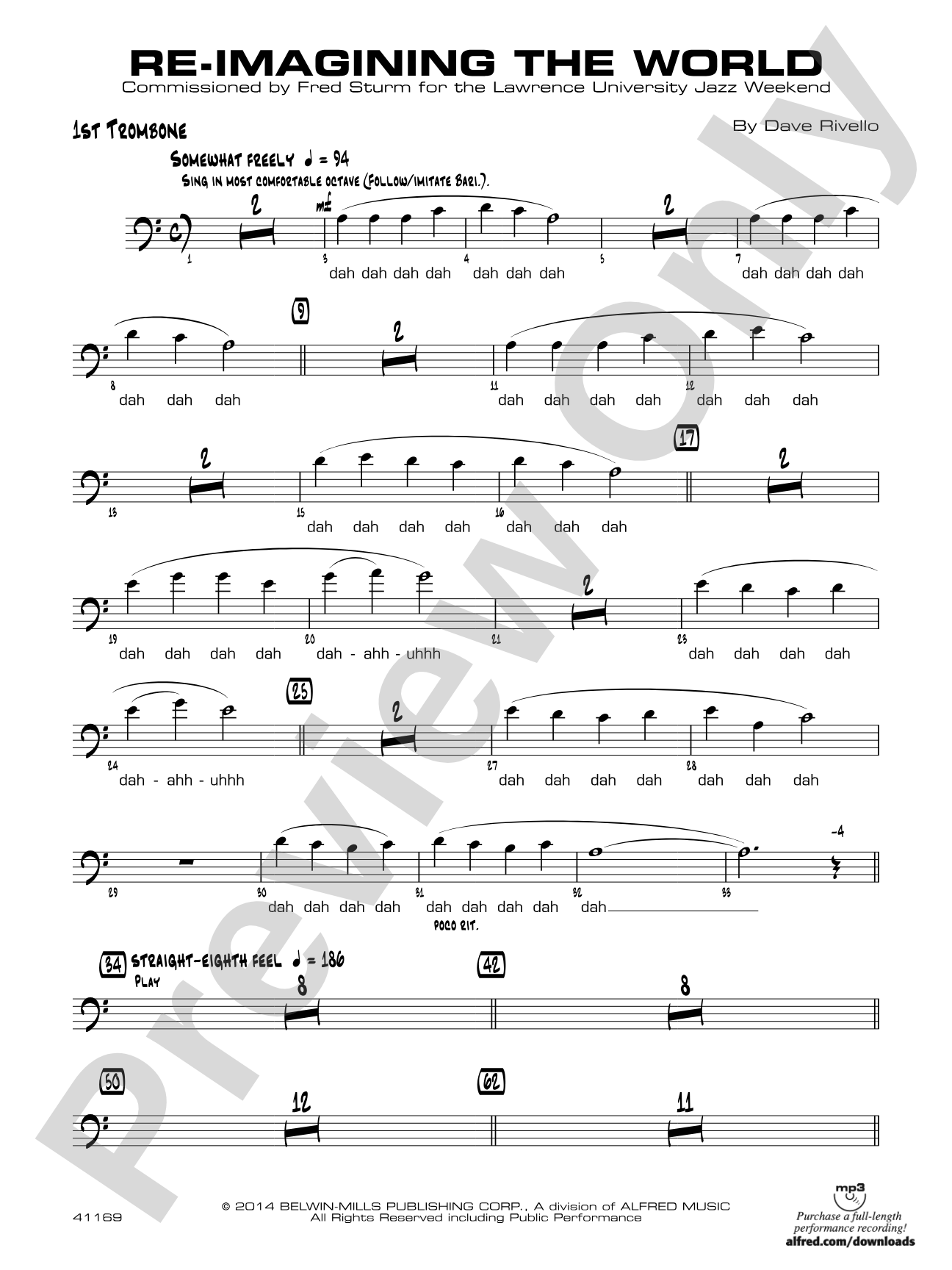

Re-Imagining the World: 1st Trombone
By Dave Rivello
Grade: 4 (Medium Advanced / Difficult)
Item: 00-PC-0016297_TN1
$3.00
Pickup currently not available
Description
This chart is a creative musical voyage! With a Metheny-flavor, the work begins with bari sax and band vocals trading back and forth. Then the swing groove begins at 184 BPM with a soaring ensemble featuring a trombone solo and plenty of energy. An upbeat and exciting chart. (5:42)


Don't just read it, hear it, play along with it, and watch your students grow with it. In MakeMusic Cloud, Re-Imagining the World: 1st Trombone comes alive with professional accompaniment, adjustable tempo, and built-in practice tools that turn solo practice into real progress.
Open in the Player
Jump straight in and assign it today.
Start Your Free Trial
Open this title and explore the full library in minutes.
Sample Audio
1
Audio File
--:--
0:00
0:00
Sample Video
No sample videos found.
Additional Details
Series:
Premier Jazz Series
Publisher:
Alfred Music
Page Count:
74
SKU:
00-PC-0016297_TN1
More about this title
About the Composer: Dave Rivello

Dave Rivello directs the New Jazz Ensemble at the Eastman School of Music, an ensemble that has earned recognition for artistic excellence. His compositional voice developed through study with leading figures in jazz arranging: Bob Brookmeyer, Rayburn Wright, Bill Dobbins, and Sam D'Angelo. He holds degrees from the Eastman School of Music and the Dana School of Music at Youngstown State University.
Rivello's commissions and compositions have been performed by world-class soloists and ensembles, including Bobby McFerrin, Phil Woods, Randy Brecker, Regina Carter, The Smithsonian Institute, and The Airmen of Note. His work circulates throughout the United States and has been heard in Germany and Spain, reflecting a catalog rooted in the demands of professional jazz musicians and the standards of university-level performance.
Why we love this
Rivello writes with the confidence of someone who leads a major university jazz ensemble: the chart balances accessibility with real musical substance. The opening dialogue between bari sax and band vocals immediately establishes a conversational quality that engages both players and listeners, while the swing section at 184 BPM demands genuine musicianship without overreaching in difficulty. This is the kind of piece that feels rewarding to rehearse and thrilling to perform.
What to expect
The piece opens with an intimate, almost conversational quality before expanding into a propulsive swing groove filled with contemporary harmonic color. There is both restraint and energy here: the opening breathes with space, but once the swing section lands at 184 BPM, the piece soars with the exuberance of an ensemble firing on all cylinders. The trombone solo cuts through with warmth while the full ensemble drives underneath with infectious momentum.
Who it's for
This chart fits a Grade 4 jazz ensemble with strong fundamentals in swing feel, sectional balance, and jazz phrasing. The Metheny-influenced harmonic vocabulary and soloing opportunities appeal to programs that have solid soloists ready to carry feature moments while challenging the full ensemble to maintain sophisticated ensemble awareness.
How to get the most out of it
- Shape the opening bari sax and vocal exchange with clear phrasing and space between statements; treat it as a musical conversation rather than a continuous line.
- Lock the groove section at 184 BPM by having the rhythm section commit fully to the swing feel; the energy depends on their confidence and pocket feel.
- Build the trombone solo passage with dynamics and restraint; let the soloist sit comfortably in the mix rather than pushing to cut through the ensemble.
- Maintain ensemble cohesion during the upbeat passages by balancing the full section sound; mark in cue lines that help everyone lock together without one section dominating.
How to use it
Schedule this as a feature piece on a jazz festival or competition program where it will showcase your ensemble's range and polish. The five-minute-plus runtime gives it weight on a concert; pair it with a ballad and an uptempo small-group selection to create a balanced set that demonstrates your program's stylistic depth.
Skills your students will build
- Swing feel and groove pocket at demanding tempos (184 BPM)
- Listening and responding in ensemble dialogue (bari sax and vocal call-and-response)
- Jazz phrasing and articulation in an ensemble context
- Supporting and balancing a featured soloist within the section
- Maintaining cohesion and precision during energetic, syncopated ensemble passages
- Understanding and executing contemporary jazz harmony and reharmonization