
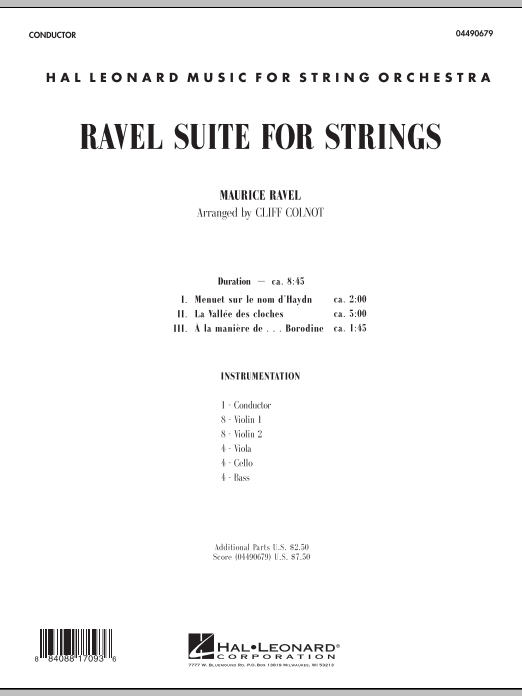

Ravel Suite for Strings: String Orchestra Conductor Score & Parts
By Maurice Ravel / Arranged by Cliff Colnot
Grade: 3-4
Item: 35-PK00096783
$50.00
Pickup currently not available
Buy Extra Parts (Digital PDF Download)
| Product | Price | Quantity |
|---|---|---|
| Ravel Suite for Strings - Full Score | $7.50 | |
| Ravel Suite for Strings - Violin 1 | $7.00 | |
| Ravel Suite for Strings - Violin 2 | $7.00 | |
| Ravel Suite for Strings - Viola | $7.00 | |
| Ravel Suite for Strings - Cello | $7.00 | |
| Ravel Suite for Strings - Bass | $7.00 |
Parts Added to Cart!
Description
Veteran orchestral conductor and writer Cliff Colnot has created a unique set of publications featuring scoring especially for student groups with varying skill levels. With challenging parts for a solo violin and a solo cello, supported by intermediate level parts for the ensemble and simplified bass parts, these superb arrangements are ideal for many student groups. Taken from three piano pieces, songs include: "Menuet sur le nom d'Haydn," "La Vallee des cloches" (from "Miroirs"), and "A la maniere de Borodine (Valse)." Dur: 8:45


Ravel Suite for Strings: String Orchestra Conductor Score & Parts isn't in MakeMusic Cloud just yet...but it could be. Let us know you'd like to see it, and you'll help shape what comes next. In the meantime, start a free trial and dive into thousands of interactive titles your students can play along with today.
Request This Title
Tell us you want it.
Start Your Free Trial
Explore everything that's ready to play right now.
Sample Audio
No sample audio found.
Sample Video
No sample videos found.
Additional Details
Publisher:
Hal Leonard
SKU:
35-PK00096783
More about this title
About the Composer: Maurice Ravel
Maurice Ravel (1875-1937) was a French composer whose orchestral mastery and piano writing defined early 20th-century modernism. His music achieves elegance through meticulous craftsmanship rather than emotional excess; every note serves architectural purpose. Ravel's influence on music education extends beyond his concert works into his thoughtful approach to texture, color, and harmonic innovation, making his music particularly valuable for developing musicians learning to hear and execute sophisticated sonorities.
Why we love this
Colnot's layering of difficulty within a single score solves a persistent rehearsal challenge: how to keep advanced players engaged while supporting developing musicians. The solo violin and cello lines offer genuinely musical solo opportunities, while the simplified bass parts prevent young players from becoming rhythmic anchors instead of ensemble members. Programming Ravel at Grade 3-4 signals serious musical ambition without requiring a uniformly advanced group.
What to expect
Impressionistic refinement in miniature. These pieces shimmer with harmonic color and delicate instrumental touches, evoking parlor elegance and wistful bell tones. The overall effect is sophisticated without pretense, inviting players to listen for the small beauties Ravel hides in accompaniment figures.
Who it's for
Conductors working with mixed-level string orchestras who want to program recognizable, high-value Ravel without requiring uniform technical facility. Student violinists and cellists ready for exposed solo playing within an ensemble context will find genuine musical rewards here.
How to get the most out of it
- Balance the solo lines with the ensemble texture by having advanced violins and cellists rehearse separately first, establishing their part as expressive voice rather than decoration.
- Let the waltz character in 'A la maniere de Borodine' breathe; resist the urge to drive through phrase endings, as Ravel's rubato expects subtle time flexibility.
- Attend closely to the bell-tone imagery in 'La Vallee des cloches' by shaping the middle voices to shimmer around the primary melody rather than blur into it.
- Use the eight-minute total duration to map phrase architecture during rehearsal, marking where energy peaks and settles to prevent the piece from feeling like three separate sketches.
How to use it
This suite works as an opening piece that establishes musical seriousness early in a concert, or as a refined interlude between larger ensemble works. Its moderate length makes it ideal for a spring or end-of-year concert where you want to showcase both ensemble capability and individual artist development within the same program.
Skills your students will build
- Balancing solo melodic lines within ensemble texture
- Executing impressionistic harmonic language and color shifts
- Reading and sustaining longer phrase structures across multiple pieces
- Responding to subtle tempo and dynamic nuance in early 20th-century scoring
- Coordinating with differentiated parts (simplified bass, intermediate ensemble, advanced solos)