
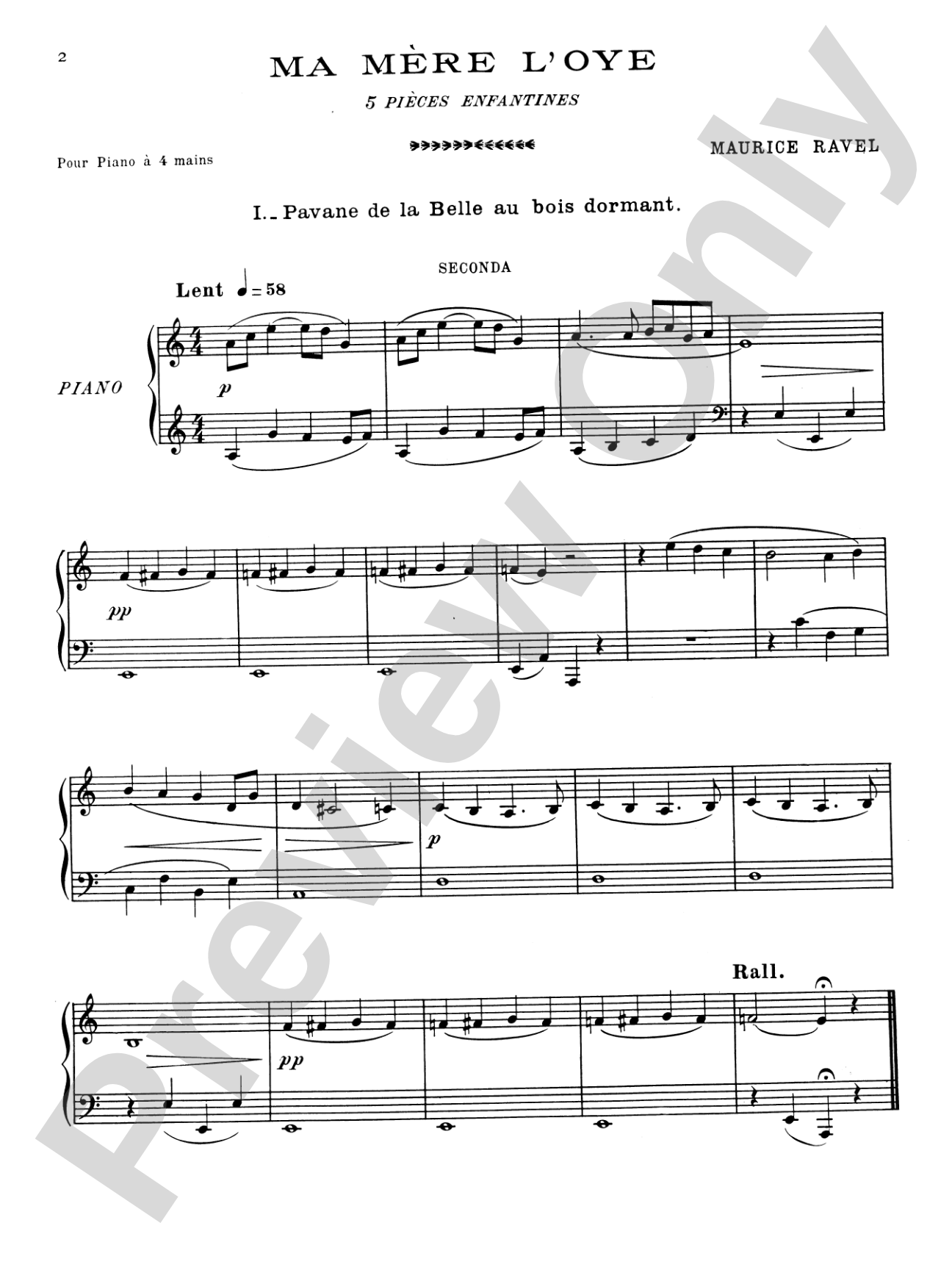
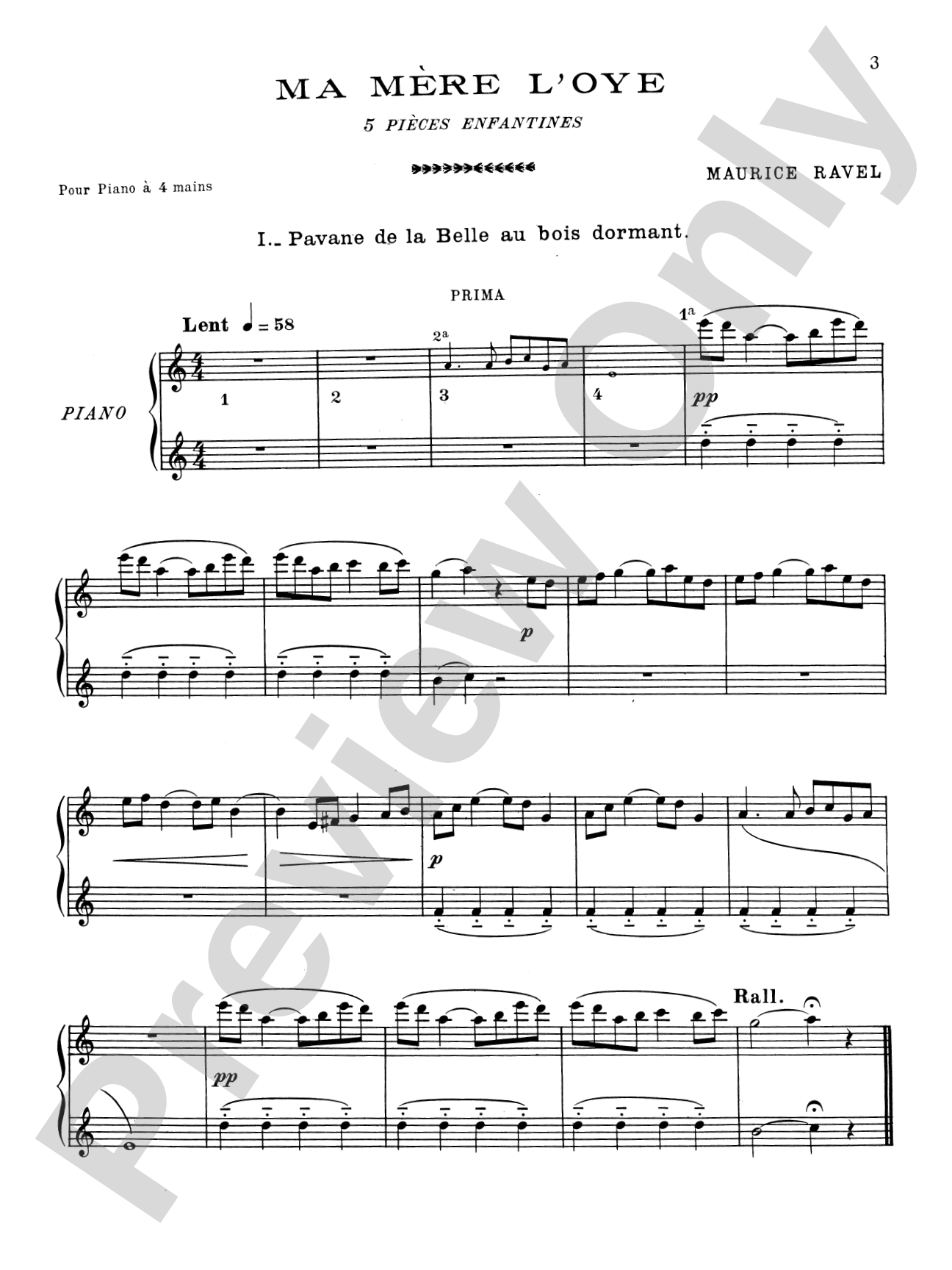

Ravel: Ma Mère l'oye (Mother Goose Suite): Piano Duet (1 Piano, 4 Hands) Book
Cinq Pieces Enfantines
By Maurice Ravel
Item: 00-PK-0003920

$9.99
Pickup currently not available
Buy Extra Parts (Digital PDF Download)
| Product | Price | Quantity |
|---|---|---|
| Ravel: Ma Mère l'oye (Mother Goose Suite) | $0.99 | |
| Ravel: Ma Mère l'oye (Mother Goose Suite) | $0.99 | |
| Ravel: Ma Mère l'oye (Mother Goose Suite) | $0.99 | |
| Ravel: Ma Mère l'oye (Mother Goose Suite) | $0.99 | |
| Ravel: Ma Mère l'oye (Mother Goose Suite) | $0.99 |
Parts Added to Cart!
Related Items
Ma Merè l'oye (Mother Goose Suite): Piano Duet (1 Piano, 4 Hands) Book |
$9.95
|
View |
Description
Titles: I, Pavane de la Belle au bois dormant * II, Petit Poucet * III, Laideronnette, Impératrice des Pagodes * IV, Les entretiens de la Belle et de la Bête * V, Le jardin féerique.


Don't just read it, hear it, play along with it, and watch your students grow with it. In MakeMusic Cloud, Ravel: Ma Mère l'oye (Mother Goose Suite): Piano Duet (1 Piano, 4 Hands) Book comes alive with professional accompaniment, adjustable tempo, and built-in practice tools that turn solo practice into real progress.
Open in the Player
Jump straight in and assign it today.
Start Your Free Trial
Open this title and explore the full library in minutes.
Sample Audio
No sample audio found.
Sample Video
No sample videos found.
Additional Details
Series:
Kalmus Edition
Publisher:
Alfred Music
Page Count:
32
SKU:
00-PK-0003920
More about this title
About the Composer: Maurice Ravel
Maurice Ravel (1875, 1937) was a French composer whose orchestral imagination and harmonic innovation defined early twentieth-century music. His works are marked by crystalline clarity, unexpected coloristic choices, and meticulous attention to instrumental detail. Though often grouped with the Impressionists, Ravel's music demands structural rigor alongside its shimmering surfaces, making him essential study for musicians who want to understand how modern harmony serves storytelling and emotional depth.
Why we love this
This is Ravel at his most imaginative, translating orchestral color into piano textures that reward both players equally. Each of the five movements paints a distinct fairy-tale scene with harmonic sophistication that feels effortless rather than academic. The duet format makes this masterwork accessible to accomplished pianists who want to experience Impressionistic innovation without mastering a full orchestral score.
What to expect
Stepping into Ravel's fairy-tale world feels like watching shadow puppets dance in candlelight. Each movement unfolds as a delicate landscape: a sleeping princess in a shimmering haze, a young boy wandering through bread crumbs, an exotic empress amid fantastical pagodas, a dialogue between beauty and beast steeped in mystery, and finally a magical garden of harp-like cascades and luminous chords. The writing alternates between dreamlike stillness and sudden bursts of color.
Who it's for
Intermediate-advanced pianists seeking duet repertoire that combines technical sophistication with narrative engagement. Teachers working with students ready to explore twentieth-century harmonic language through accessible four-hand repertoire will find this essential. Chamber musicians and recitalists alike treasure this work as a bridge between Romantic tradition and modern expression.
How to get the most out of it
- Balance transparency with resonance by using the sustain pedal strategically; Ravel's harmonies shimmer through careful pedaling rather than constant blur.
- Coordinate rhythmic flexibility between the two players, especially in passages where one hand carries melody while the other maintains harmonic support; the effect depends on mutual listening.
- Shape phrases across hand positions by attending to voice leading in both parts; this suite rewards pianists who think orchestrally about line and register.
- Approach tempo markings as suggestions for character rather than metronomic absolutes; Ravel's Impressionistic writing benefits from subtle tempo flexibility that serves the narrative of each tale.
How to use it
Program this as the centerpiece of a chamber recital exploring early-twentieth-century piano music, where its harmonic language will resonate alongside Debussy or Bartók. It works beautifully in a concert devoted to fairy tale and storytelling, pairing naturally with vocal works on similar themes. Studio teachers often feature this suite in student recitals where one student can showcase multiple movements or where two advanced students collaborate on a single complete performance.
Skills your students will build
- Impressionistic harmonic language and voice leading across block sonorities
- Coordination and independence between two players at a single keyboard
- Pedal technique for creating luminous, blended color without muddiness
- Narrative phrasing and character differentiation across five contrasting movements
- Reading and interpreting twentieth-century notation and performance directions
- Collaborative ensemble listening and dynamic balancing in duet texture