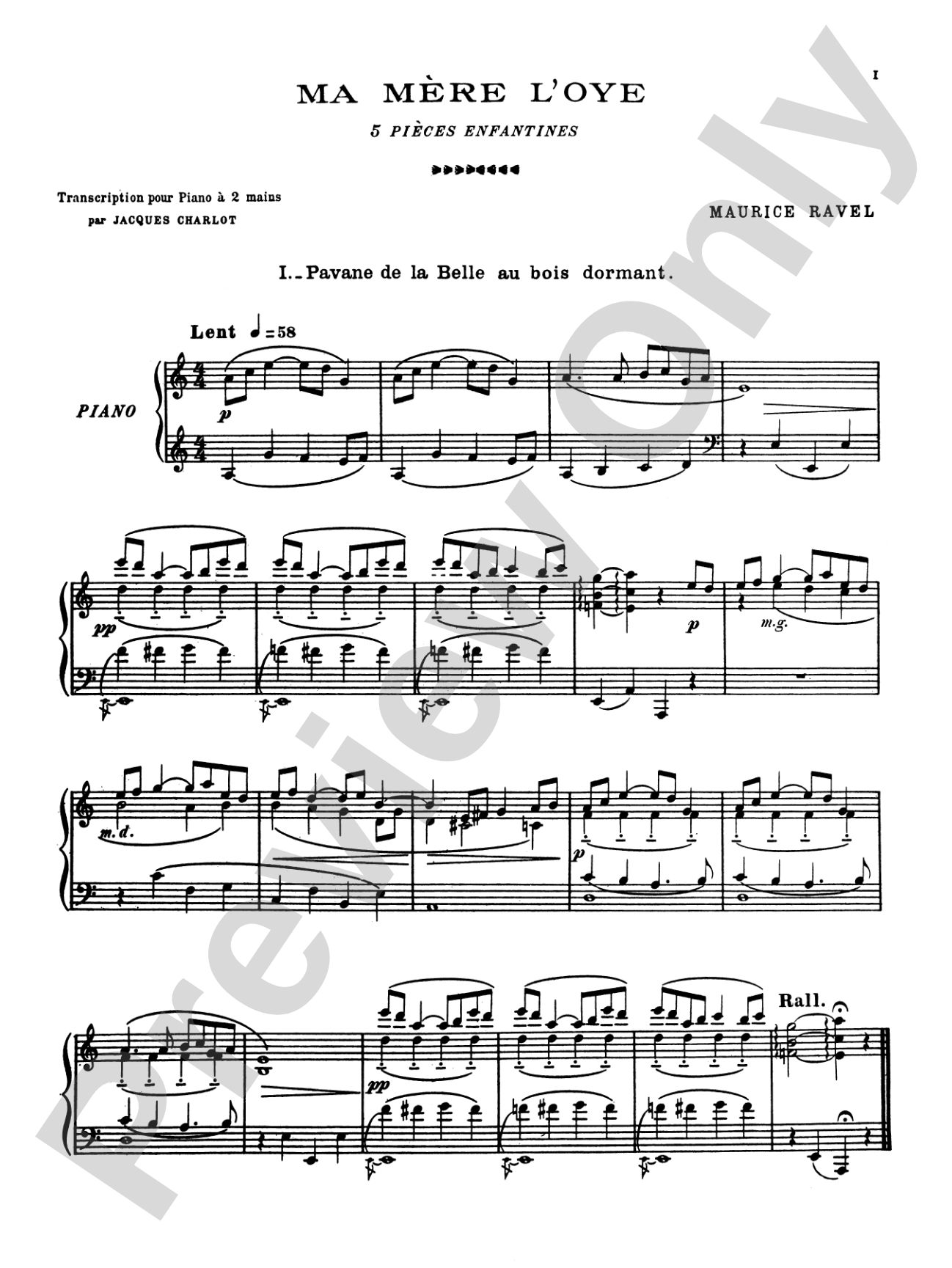
Ravel: Ma Mère l'oye (Mother Goose Suite) Sheet Music Preview

Ravel: Ma Mère l'oye (Mother Goose Suite)

By Maurice Ravel

Level: Intermediate / Advanced

Item: 00-PC-0014115

Digital Download
$0.99
Description

Don't just read it, hear it, play along with it, and watch your students grow with it. In MakeMusic Cloud, Ravel: Ma Mère l'oye (Mother Goose Suite) comes alive with professional accompaniment, adjustable tempo, and built-in practice tools that turn solo practice into real progress.

Sample Audio
No sample audio found.
Sample Video
Additional Details
Series: Kalmus Edition
Publisher: Alfred Music
Page Count: 20
SKU: 00-PC-0014115

More about this title

About the Composer: Maurice Ravel

Maurice Ravel (1875-1937) was a French composer whose fastidious orchestration and harmonic innovation fundamentally reshaped early twentieth-century music. Working alongside Debussy, he developed a distinctly personal impressionistic voice marked by jewel-like clarity, rhythmic precision, and an almost obsessive attention to instrumental color. His transcriptions and arrangements of his own works for various ensembles reveal a composer equally comfortable at the piano as in the orchestra; he understood how to translate orchestral ideas into idiomatic keyboard writing without sacrificing their essence.

Ravel's influence on piano pedagogy remains substantial. His works demand not merely technical facility but interpretive sophistication, rewarding students who engage deeply with texture, pedal control, and the relationship between harmonic structure and surface figuration. For intermediate and advanced pianists, his music offers a natural bridge between Romantic keyboard tradition and modern compositional thinking.

Why we love this

This suite moves beyond being a charming program piece by revealing Ravel's compositional mastery in miniature form. Each movement showcases distinct pianistic and harmonic challenges that demand refined technique without sacrificing the work's inherent charm and poetic imagery. Programming it signals to an audience that you're programming from strength rather than convenience.

What to expect

Ravel's Mother Goose Suite evokes a world of fairy tales and nursery rhyme imagery filtered through a composer's sophisticated harmonic lens. The music shimmers with whole-tone and modal colorations, delicate counterpoint, and rhythmic patterns drawn from French court dances, creating an effect both intimate and distinctly cosmopolitan. Each movement feels like a jeweled cabinet containing movement, character, and unexpected harmonic turns.

Who it's for

Intermediate to advanced pianists ready to engage with twentieth-century impressionistic writing. This suite suits recital programming, studio masterclasses, and advanced piano students preparing a diverse repertoire spanning multiple eras and compositional approaches.

How to get the most out of it

  • Treat the pedal as an orchestral instrument. Ravel wrote these dances with specific harmonic clouds in mind; frequent and precise pedal changes maintain clarity without muddying the impressionistic colors.
  • Practice each movement's rhythmic profile separately before integrating them into the full suite. The shift between dance rhythms (the Minuet, the Rigaudon) and freer textures (the Fairy Tale) requires mental precision that isolated work builds.
  • Listen closely to the balance between melody and accompaniment in the left hand. Many passages ask the accompaniment to establish harmonic atmosphere while the right hand carries a secondary melodic idea; transparency requires deliberate voice leading.

How to use it

Program this suite as a thoughtful anchor for a recital focused on early twentieth-century keyboard music, pairing it with Debussy or Satie to show the breadth of French impressionism. The work's moderate length and varied character make it a strong centerpiece between heavier romantic works and contemporary pieces.

Skills your students will build

  • Impressionistic harmonic language including whole-tone scales and modal inflection
  • Pedal control and its role in sustaining harmonic color without muddying texture
  • Rhythmic precision in French dance forms (minuet, rigaudon, gigue)
  • Voice leading between multiple melodic layers in the left hand
  • Interpretive balance between programmatic imagery and structural clarity

You May Also Like