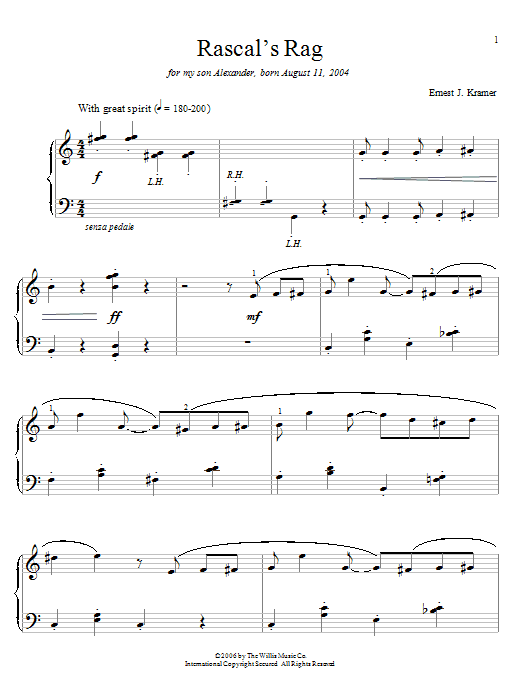
Ernest J. Kramer was a prolific composer and arranger who specialized in accessible educational works for young pianists. His compositions bridged classical technique with contemporary idioms, making them valuable tools for teachers introducing students to diverse musical styles and extended harmonic language.
Why we love this
Kramer's ability to embed real musical sophistication into a three-page package means students tackle genuine compositional ideas rather than oversimplified versions. The jazz elements feel integrated rather than tacked on, giving your pianists a taste of how classical and jazz vocabularies can coexist naturally.
What to expect
Playful and a little unpredictable. The rag feels conversational, full of small surprises and rhythmic winks that keep both player and listener engaged. There's a lightness here, but one that requires real technical control and musical maturity to pull off.
Who it's for
Intermediate pianists ready to explore repertoire that isn't purely traditional classical or purely jazz. This works well for students in their second or third year of study who benefit from exposure to multiple idioms within a single piece.
How to get the most out of it
Establish the character early: decide whether the 'rascal' personality skews playful or mischievous, then commit to that tone in your phrasing and articulation choices.
Map out the harmonic shifts between classical and jazz sections so students understand where the tonal center shifts or gets recontextualized.
Practice the rhythmic figures separately if your student tends to rush; the syncopation will feel more natural after isolated drilling.
Record yourself playing it at tempo, then have students listen actively before they learn it. Hearing the full piece first builds intuition for phrasing and style.
How to use it
Include this in a recital that explores American musical traditions, pairing it with other rags or with contemporary classical works. It also works beautifully as an encore or as the closing piece of a student recital when you want to send the audience out smiling.
Skills your students will build
Reading and executing syncopated rhythms across bar lines
Navigating harmonic movement between diatonic and jazz-inflected chords
Balancing legato and articulated touch within a single piece
Developing phrasing sensitivity across contrasting musical idioms
Building independence between hands in polyrhythmic passages
You May Also Like
Scan to Complete Your Purchase
Use your phone's camera to scan the code below
You'll log in on your phone and the order will be added to your account