
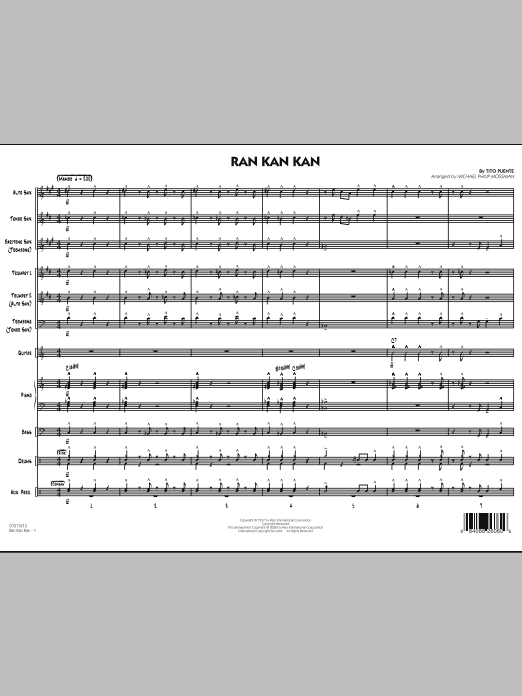

Ran Kan Kan: Jazz Ensemble Conductor Score & Parts
By Tito Puente / Arranged by Michael Philip Mossman
Grade: 4
Item: 35-PK00117809
$45.00
Pickup currently not available
Buy Extra Parts (Digital PDF Download)
| Product | Price | Quantity |
|---|---|---|
| Ran Kan Kan - Conductor Score (Full Score) | $7.50 | |
| Ran Kan Kan - Alto Sax | $6.00 | |
| Ran Kan Kan - Tenor Sax | $6.00 | |
| Ran Kan Kan - Baritone Sax | $6.00 | |
| Ran Kan Kan - Trumpet 1 | $6.00 | |
| Ran Kan Kan - Trumpet 2 | $6.00 | |
| Ran Kan Kan - Trombone | $6.00 | |
| Ran Kan Kan - Guitar | $6.00 | |
| Ran Kan Kan - Piano | $6.00 | |
| Ran Kan Kan - Bass | $6.00 | |
| Ran Kan Kan - Drums | $6.00 | |
| Ran Kan Kan - Aux Percussion | $6.00 | |
| Ran Kan Kan - Alternate Alto Sax | $6.00 | |
| Ran Kan Kan - Alternate Tenor Sax | $6.00 | |
| Ran Kan Kan - Alternate Trombone | $6.00 |
Parts Added to Cart!
Description
Michael has reworked his popular big band version of this Latin classic to work in this format for little big band. Great groove and tight ensemble writing.


Ran Kan Kan: Jazz Ensemble Conductor Score & Parts isn't in MakeMusic Cloud just yet...but it could be. Let us know you'd like to see it, and you'll help shape what comes next. In the meantime, start a free trial and dive into thousands of interactive titles your students can play along with today.
Request This Title
Tell us you want it.
Start Your Free Trial
Explore everything that's ready to play right now.
Sample Audio
No sample audio found.
Sample Video
No sample videos found.
Additional Details
Publisher:
Hal Leonard
SKU:
35-PK00117809
More about this title
About the Composer: Tito Puente
Tito Puerte, known as the "King of the Timbales," shaped the sound of Latin jazz and Afro-Cuban music throughout the second half of the twentieth century. His compositions and arrangements bridged mambo, cha-cha-cha, and salsa with jazz harmony and orchestration, creating a distinct voice that influenced generations of bandleaders and composers. His work remains essential repertoire for any ensemble serious about Latin jazz idioms.
Puente's legacy extends beyond composition into pedagogy. His rhythmic innovations and ensemble writing demonstrate how to layer percussion, horns, and rhythm section into cohesive grooves, making his music invaluable for teaching both technique and cultural understanding.
Why we love this
Michael Philip Mossman has distilled everything that makes Ran Kan Kan irresistible into a little big band format without sacrificing the bounce or the sophistication of the original. The arrangement respects Puente's signature clave-driven architecture while giving younger ensembles accessible parts that still demand precision and ensemble awareness. You get a piece with real Latin credentials that your students will feel excited to play.
What to expect
Ran Kan Kan bounces with infectious energy and swings hard. The rhythm section propels you forward while the horns paint bright, playful lines overhead; it feels both celebratory and tight, like walking into a club where the band knows exactly what it's doing. This is music that makes people move.
Who it's for
Grade 4 jazz ensembles ready to step into authentic Latin jazz vocabulary without oversimplifying the genre. This works equally well for high school big bands wanting to build their Latin repertoire or adult community ensembles seeking accessible but genuine material. Directors looking for a piece that teaches clave-based composition and expands students' musical palette will find a solid choice here.
How to get the most out of it
- Lock the clave rhythm into your rhythm section first. Have piano, bass, and percussion internalize the underlying clave pattern before rehearsing with horns; the entire groove hinges on this foundation.
- Shape the brass entrances with deliberate phrasing. These horn lines sit on top of the groove, so resist the urge to rush; let the laid-back pocket carry the time.
- Balance percussion texture carefully. Timbales and cowbell define Puente's sound, so give the percussion section space to articulate without overpowering the ensemble.
- Encourage soloists to embrace the rhythmic asymmetry. Latin jazz solos work best when players sit slightly behind the beat, giving the groove room to breathe.
How to use it
Lead with this as an opener or closer on a jazz concert; its groove and accessibility make it a crowd pleaser that also establishes your ensemble's ensemble chops. Pair it with other Latin jazz standards to build a thematic set, or use it as a bridge between bebop and contemporary jazz in a teaching narrative about stylistic evolution. Its energy makes it particularly effective late in a program when audience attention needs sharpening.
Skills your students will build
- Reading and playing within clave-based rhythmic frameworks
- Ensemble precision in syncopated, layered horn lines
- Swing phrasing and rhythmic placement in a Latin context
- Percussion independence and texture awareness
- Chord-tone soloing over Latin jazz progressions