
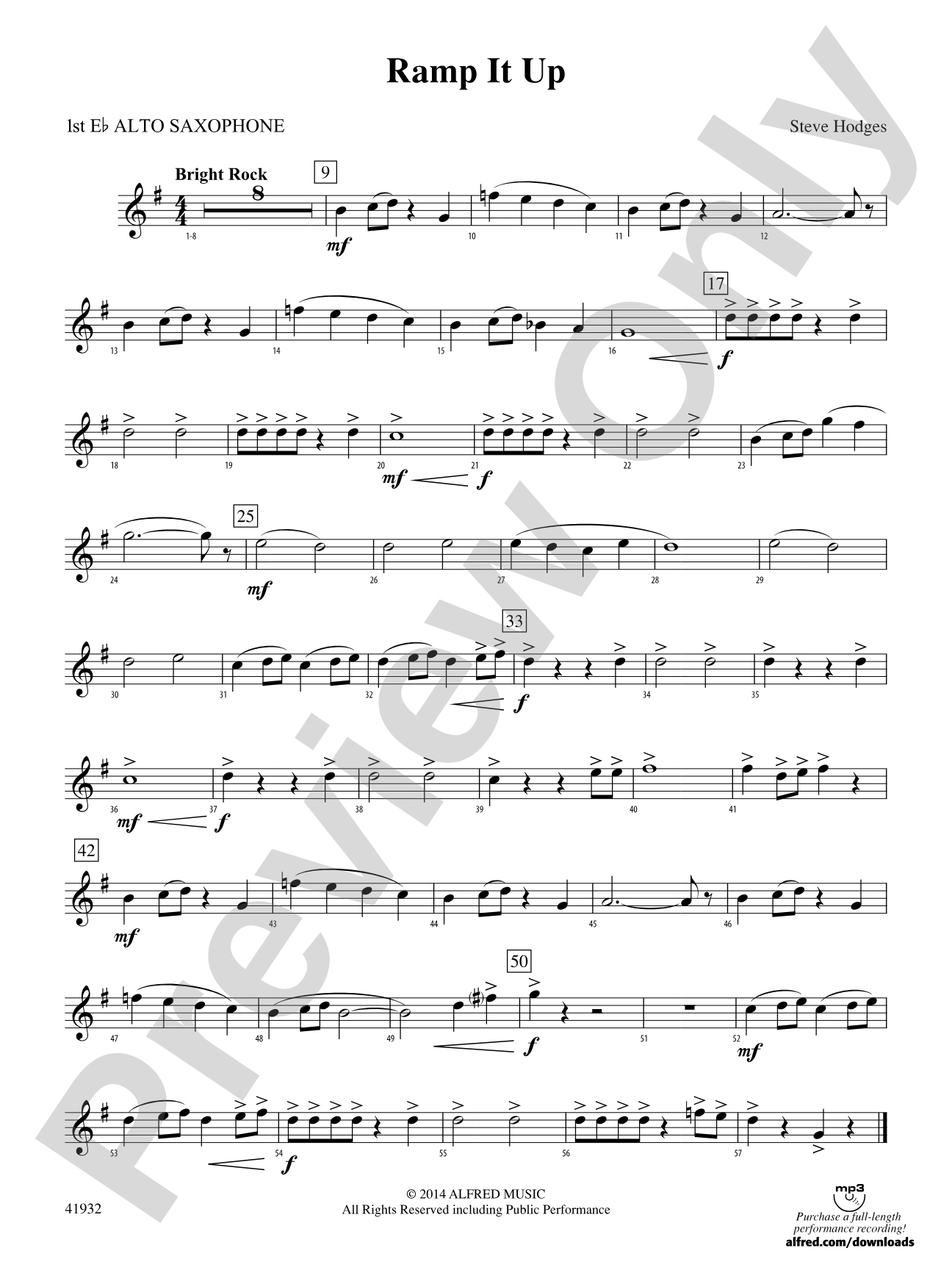

Ramp It Up: E-flat Alto Saxophone
By Steve Hodges
Grade: 1 (Very Easy)
Item: 00-PC-0016414_AX1
$3.00
Pickup currently not available
Description
Just as the local skateboard park showcases the individual moves and tricks of the skateboarders, this exciting rock piece showcases each section of the young band. With a powerful percussion section and a strong bass line, a solid foundation will allow the rest of the band to show their moves on the melody and accompaniment parts. (1:45)


Don't just read it, hear it, play along with it, and watch your students grow with it. In MakeMusic Cloud, Ramp It Up: E-flat Alto Saxophone comes alive with professional accompaniment, adjustable tempo, and built-in practice tools that turn solo practice into real progress.
Open in the Player
Jump straight in and assign it today.
Start Your Free Trial
Open this title and explore the full library in minutes.
Sample Audio
1
Audio File
--:--
0:00
0:00
Sample Video
No sample videos found.
Additional Details
Series:
Alfred Debut Series
Publisher:
Alfred Music
Page Count:
118
SKU:
00-PC-0016414_AX1
More about this title
About the Composer: Steve Hodges

Steve Hodges holds degrees from Western Oregon University (B.S.) and Central Washington University (M.M.Ed.). His four-decade career in public school music education spanned all levels of band, choir, and chamber ensemble work. Since 1986, he has composed over 120 concert band pieces published by Alfred Music, along with choral arrangements released through Staff Music and Shawnee Press.
Hodges's works have appeared at festivals and state conventions across multiple countries and have been performed by honor bands and schools throughout North America. His music has been featured on TBS and ESPN broadcasts, and he has composed commissioned pieces for ensembles in Virginia, Iowa, Winnipeg, British Columbia, Oregon, Washington, and North Carolina. An ASCAP member, Hodges resides in The Dalles, Oregon, where he remains active in community music alongside his family. He particularly enjoys hearing his grandchildren perform his compositions in their school bands.
Why we love this
Hodges designs this piece around the strengths of beginning musicians, building the arrangement so each section has something meaningful to play. The rock idiom naturally engages young players, and the scaffolded texture means your less experienced students won't feel buried while your stronger ones get real musical material to sink their teeth into.
What to expect
Energy and motion drive this rock piece from the opening. The percussion and bass lock into a groove that makes the whole ensemble feel like they're moving together, while the melody sits on top with accessibility and character. By the end, students will feel like they actually played a real rock song, not a dumbed-down exercise.
Who it's for
Beginning band students who need a confidence boost. Grade 1 difficulty means even players in their first year can participate fully without simplified or passive parts. Directors programming first or second concerts will find this piece gives every musician a genuine contribution to a complete, satisfying arrangement.
How to get the most out of it
- Lock the rhythm section first. Have your percussion and low brass work through the bass line and groove separately until they're absolutely solid; that foundation determines whether the melody soars or sags.
- Keep the tempo steady and confident. This style lives in a pocket, not a race. A metronome or drum machine in rehearsal will help your band feel the consistency that makes rock music actually rock.
- Balance the melody against accompaniment by ear during full ensemble run-throughs. Young musicians often play their parts equally loudly, so listen carefully and adjust section volumes so the intended voice comes forward naturally.
How to use it
This works perfectly as a high-energy concert opener or closer, especially on a program where you want to build or maintain audience engagement. It pairs naturally alongside other contemporary pieces and provides variety if you're programming classical or jazz selections. The 1:45 length also makes it ideal filler for a concert that needs one more piece without eating up rehearsal time.
Skills your students will build
- Playing within a groove and maintaining steady pulse in rock idiom
- Balancing melody against harmonic accompaniment in mixed dynamics
- Reading and executing rhythmic patterns across full ensemble with different parts
- Responding to percussion and bass section leadership and timing cues