
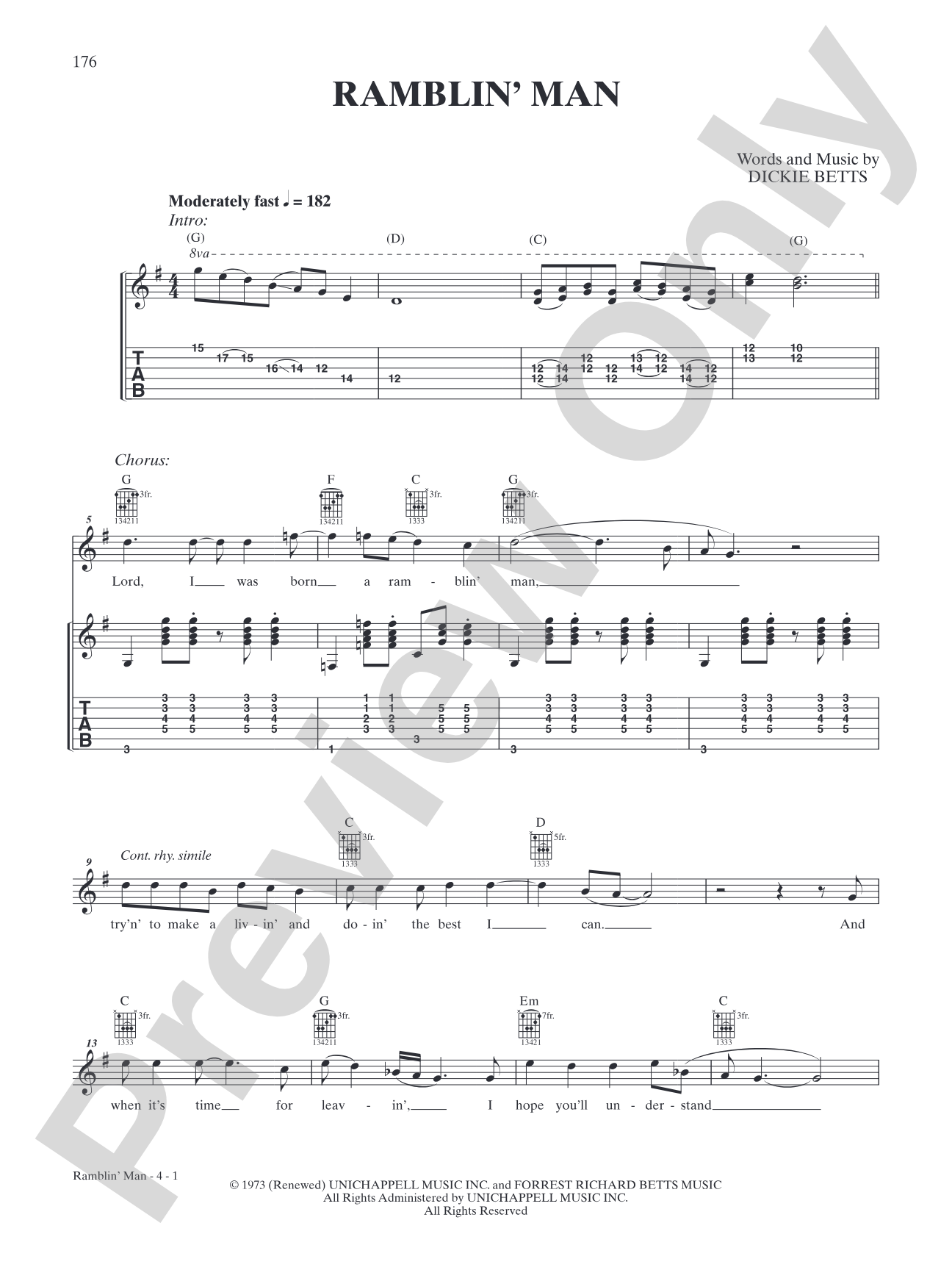

Ramblin' Man: Interm./Easy Guitar TAB
56 Essential Songs of the Era
Item: 00-PS-0011122
$4.99
One moment…
Description
As the baby boom generation changed the world, they also changed and evolved. This book is the soundtrack of that change. This book contains easy guitar TAB arrangements of 56 songs by the greatest artists of the '70s and '80s, including Pink Floyd, The Doobie Brothers, The Rolling Stones, Fleetwood Mac, Jimmy Buffett, Eric Clapton, James Taylor, Led Zeppelin, Joe Cocker, Journey, Santana, The Sex Pistols, The Eagles, Van Morrison, Loggins & Messina, John Denver, Gordon Lightfoot, The Allman Brothers Band, Bad Company, The Bee Gees, Bruce Springsteen, and many more!


Ramblin' Man: Interm./Easy Guitar TAB isn't in MakeMusic Cloud just yet...but it could be. Let us know you'd like to see it, and you'll help shape what comes next. In the meantime, start a free trial and dive into thousands of interactive titles your students can play along with today.
Request This Title
Tell us you want it.
Start Your Free Trial
Explore everything that's ready to play right now.
Sample Audio
No sample audio found.
Sample Video
No sample videos found.
Additional Details
Series:
The Boomer's Book
Publisher:
Alfred Music
Page Count:
260
SKU:
00-PS-0011122
More about this title
About the Composer: Dickie Betts
Dickie Betts co-founded The Allman Brothers Band and became one of rock's most distinctive slide guitarists. His signature tone and compositional voice shaped Southern rock's identity, earning him recognition as a guitarist who could balance technical fluency with raw emotional expression. Betts' work spans five decades and continues to influence how musicians approach guitar arrangement and improvisation.
Why we love this
This collection captures 56 essential songs across 260 pages of intermediate-friendly TAB, giving students a coherent narrative arc through rock's most transformative decades. The mix of iconic riffs, fingerstyle passages, and rhythmic patterns means players encounter genuine variety in technique rather than repetitive templates. Programming these songs connects students to music they've actually heard, building motivation through cultural relevance.
What to expect
This is the sound of a generation's musical awakening captured in 56 snapshots. You move through Southern rock grooves, folk-inflected fingerstyle, arena rock power, and blues-rooted soloing, feeling how artists drew from one another and evolved together. The TAB reveals the actual shapes and positions that created these unforgettable sounds.
Who it's for
Intermediate and early-advanced guitarists building a working repertoire of recognizable material. Solo performers and students in private lessons will find immediate performance-ready pieces. Classroom guitar programs can use individual songs as shared repertoire for group play.
How to get the most out of it
- Balance fingerstyle and pick approaches across the folio. Some arrangements favor fingerpicking patterns while others demand percussive rhythm work; switching between techniques keeps your hands fresh and builds versatility.
- Pay attention to the TAB's rhythmic notation, not just fret numbers. Many '70s and '80s songs rely on subtle timing and swing feel that standard notation captures more accurately than tabs alone.
- Reference recordings while learning. Tone, dynamics, and phrasing differ wildly across these artists; hearing how the original sits in a mix clarifies what matters in your interpretation.
- Work through the book thematically rather than sequentially. Grouping songs by similar tuning, rhythm style, or era lets you develop mastery in clusters rather than jumping between vastly different techniques.
How to use it
Use individual songs as performance pieces for recitals, rotating through different eras and styles to show range. Build unit lessons around specific songs or artists, pairing TAB study with listening analysis and historical context. A group class can tackle ensemble arrangements of familiar tunes while students solidify their individual parts from this book.
Skills your students will build
- Reading guitar TAB fluently across multiple tunings and playing positions
- Fingerstyle patterns and hybrid pick techniques common to 1970s-1980s rock
- Recognizing and replicating rhythm feels including shuffle, swing, and syncopation
- Translating recorded tone and phrasing into playing choices
- Navigating position shifts and chord voicings across the fretboard
- Building accuracy in iconic riffs and signature passages