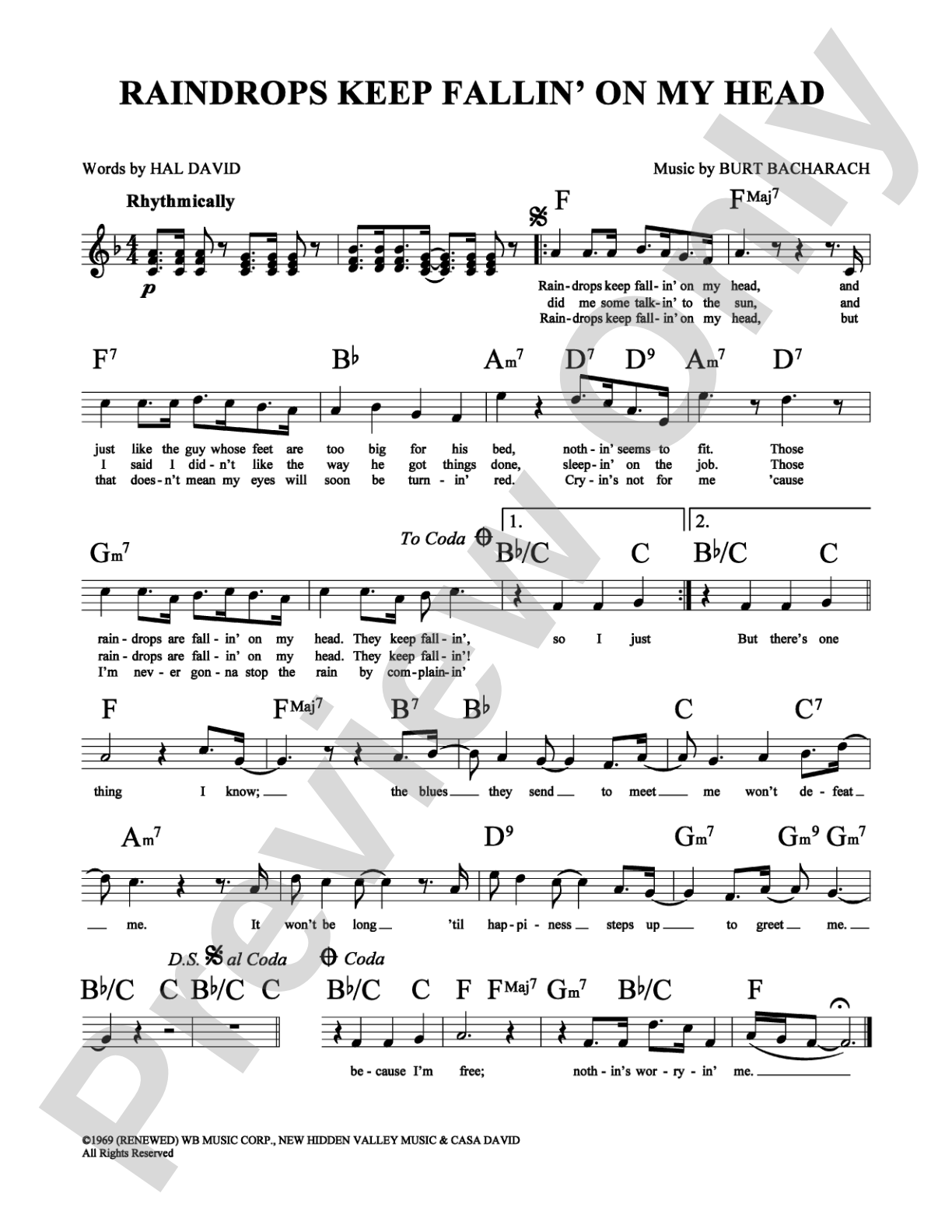
Raindrops Keep Fallin' On My Head: Lead Sheet Digital Sheet Music

Raindrops Keep Fallin' On My Head: Lead Sheet Digital Sheet Music

Burt Bacharach, B. J. Thomas

Item: 00-PS-0003555

Digital Download
$1.99
Description

Raindrops Keep Fallin' On My Head: Lead Sheet Digital Sheet Music isn't in MakeMusic Cloud just yet...but it could be. Let us know you'd like to see it, and you'll help shape what comes next. In the meantime, start a free trial and dive into thousands of interactive titles your students can play along with today.

Sample Audio
No sample audio found.
Sample Video
Additional Details
SKU: 00-PS-0003555

More about this title

About the Artist: B. J. Thomas

B. J. Thomas became a household name with his 1969 recording of "Raindrops Keep Fallin' On My Head," the Oscar-winning theme from Butch Cassidy and the Sundance Kid. His warm, conversational vocal delivery and ability to navigate both pop and country material made him a distinctive voice across multiple genres throughout the 1960s and 1970s.

Thomas's interpretive approach emphasizes accessibility and emotional directness. His work remains a touchstone for musicians learning how to shape a melody with restraint and sincerity rather than technical display.

Why we love this

This lead sheet captures one of the most instantly recognizable melodies in American popular music, and its straightforward harmonic language makes it ideal for musicians working on vocal interpretation, chord substitution, and improvisation. The song's unhurried pace gives players and singers room to shape the line with intention rather than rushing through changes.

What to expect

Unhurried and contemplative, with a gentle humor underneath. The melody moves in small intervals and settles comfortably within a narrow range, creating an impression of intimacy and understated optimism even when life feels complicated.

Who it's for

Piano accompanists and singers preparing this standard, as well as jazz and pop musicians studying melodic phrasing and harmonic interpretation. Music students learning to read and work from lead sheets will find the familiar tune helpful for developing fluency with chord symbols and arrangement thinking.

How to get the most out of it

  • Treat the melody as a conversation rather than a declaration; the lyrical phrasing depends on breathing naturally between phrases and letting silence carry weight.
  • Experiment with chord extensions and passing chords over the basic progression to understand how the tune can support different harmonic colors without losing its essential character.
  • Notice where the melody sits relative to the harmony; the lead sheet format makes it clear how certain notes land on strong versus weak beats, which informs dynamic shaping.

How to use it

Program this as a palate cleanser between more demanding pieces, or as a vehicle for exploring how a simple melody becomes unforgettable through sincerity of delivery. It works well in a variety show or cabaret context where variety and accessibility matter as much as virtuosity.

Skills your students will build

  • Reading and interpreting lead sheet notation with chord symbols
  • Shaping a simple melody through rhythmic phrasing and lyrical breath placement
  • Understanding how a melody functions across a basic harmonic progression
  • Exploring chord substitution and harmonic reharmonization

You May Also Like