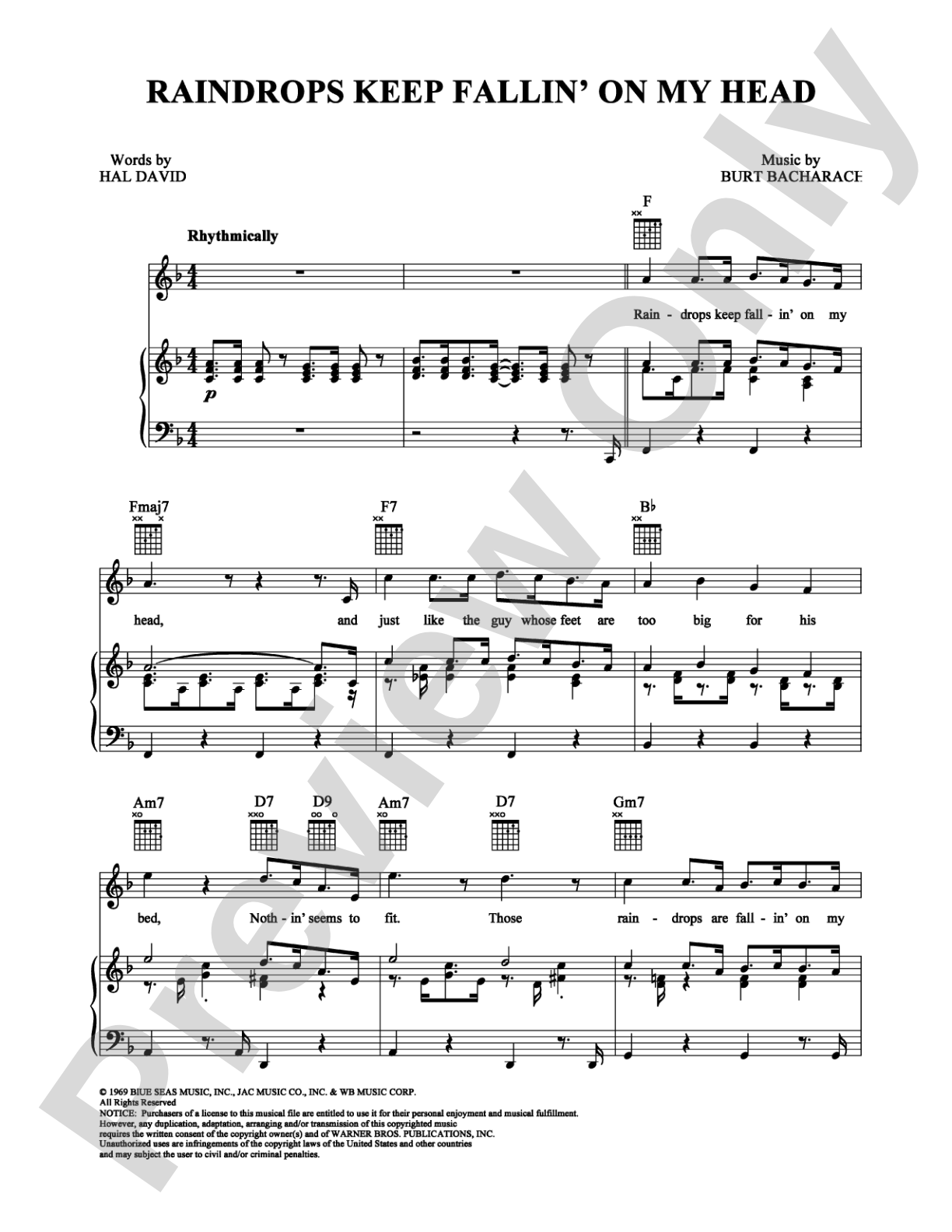
Raindrops Keep Fallin' On My Head: Piano/Vocal/Chords Digital Sheet Music

Raindrops Keep Fallin' On My Head: Piano/Vocal/Chords Digital Sheet Music

Burt Bacharach, B. J. Thomas

Item: 00-PS-0002479

Digital Download
$3.99
Description

Raindrops Keep Fallin' On My Head: Piano/Vocal/Chords Digital Sheet Music isn't in MakeMusic Cloud just yet...but it could be. Let us know you'd like to see it, and you'll help shape what comes next. In the meantime, start a free trial and dive into thousands of interactive titles your students can play along with today.

Sample Audio
No sample audio found.
Sample Video
Additional Details
SKU: 00-PS-0002479

More about this title

About the Artist: B. J. Thomas

B. J. Thomas rose to prominence in the 1960s and 1970s as a versatile performer equally at home in country, pop, and soul idioms. His warm baritone and emotionally direct delivery made him a natural interpreter of contemporary standards and film songs. "Raindrops Keep Fallin' on My Head" became his signature recording and one of the most enduring popular songs of the era.

Thomas's recording career spanned multiple genres and contexts, from country radio to mainstream pop charts to film soundtracks. His interpretive approach valued clarity of lyric and emotional authenticity over technical display, making his arrangements accessible templates for singers working in popular and easy listening styles.

Why we love this

The piano/vocal arrangement captures the song's essential warmth without overcomplicating it. Singers find that the vocal line sits naturally in a comfortable range, and the chord changes offer enough harmonic interest to keep accompanists engaged without demanding advanced voicing skills.

What to expect

The song settles into a minor-key melancholy that refuses to become self-pitying. Despite the rainy subject matter, there is acceptance and even gentle humor in the lyric. The piano accompaniment provides warmth and grounding while the vocal melody floats above it with unforced sincerity.

Who it's for

This arrangement serves singers in recital settings, music theater ensembles exploring popular standards, and pianists developing their collaborative skills. It works equally well for voice students building confidence with accessible yet genuine popular material and for adult learners returning to singing after years away.

How to get the most out of it

  • Maintain a conversational, unstressed tone throughout. The lyric works best when sung as if confiding in someone, not performing for an audience.
  • Shape phrases around the natural speech rhythm of the text rather than forcing strict metrical divisions. The song breathes in irregular places.
  • Use the chord symbols to explore gentle reharmonization with the pianist; simple passing chords and substitutions suit the song's intimate character.
  • Keep the tempo steady but unhurried. Rushing undermines the reflective mood that makes the lyric land emotionally.

How to use it

Pair this with other American standards from the 1960s and 1970s to create a program exploring how popular song intersects with art song traditions. It also works beautifully as a palate-cleanser between more dramatic classical repertoire or as a standalone encore. The intimate scale makes it ideal for small recitals, coffee house performances, or informal studio recital series.

Skills your students will build

  • Maintaining consistent breath support across a legit, unstressed vocal line
  • Coordinate piano and voice in a lead sheet arrangement
  • Interpreting lyric-driven phrasing over strict meter
  • Vocal stylization appropriate to popular song idiom

You May Also Like