
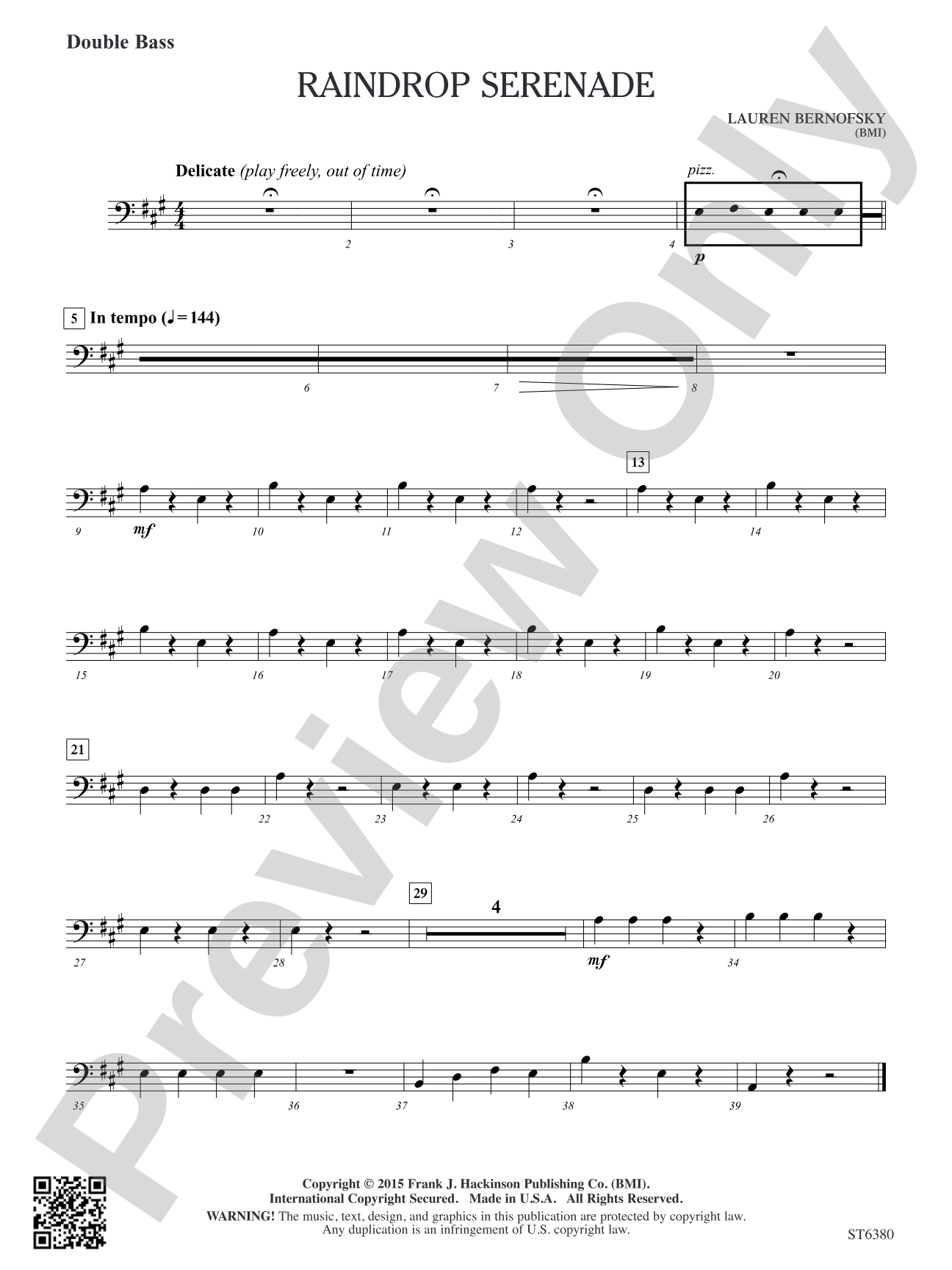

Raindrop Serenade: Double Bass
By Lauren Bernofsky
Grade: 1
Item: 98-PC-DST6380_SB
$7.00
Pickup currently not available
Description
This all-pizzicato work uses easy aleatoric devices to create the gentle sound of rainfall. Out of the rain emerges a simple accompaniment line that is soon joined by an endearing melody. A wonderful way to focus on good left-hand position while making great music!


Don't just read it, hear it, play along with it, and watch your students grow with it. In MakeMusic Cloud, Raindrop Serenade: Double Bass comes alive with professional accompaniment, adjustable tempo, and built-in practice tools that turn solo practice into real progress.
Open in the Player
Jump straight in and assign it today.
Start Your Free Trial
Open this title and explore the full library in minutes.
Sample Audio
1
Audio File
--:--
0:00
0:00
Sample Video
No sample videos found.
Additional Details
Series:
FJH Beginning Strings
Publisher:
The FJH Music Company, Inc.
SKU:
98-PC-DST6380_SB
More about this title
About the Composer: Lauren Bernofsky

Lauren Bernofsky has established herself as a prolific composer whose work spans solo pieces, chamber music, choral works, orchestral compositions, and large-scale projects for film, musical theatre, opera, and ballet. Her music has earned recognition worldwide, including a National Flute Association Newly Published Music Competition win for her Sonatine and a Boston Metro Opera award for her opera Mooch the Magnificent. She has received support from The National Foundation for the Advancement of the Arts, The American Music Center, and The American Composers Forum, and her compositions have been commissioned by ensembles ranging from regional orchestras to chamber groups and specialized performance organizations.
Bernofsky holds degrees from The Hartt School (Bachelor's in violin and composition), the New England Conservatory (Master's in composition), and Boston University (Doctorate of Musical Arts in composition). She has taught at the Peabody Institute and Interlochen Center for the Arts. Her work is marked by what critics describe as a distinctive balance between emotional and intellectual content, combining technical sophistication with lyrical expression. Her string quartet Anacostia Journal was featured on PBS's NOW with Bill Moyers, and her choral work Prayer of Shantideva, winner of the Dalai Lama Composition Contest, was premiered at a prayer service honoring the Dalai Lama of Tibet.
Why we love this
Bernofsky captures something genuinely difficult to achieve at Grade 1: a piece that feels like real music-making rather than a technical exercise. The aleatoric pizzicato creates an authentic sound world that engages students immediately, and the gradual emergence of melody from texture teaches orchestration thinking without requiring advanced technique. It's rewarding to teach because the left-hand focus builds fundamentals that transfer directly to all future string playing.
What to expect
The pizzicato passages shimmer like rain on a surface, creating movement and lightness before a simple, tender accompaniment emerges from beneath. When the melody joins, it arrives as naturally as a pause in the rainfall, gentle and unhurried, making the listener feel as though they've discovered something rather than been told a story.
Who it's for
Grade 1 string orchestras that are ready to move beyond note-reading into ensemble texture and tone quality. This piece works especially well for orchestras where students are developing consistent left-hand position and intonation in a musical context rather than through scales alone.
How to get the most out of it
- Establish a steady pulse for the pizzicato sections before rehearsing, since the aleatoric elements depend on a solid rhythmic foundation from the conductor. Students will gain confidence when they understand their starting and ending points within the larger texture.
- Encourage consistent left-hand position throughout the pizzicato passages; this is where the pedagogical power of the piece lives. Check for curved fingers and proper thumb placement repeatedly, as repetition in a musical context makes the correction stick better than isolated exercises.
- Balance the accompaniment line carefully when it enters, ensuring it supports rather than overwhelms the eventual melody. The beauty of the piece relies on this gentle layering, so dynamics must be sculpted from the beginning.
How to use it
Program this as an opener or interlude on a concert where it can breathe without competition from heavier repertoire; its understated beauty deserves an attentive audience. It also works beautifully as a contest or festival selection because it demonstrates musicianship and ensemble awareness at an accessible level, showing growth in areas that matter far beyond the Grade 1 repertoire.
Skills your students will build
- Consistent left-hand position and posture under musical pressure
- Maintaining steady rhythm while executing aleatoric pizzicato textures
- Balancing and blending ensemble sound across different orchestral layers
- Listening to and responding to other sections while reading notation
- Creating dynamic variety and shaping phrase contour in simple melodies