Rainbows: 2nd B-flat Clarinet Sheet Music Preview

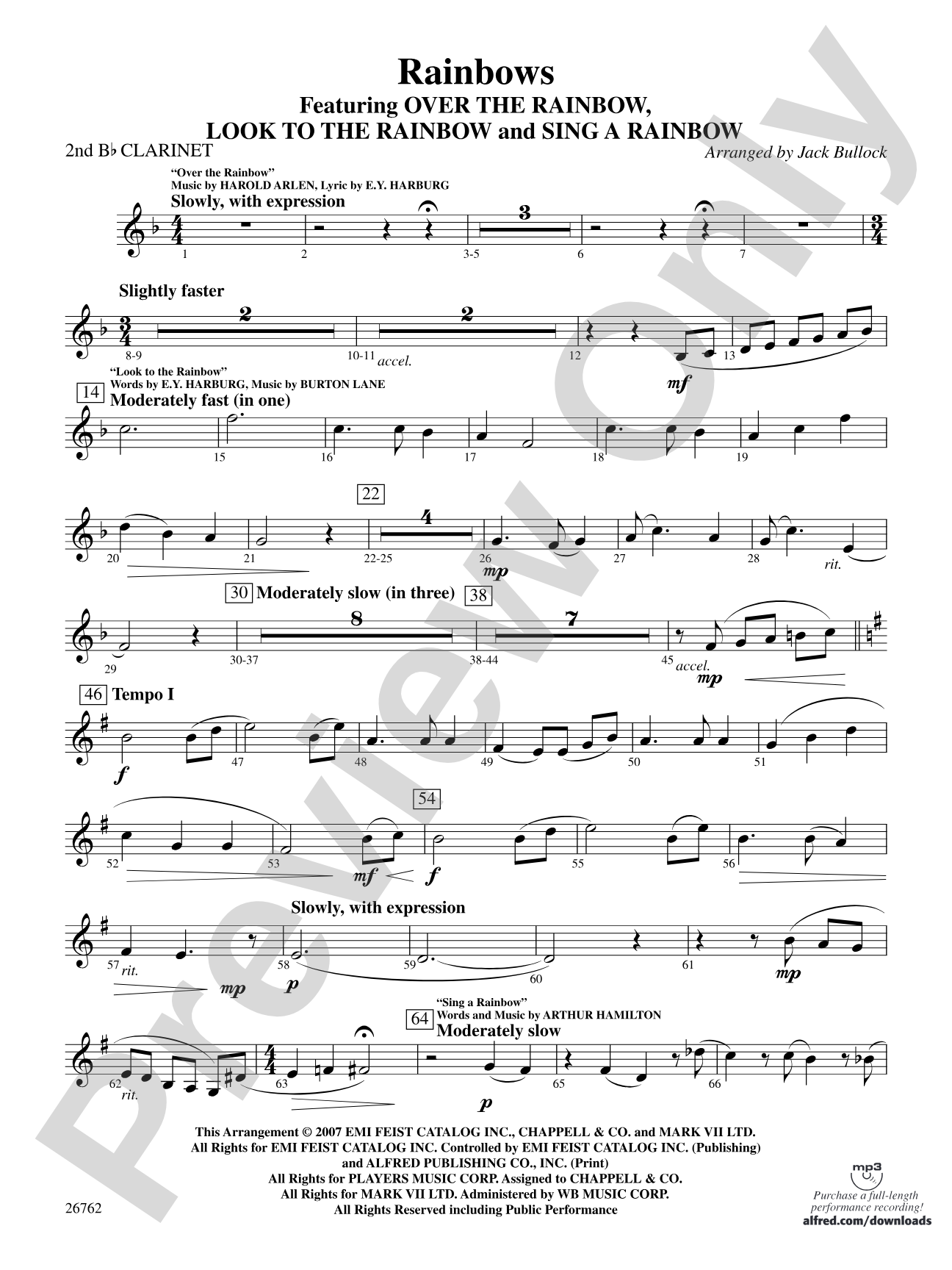
Rainbows: 2nd B-flat Clarinet

Featuring: Over the Rainbow / Look to the Rainbow / Sing a Rainbow

Arr. Jack Bullock

Grade: 3 (Medium Easy)

Item: 00-PC-0015685_C2

Digital Download
$3.00
Description
Rainbows are colorful sights, and evoke peaceful emotions in most of us. Jack Bullock has chosen three charming melodies that capture the essence of that peaceful experience. Including four solos, your ensemble will really enjoy this medley. You've found the pot of gold with this delightful arrangement. Contains: "Over the Rainbow" * "Look to the Rainbow" * "Sing a Rainbow."

Don't just read it, hear it, play along with it, and watch your students grow with it. In MakeMusic Cloud, Rainbows: 2nd B-flat Clarinet comes alive with professional accompaniment, adjustable tempo, and built-in practice tools that turn solo practice into real progress.

Sample Audio
0:00
0:00
Sample Video
Additional Details
Series: Pop Concert Band
Publisher: Alfred Music
Page Count: 128
SKU: 00-PC-0015685_C2

More about this title

About the Arranger: Jack Bullock

Jack Bullock

Jack Bullock combines deep training in music education with a prolific career as a composer and arranger. He earned undergraduate, graduate, and doctoral degrees in music education, studied trumpet with several prominent instructors, and performed with the Miami Philharmonic Orchestra and Miami Opera Company, as well as with regional and touring ensembles across the country.

Bullock has taught instrumental music in public school settings for 20 years and served as an assistant band director at Ithaca College's School of Music, where he also chaired the Music Education Department. His output spans over 600 published works for concert band, orchestra, jazz ensemble, and marching band. He co-authored the Belwin 21st Century Band Method and contributed arrangements to Music Expressions, Alfred Music's comprehensive school music curriculum. His work has been recognized in national directories, and he has conducted clinics across North America and internationally since joining ASCAP in 1980.

Why we love this

Bullock's arrangement captures something genuinely uplifting without relying on bombast or unnecessary complexity. The inclusion of four solos creates natural performance opportunities across your section and keeps players engaged throughout the medley, making it rewarding for both strong players seeking spotlight moments and ensemble members building confidence.

What to expect

The medley evokes the quiet joy and wonder of witnessing a rainbow, with each melody contributing its own character within an overall atmosphere of calm reflection. The solos add moments of individual voice and expression, much like light rays breaking through clouds.

Who it's for

Concert bands working at the Grade 3 level will find this arrangement accessible and satisfying. It works equally well for student ensembles learning to balance solos with accompaniment and for community or adult bands seeking repertoire that connects with general audiences.

How to get the most out of it

  • Balance the solos within the fuller ensemble sections so each featured player projects clearly without the accompaniment drowning them out.
  • Emphasize the peaceful quality in transitions between melodies; resist the urge to accelerate or rush through quieter passages.
  • Use dynamic contrasts to shape each of the three melodies distinctly, reinforcing the medley structure so the piece doesn't blur into one continuous line.

How to use it

This piece works beautifully as a gentle opener or a feel-good closer for spring or early summer concerts. It also pairs well with other accessible Grade 3 selections in a program designed to highlight younger or developing ensembles, or as a contrast to heavier concert band standards.

Skills your students will build

  • Balancing solo passages against ensemble accompaniment
  • Shaping lyrical phrases with appropriate dynamic control
  • Transitioning smoothly between multiple melodies in medley form
  • Reading and executing parts in a mixed-difficulty ensemble (featuring sections with varying demands)

You May Also Like