
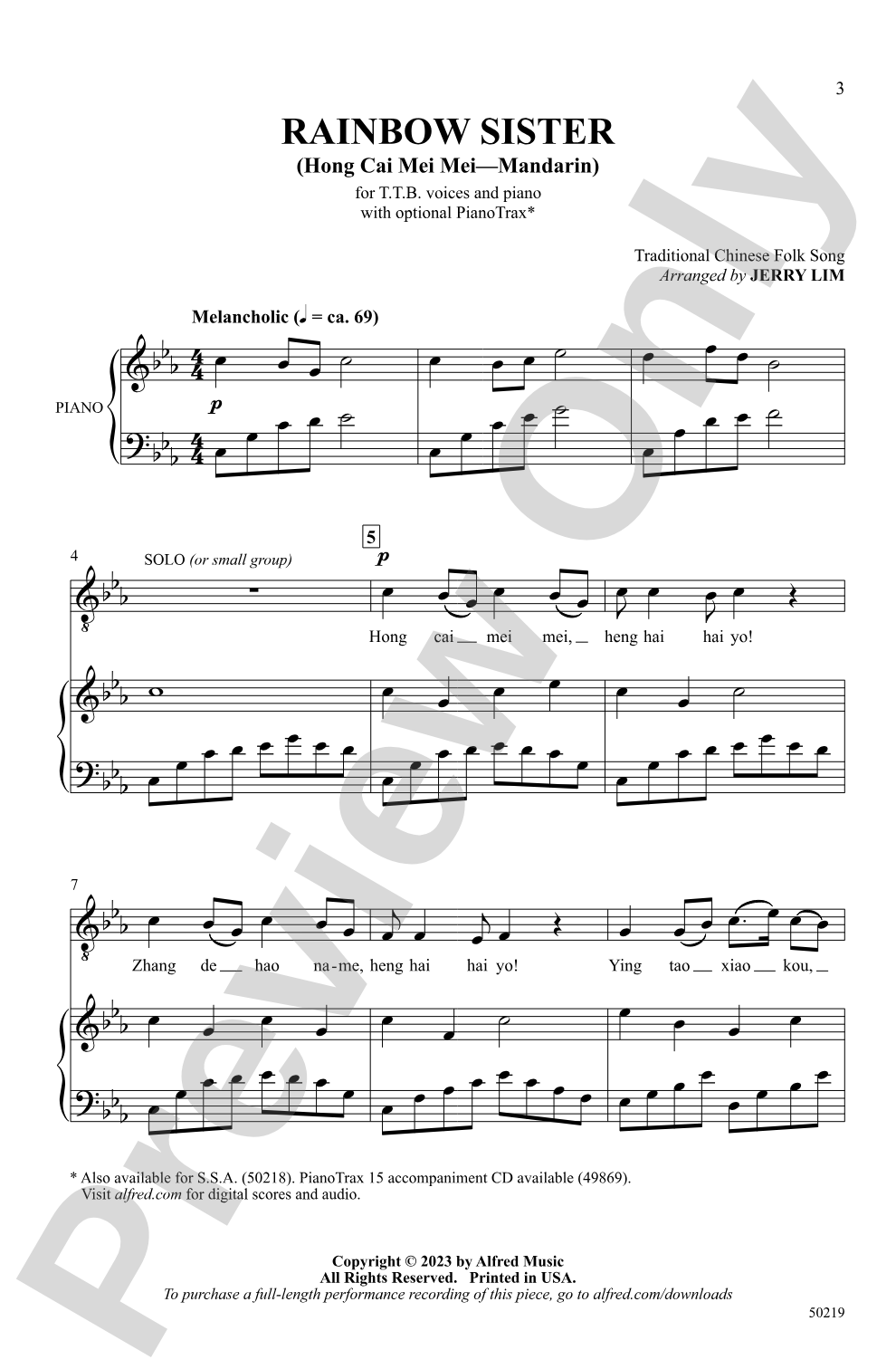

Rainbow Sister: TTB Choral Octavo
(Hong Cai Mei Mei---Mandarin)
Traditional Chinese Folk Song / arr. Jerry Lim
Item: 00-PO-0007064
$2.05
Minimum order quantity: 10 copies
Please note: Under U.S. copyright law, you must purchase the exact number of copies needed for your ensemble. Printing, duplicating or sharing additional copies is strictly prohibited.
Pickup currently not available
Description
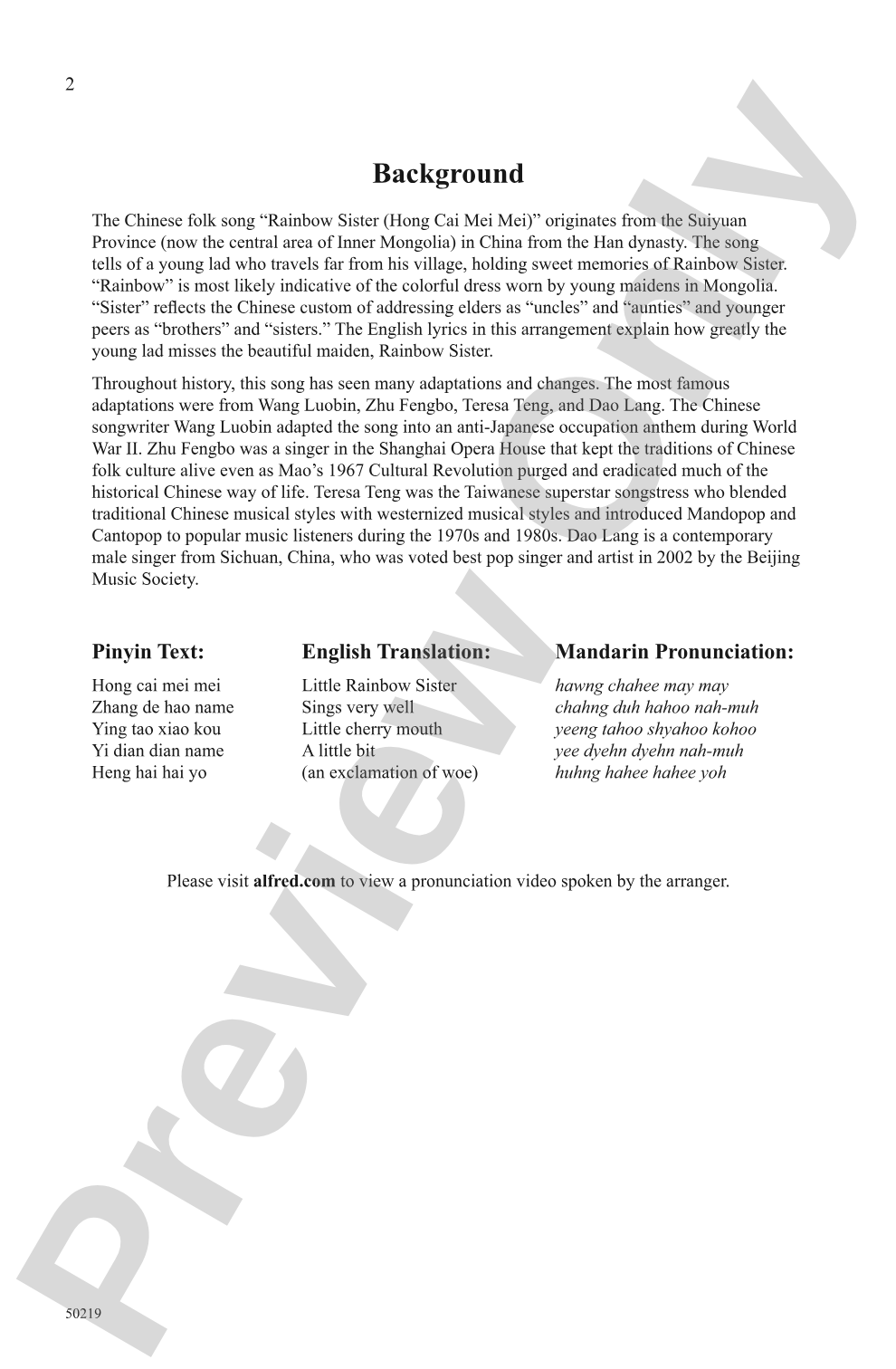
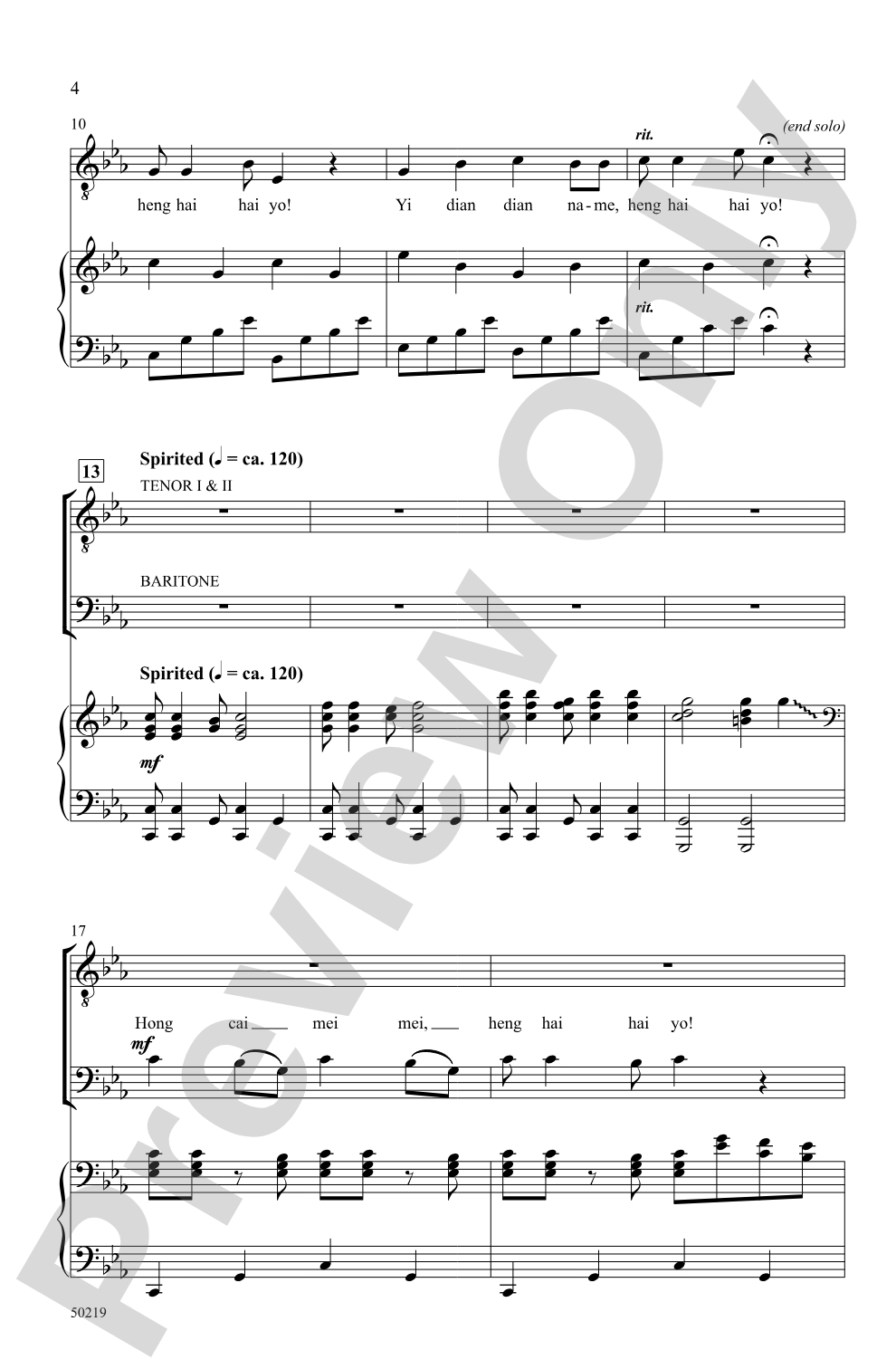
This traditional Chinese folk song tells of a young lad who travels far from his village, holding fond memories of a loved one. After an expressive opening solo, the tempo picks up in this authentic and spirited arrangement, which includes both Mandarin and English text. See below for a pronunciation video spoken by the arranger. Growing up in multiracial Malaysia, Jerry Lim was immersed in various European, American, and Asian music, giving him a unique perspective on integrating Western and Eastern styles.


Discover MakeMusic Cloud: thousands of interactive titles your students can play along with today.
Sample Audio
1
Audio File
--:--
0:00
0:00
Sample Video
1 / 2
Additional Details
Series:
Alfred Choral Designs
Publisher:
Alfred Music
Page Count:
12
SKU:
00-PO-0007064
More about this title
About the Arranger: Jerry Lim

Jerry Lim brings three decades of K-12 choral experience to his arranging work, currently directing high school choir in Washington state. He holds degrees in Music Education from the University of Washington and grew up in multiracial Malaysia, where exposure to European, American, and Asian musical traditions shaped his compositional voice. His work spans from critically acclaimed video game soundtrack composition (Magi Nation, 2001) to choral and instrumental arrangements that authentically blend Western harmonic language with Eastern melodic sensibilities. An active member of NAfME and ACDA, he has contributed to festival management and conference development while maintaining a steady output of original works and arrangements for his ensembles.
Why we love this
Lim's arrangement honors the emotional core of this Chinese folk narrative while building ensemble energy through smart tempo and textural choices. The inclusion of both Mandarin and English text, paired with a pronunciation video, removes barriers to authentic performance and cultural engagement. What sets this apart is how naturally the arrangement integrates Eastern melodic contour with Western TTB writing, never forcing one aesthetic onto the other.
What to expect
The piece opens with intimate longing, a traveler's quiet remembrance of home and someone left behind. Then the music shifts: the tempo quickens, the texture thickens, and what began as solitary reflection becomes communal storytelling. There's a bittersweet quality throughout, nostalgia mixed with the energy of tradition.
Who it's for
This arrangement works for TTB or flexible upper-voices choirs in grades 9 and up. Directors seeking repertoire that connects students to world music traditions while developing their musicianship through authentic cross-cultural performance will find this piece particularly valuable.
How to get the most out of it
- Balance the expressive opening solo against the accompanying voices; this moment establishes the storyteller's emotional distance before the tempo lifts and the ensemble builds energy.
- Use the pronunciation video to establish accurate syllabic stress and vowel placement across all three parts, especially important for maintaining clarity as the tempo accelerates.
- Shape the tempo transition thoughtfully rather than cutting it abruptly. The shift from reflective to spirited should feel inevitable, not jarring.
- Lock the harmonic tension in sections where Mandarin and English text run simultaneously; slight rhythmic adjustments in rehearsal will ensure both languages sit clearly without competing.
How to use it
Program this as a concert centerpiece or festival selection when you want to demonstrate your choir's stylistic range and cultural awareness. It pairs well alongside Western art song or contemporary choral works, offering audiences a genuine bridge between traditions. The piece also works as a teaching moment in world music units or culturally responsive programming initiatives.
Skills your students will build
- Singing in Mandarin Chinese with accurate tonal and syllabic clarity
- Reading and performing authentic non-Western melodic contours within a Western harmonic framework
- Coordinating ensemble balance when multiple languages and melodic lines occur simultaneously
- Responding to significant tempo and character shifts within a single piece
- Understanding how folk narratives shape musical structure and arrangement choices