Rain, Rain, Beautiful Rain Sheet Music Preview

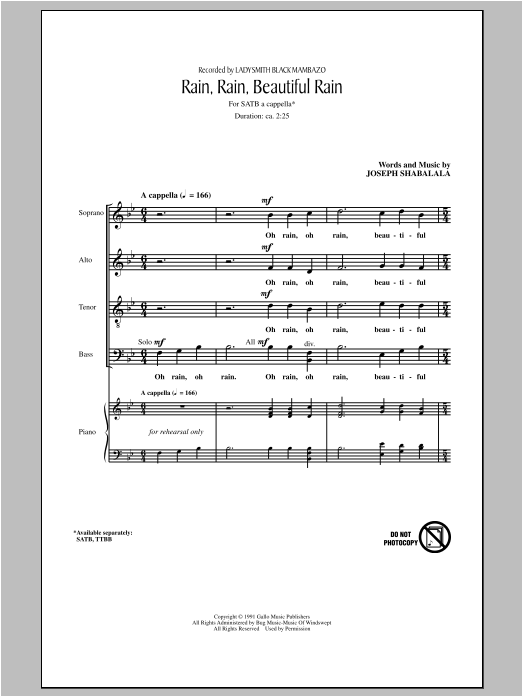
Rain, Rain, Beautiful Rain: SATB Choral Octavo

By Joseph Shabalala / As performed by Ladysmith Black Mambazo

Item: 35-DS00263012

Digital Download
$2.95
Description

Rain, Rain, Beautiful Rain: SATB Choral Octavo isn't in MakeMusic Cloud just yet...but it could be. Let us know you'd like to see it, and you'll help shape what comes next. In the meantime, start a free trial and dive into thousands of interactive titles your students can play along with today.

Sample Audio
No sample audio found.
Sample Video
Additional Details
Publisher: Hal Leonard
Page Count: 15
SKU: 35-DS00263012

More about this title

About the Composer: Joseph Shabalala

Joseph Shabalala founded Ladysmith Black Mambazo in 1964 and spent decades developing the group's signature isicathamiya vocal style, a form of South African a cappella music rooted in Zulu traditions. His compositional approach merges layered harmonies with deeply humanistic themes, creating work that functions simultaneously as entertainment and social commentary. Shabalala's influence on global popular music and world music education cannot be overstated; his arrangements taught millions of listeners that complex harmony and cultural authenticity are not opposing forces.

As a composer for choral ensembles, Shabalala prioritizes accessibility without sacrificing artistic integrity. His pieces typically feature singable melodies, open vocal textures, and rhythmic clarity that allow singers to engage meaningfully with the music while exploring unfamiliar harmonic and cultural territory.

Why we love this

Rain, Rain, Beautiful Rain captures the spirit of Ladysmith Black Mambazo's democratic approach to harmony, where every voice matters and the texture breathes. The piece gives your singers direct access to a compositional tradition that has influenced contemporary choral writing worldwide, and the subject matter (celebrating rain in a water-scarce region) carries genuine environmental and cultural resonance without preaching.

What to expect

The piece radiates quiet joy and gratitude, moving with a gentle, unhurried quality that invites the listener into a moment of shared relief and celebration. There is dignity in the simplicity of the text and the directness of the harmony, creating space for both reflection and communal warmth.

Who it's for

This octavo suits choirs with at least intermediate reading skills and a willingness to engage with non-Western harmonic traditions. It works equally well for high school advanced groups, collegiate ensembles, and adult community choirs seeking substantive crosscultural repertoire.

How to get the most out of it

  • Balance the overlapping melodic lines by rehearsing sections in pairs before bringing the full SATB texture together; this reveals how each voice supports the harmonic progression rather than competing for attention.
  • Pay close attention to the rhythmic relationship between parts. Isicathamiya style often features subtle syncopation and call-and-response elements that feel natural only when singers understand how their line relates to the whole.
  • Consider how your choir's approach to vowel color can enhance the African character of the piece; consistency within each voice part will strengthen the unified sound Shabalala's writing requires.

How to use it

Pair this with other world music selections to build a concert focused on water, environment, or cultural celebration; its moderate length and a cappella format make it an ideal contrast to accompanied pieces on the same program. It also serves beautifully as a closing number, leaving audiences with a sense of unity and hope.

Skills your students will build

  • Reading and performing non-Western harmonic structures
  • Maintaining rhythmic independence within layered vocal textures
  • Blending tone across SATB voicing without losing individual voice clarity
  • Interpreting cultural context in contemporary choral music
  • Sustaining legit singing in a cappella settings

You May Also Like