Rain: Piano Digital Sheet Music

Rain: Piano Digital Sheet Music

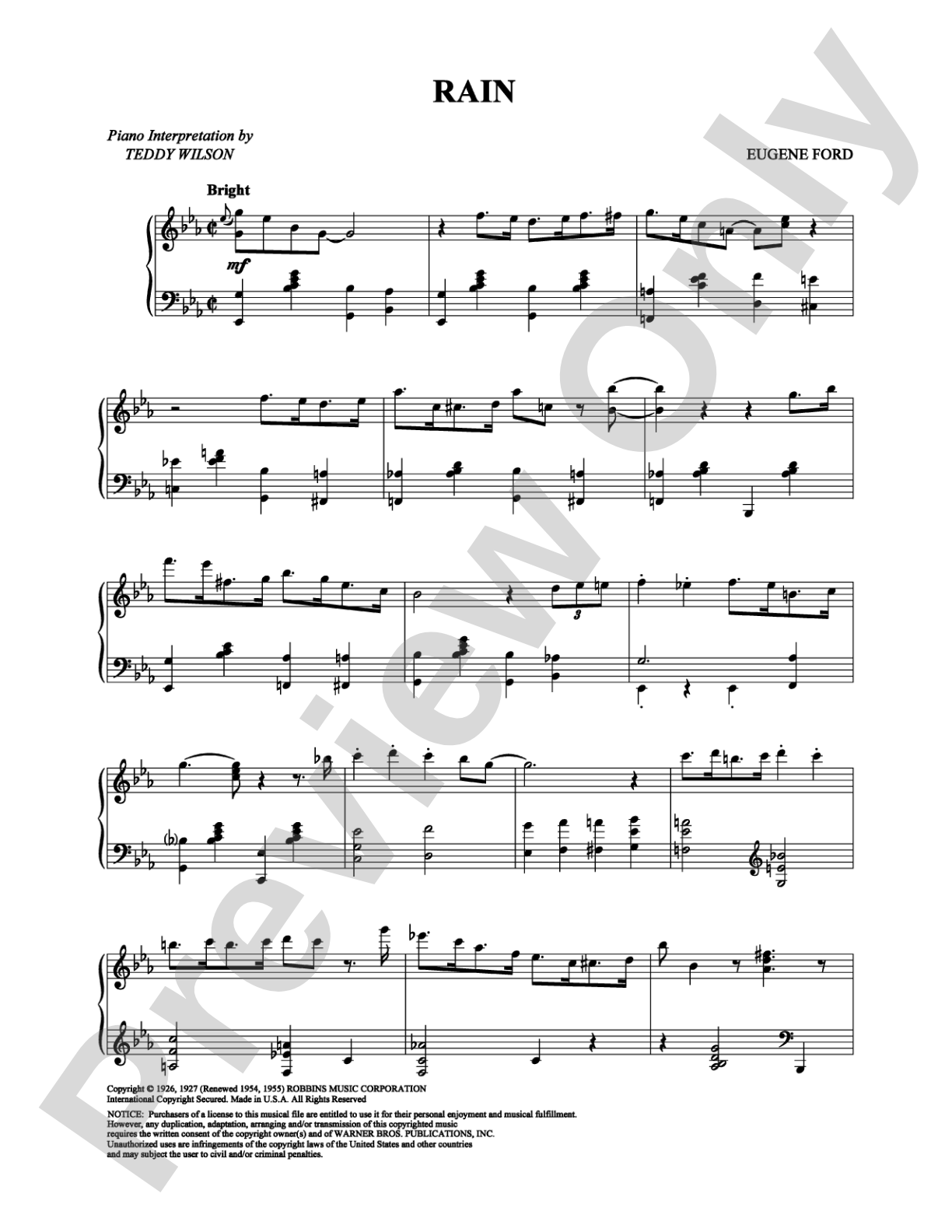
Teddy Wilson, Eugene Ford

Item: 00-PS-0000531

Digital Download
$3.99
Description

Rain: Piano Digital Sheet Music isn't in MakeMusic Cloud just yet...but it could be. Let us know you'd like to see it, and you'll help shape what comes next. In the meantime, start a free trial and dive into thousands of interactive titles your students can play along with today.

Sample Audio
No sample audio found.
Sample Video
Additional Details
SKU: 00-PS-0000531

More about this title

About the Artist: Teddy Wilson

Teddy Wilson (1912-1986) was a pianist and bandleader who shaped the sound of swing jazz through his harmonic sophistication and rhythmic elegance. His work with Benny Goodman's integrated ensembles in the 1930s broke racial barriers in American jazz, while his prolific recording career as a leader established him as a standard-bearer for refined, melody-centered improvisation.

Wilson's approach to the piano emphasized clarity, touch control, and respect for the tune. He recorded hundreds of sides across five decades, leaving behind a body of work that remains essential listening for any musician studying how to accompany singers, lead a small group, and navigate complex changes with grace rather than display.

Why we love this

This standard gives pianists a chance to study how swing-era masters balanced reharmonization with melodic integrity. The piece rewards close listening to recorded performances and offers enough harmonic terrain to keep intermediate and advanced players engaged with voicings and comping ideas that extend far beyond the changes themselves.

What to expect

The piece has a contemplative, intimate quality despite its dance-floor origins. It moves at an unhurried pace with emotional warmth, inviting the player into a conversation between the hands rather than a display of technique.

Who it's for

Pianists studying jazz history and swing-era vocabulary will find this a touchstone for understanding how to play behind a melody while still being interesting harmonically. It suits pianists comfortable with jazz standards and intermediate chord-reading who want to deepen their interpretive choices and touch.

How to get the most out of it

  • Listen to Wilson's own recording to absorb the rhythmic placement and touch; his relaxed sense of time in the left hand anchors everything.
  • Approach the melody with a singing quality rather than a percussive one. The piece breathes between phrases, so resist the urge to fill every space.
  • Explore the middle register of the piano. Wilson rarely played high or low in isolation; the sweet spot for the tune lives in the center of the keyboard.
  • Leave space for silence. Comping doesn't mean constant playing; sometimes the most swinging thing is what you don't play.

How to use it

Pair this with other Wilson-era standards in a jazz recital focused on small-group swing, or use it as a study piece alongside recordings when teaching jazz history and the evolution of piano comping. It works equally well as a solo feature or as a springboard for arranging with other instruments.

Skills your students will build

  • Reading and interpreting jazz chord symbols with harmonic flexibility
  • Developing touch sensitivity and dynamic control in both hands
  • Understanding swing-era rhythm and phrasing conventions
  • Analyzing how to reharmonize a melody while keeping it recognizable
  • Building left-hand comping vocabulary typical of 1930s-1940s small-group jazz

You May Also Like