Ragtag Rag Sheet Music Preview

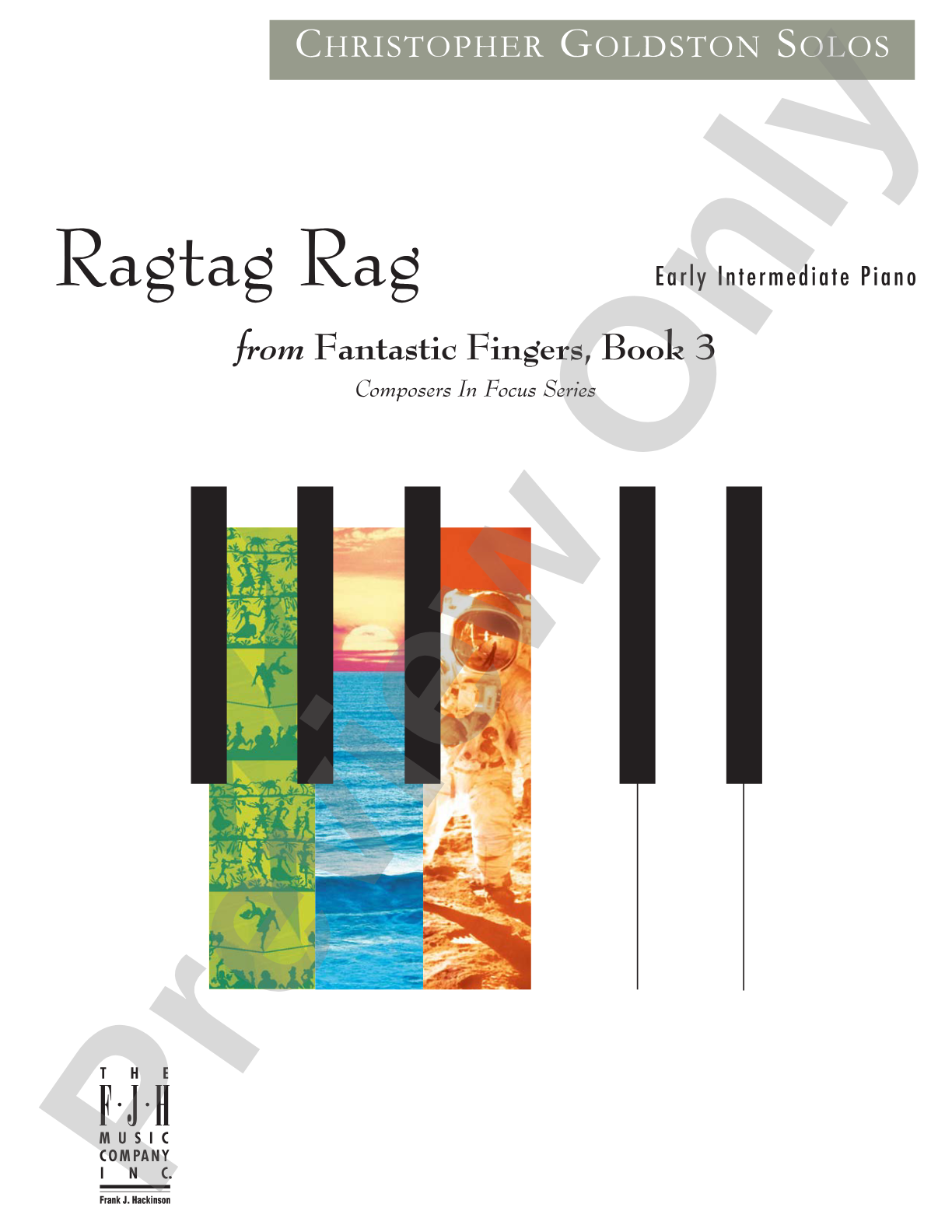
Ragtag Rag: Piano

By Christopher Goldston

Item: 98-DW9203

Digital Download
$2.50
Description
Originally part of Fantastic Fingers, Book 3, Ragtag Rag is now available as a stand-alone solo sheet. Its sauntering, lazy tune delightfully trips along with fun, rhythmic articulations (triplet figures; clipped, staccato phrasing). Some raised and lowered neighbor tones offer additional melodic interest. A gentle, chromatic base line also leads the rag toward its conclusion. Goldston has cleanly captured the rag form for the early intermediate pianist.

Ragtag Rag: Piano isn't in MakeMusic Cloud just yet...but it could be. Let us know you'd like to see it, and you'll help shape what comes next. In the meantime, start a free trial and dive into thousands of interactive titles your students can play along with today.

Sample Audio
No sample audio found.
Sample Video
Additional Details
Series: Written For You
Publisher: The FJH Music Company, Inc.
SKU: 98-DW9203

More about this title

About the Composer: Christopher Goldston

Christopher Goldston

Christopher Goldston earned his Master of Music in piano performance and pedagogy from Northwestern University and his Bachelor of Music from the University of North Carolina-Greensboro. He has served on the faculty at Columbia College Chicago, Roosevelt University, and Sherwood Conservatory of Music, while also maintaining a private studio and virtual teaching practice in Chicago.

Goldston's compositional voice earned early recognition when he received the National Federation of Music Clubs Lynn Freeman Olson Composition Award in 1991 for Night Train. Since 2010, he has directed the MTNA Composition Competition at the national level. His leadership in music education extends across multiple roles: he served as president of both the Illinois State Music Teachers Association and the Chicago Area Music Teachers Association, was named an MTNA Foundation Fellow in 2020, and held the position of MTNA National Secretary-Treasurer from 2021 to 2023. The Music Teachers National Association commissioned Four Virtues (for oboe, violin, and piano) from Goldston, which premiered at the 2022 MTNA National Conference.

Why we love this

Goldston captures the essential spirit of ragtime without overwhelming early intermediate players. The piece balances historical authenticity with pedagogical clarity: students experience genuine syncopation, articulation variety, and chromatic movement without navigating excessive technical demands. It's a genuine rag, not a simplified approximation.

What to expect

Playful and unhurried, with a stride-like pulse that feels almost conversational. The raised and lowered neighbor tones create subtle melodic winks, while the staccato articulations snap with personality against the walking chromatic bass.

Who it's for

Early intermediate pianists ready to explore ragtime idioms with confidence. This solo rewards players who have developed secure hand independence and can manage rhythmic complexity with clarity and style.

How to get the most out of it

  • Shape the lazy melodic line with subtle dynamic shaping rather than strict tempo. Let the sauntering character breathe naturally through the triplet figures.
  • Clarify the contrast between the clipped staccato phrasing and the more legato passages by controlling the weight and release of each articulation distinctly.
  • Balance the chromatic bass line so it supports without overwhelming the melody; think of it as a harmonic foundation that gently propels the rag forward.
  • Experiment with light swing or a slight push-pull of tempo to capture the authentic ragtime feel without losing rhythmic precision.

How to use it

Pair this with other early 20th-century American piano music for a recital exploring vernacular styles and their influence on concert composition. It also works beautifully as a transition piece between classical and contemporary repertoire, or as a standalone crowd-pleaser at informal student performances.

Skills your students will build

  • Ragtime rhythmic patterns and triplet coordination
  • Independent hand voicing with melody and accompaniment
  • Articulation contrast (staccato versus legato)
  • Chromatic voice leading and harmonic movement
  • Stylistic awareness of early American vernacular music

You May Also Like