
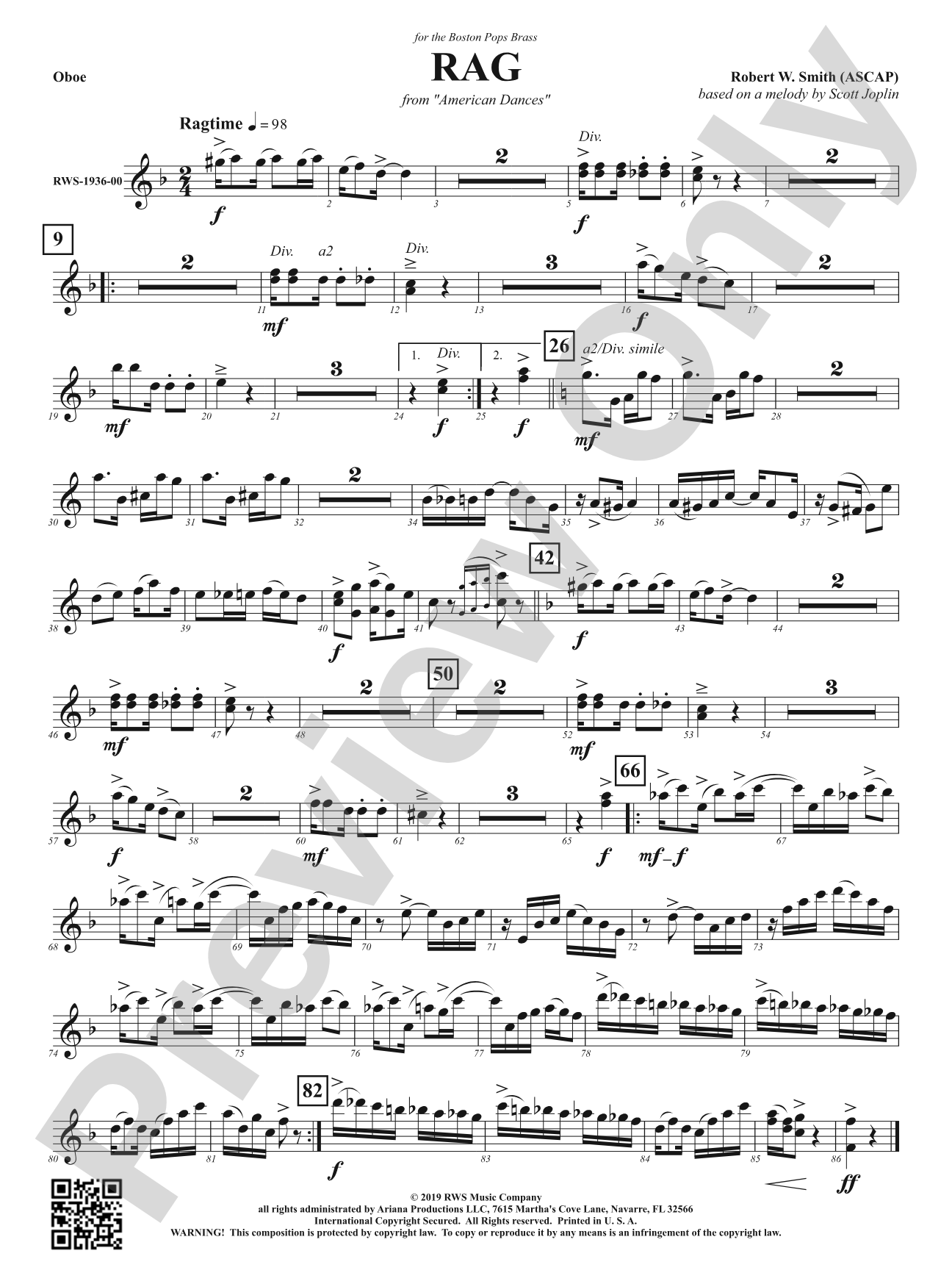

Rag - Mvt. 1 from American Dances: Oboe
Mvt. 1 from American Dances
By Robert W. Smith
Grade: 4.5
Item: 98-PC-RWS1936_O1
$3.99
Pickup currently not available
Description
"American Dances" is a three movement suite originally composed for the Boston Pops Brass. Each movement features an American popular music genre. "Rag" draws upon the ragtime style most often associated with Scott Joplin and the city of New Orleans. This infectious rag will delightfully challenge your wind sections. When programmed with "Square" (Mvt. 2) and "Swing" (Mvt. 3), the full "American Dances" suite is particularly effective in any concert setting.
Original Item#: RWS-1936-00


Original Item#: RWS-1936-00
Rag - Mvt. 1 from American Dances: Oboe isn't in MakeMusic Cloud just yet...but it could be. Let us know you'd like to see it, and you'll help shape what comes next. In the meantime, start a free trial and dive into thousands of interactive titles your students can play along with today.
Request This Title
Tell us you want it.
Start Your Free Trial
Explore everything that's ready to play right now.
Sample Audio
1
Audio File
--:--
0:00
0:00
Sample Video
No sample videos found.
Additional Details
Series:
RWS - Symphony Band
Publisher:
RWS Music Company
SKU:
98-PC-RWS1936_O1
More about this title
About the Composer: Robert W. Smith

Robert W. Smith is among the most widely performed composers of concert band and orchestral music in the United States, with over 400 published works to his credit. He holds degrees in music education from Troy State University and a master's degree from the University of Miami. His compositions have been performed internationally across North America, Europe, Australia, and Asia, with major works like The Divine Comedy and The Odyssey establishing themselves as pillars of the repertoire.
Beyond the concert hall, Smith's music has reached audiences through television broadcasts, Olympic ceremonies, the Macy's Thanksgiving Day Parade, and stadium events. His work as both composer and clinician has taken him across the United States and to Canada, Japan, Australia, Italy, Austria, and the United Kingdom, making him one of the most recognized figures in wind band composition.
Why we love this
Smith captures the infectious energy of ragtime without resorting to pastiche; the writing is idiomatic for concert band and genuinely fun to perform. The Grade 4.5 difficulty sits in that sweet spot where developing ensembles can tackle sophisticated syncopation and articulation without becoming bogged down in technical complexity. Programmed with its companion movements (Square and Swing), this suite offers a refreshing departure from standard pops fare while remaining accessible and crowd-pleasing.
What to expect
The rag bounces with the infectious swagger of turn-of-the-century New Orleans, built on syncopated piano figures and a striding bass line that propels the ensemble forward. Despite its lighter mood, the writing is musically substantial, with independent lines woven through the band that demand focused rehearsal and ensemble maturity to sound polished.
Who it's for
Concert bands at the intermediate to early advanced level, particularly those seeking repertoire that challenges rhythm section execution and sectional articulation without extreme range demands. Directors programming pops concerts, holiday shows, or all-American programs will find this movement especially valuable as a standalone opener or closer.
How to get the most out of it
- Establish the ragtime feel early in rehearsal by having the ensemble listen to authentic Scott Joplin recordings; rhythmic clarity and the characteristic off-beat emphasis depend on everyone internalizing the style, not just reading the notation.
- Balance the written articulations carefully between sections. Ragtime requires crisp staccato in some voices while maintaining a singing legato melody; mark parts visibly so each section understands its role in creating the texture.
- Keep tempos honest and steady. Ragtime can feel slightly rushed when ensemble energy peaks; work the rhythm section (particularly percussion and bass line) to maintain a groove that breathes without wavering.
- Give the percussion section appropriate spotlight during tutti sections. The march-like patterns and syncopated hits are as essential to the rag's character as any melodic line.
How to use it
Open a concert with this movement for an immediate energy surge that sets a high bar for the rest of your program. Alternatively, program it as an intermission closer on a concert built around American themes, or pair all three movements of American Dances as a complete suite to showcase range across American popular idioms.
Skills your students will build
- Ragtime articulation and phrasing (crisp staccato with stylistic precision)
- Syncopated rhythm reading and execution across multiple voices
- Sectional balance and independence (maintaining separate rhythmic figures without rhythmic bleeding)
- Stylistic awareness and genre recognition
- Ensemble groove and steady tempo maintenance in syncopated contexts