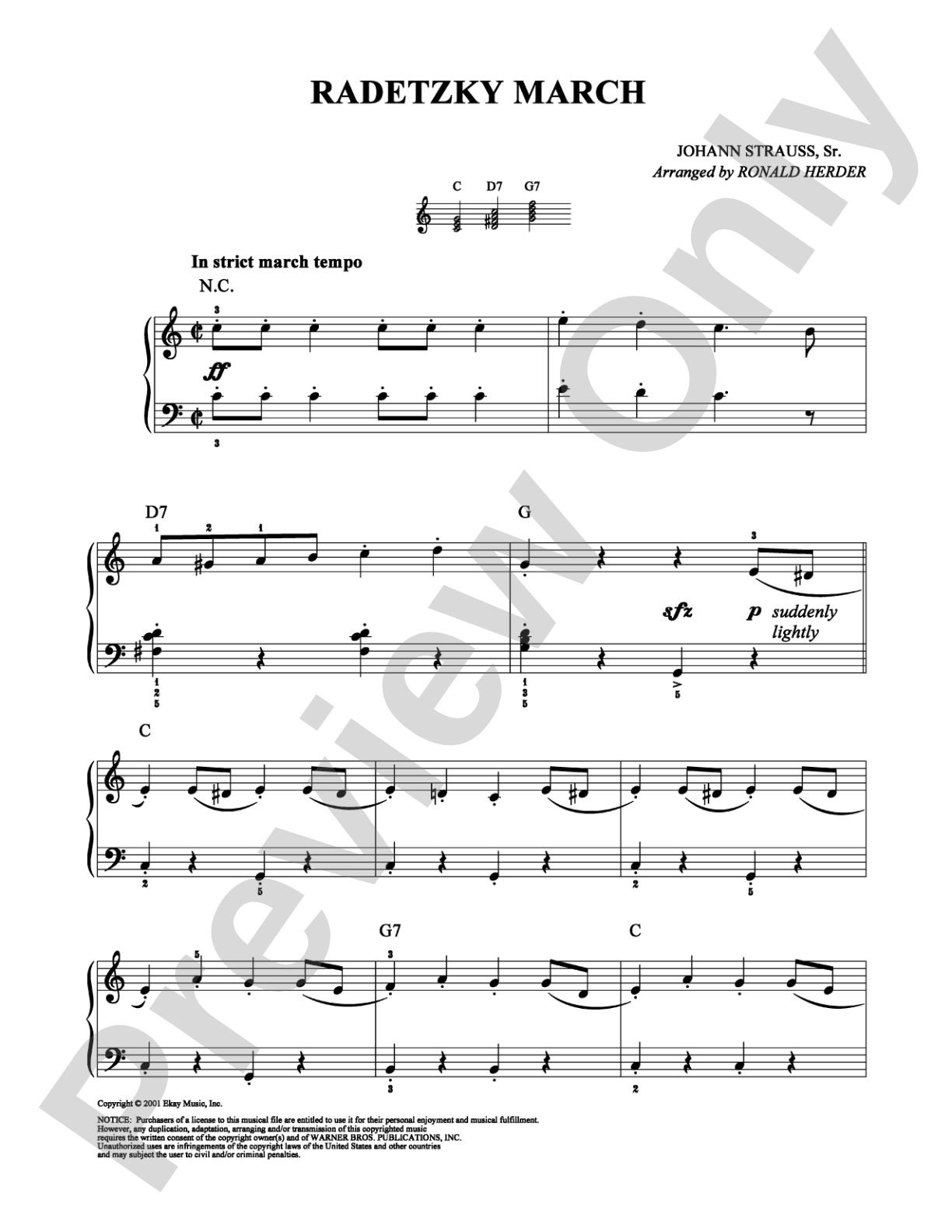
Radetzky March: Easy Piano Digital Sheet Music

Radetzky March: Easy Piano Digital Sheet Music

Johann Strauss

Item: 00-PS-0003579

Digital Download
$3.99
Description

Radetzky March: Easy Piano Digital Sheet Music isn't in MakeMusic Cloud just yet...but it could be. Let us know you'd like to see it, and you'll help shape what comes next. In the meantime, start a free trial and dive into thousands of interactive titles your students can play along with today.

Sample Audio
No sample audio found.
Sample Video
Additional Details
SKU: 00-PS-0003579

More about this title

About the Creator: Johann Strauss I

Johann Strauss I composed the Radetzky March in 1848 to commemorate an Austrian military victory, and it became one of the most performed marches in the concert repertoire. The piece captures the energy and pageantry of 19th-century Vienna, blending the rhythmic precision of military music with the elegance that defined Strauss's compositional voice.

Why we love this

This easy arrangement preserves the march's infectious momentum without requiring advanced technique, making it accessible for developing pianists who want to experience a genuine orchestral showstopper. The straightforward left-hand patterns and clear melodic line let students focus on rhythmic confidence and character rather than fighting the mechanics.

What to expect

Bright, propulsive, and ceremonial. The march moves with unstoppable forward energy, marching toward something grand and celebratory. There's a quality of dignified pageantry that makes even beginners feel they're playing something important.

Who it's for

Early intermediate pianists comfortable with solid rhythmic reading and basic hand independence will thrive with this version. It's ideal for students ready to tackle a recognized concert piece that builds confidence without overwhelm.

How to get the most out of it

  • Keep the march crisp and forward-moving; resist the urge to linger on quarter notes. The military precision is part of the character.
  • Shape the repeated sections with subtle dynamic variation rather than playing them identically. Small crescendos in the second phrase help maintain listener engagement.
  • Let the left hand provide steady, unwavering support without metallic tone. Think of it as an accompaniment pattern that sits in the background.
  • Articulate the staccatos clearly, especially in the lower register. They give the piece its characteristic lightness and bounce.

How to use it

Program this at the start of a piano recital to energize an audience, or use it as a warm-up piece for a holiday or patriotic concert. The short length and universal appeal make it a crowd-pleaser that works well alongside both classical and lighter contemporary pieces.

Skills your students will build

  • Steady rhythmic pulse maintenance in march meter (2/4)
  • Left-hand accompaniment patterns and hand independence
  • Dynamic control and articulation clarity
  • Recognizing and executing staccato and legato contrasts
  • Phrasing and shaping within a structured, repetitive form

You May Also Like