Rachmaninoff: Piano Pieces, Op. 10 Sheet Music Preview

Rachmaninoff: Piano Pieces, Op. 10

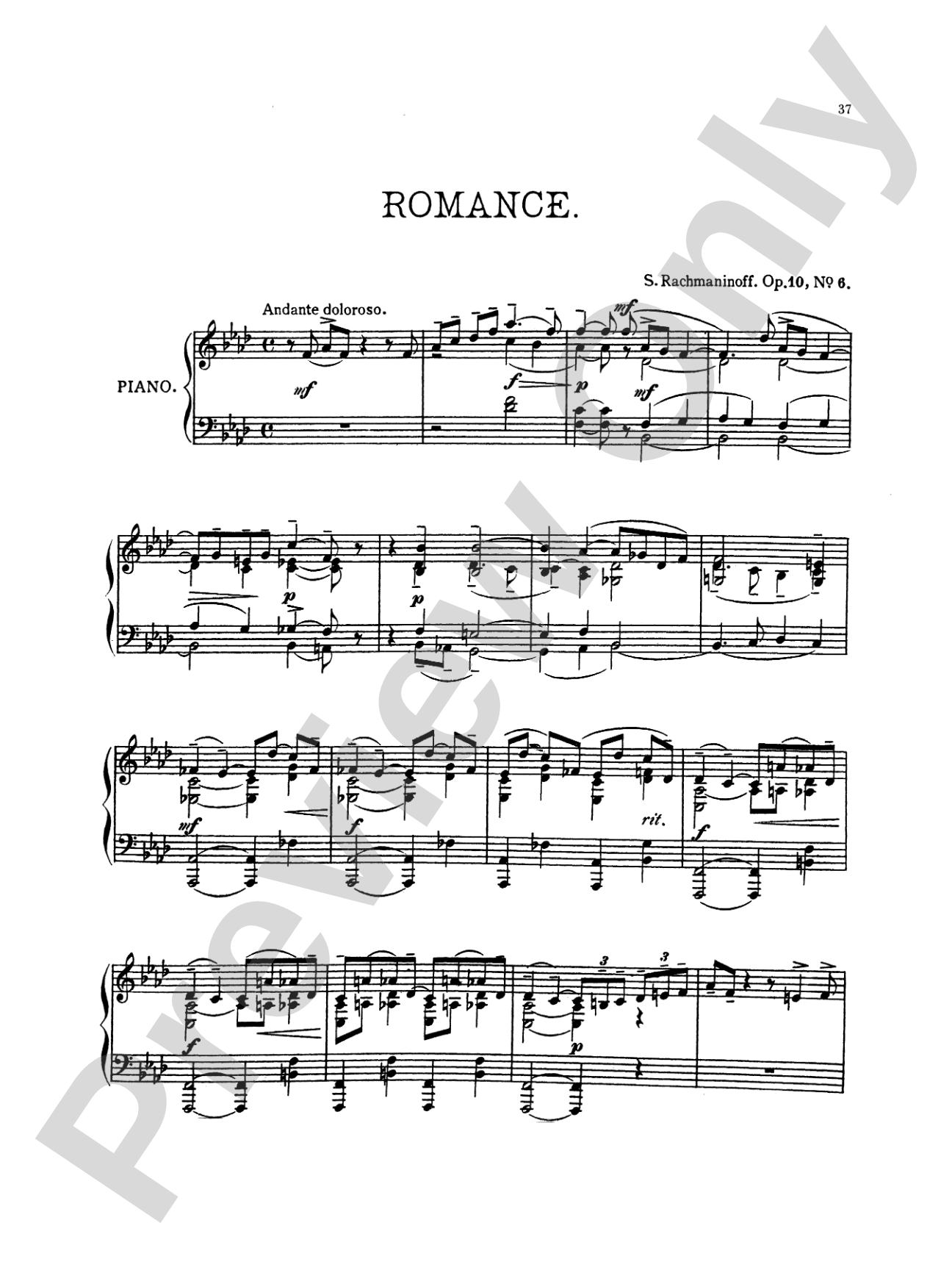
Nos. 1-7

By Sergei Rachmaninoff

Item: 00-PC-0009005

Digital Download
$0.99
Description
Titles: Nocturne * Valse * Barcarolle * Mélodie * Humoreske * Romance * Mazurka.

Don't just read it, hear it, play along with it, and watch your students grow with it. In MakeMusic Cloud, Rachmaninoff: Piano Pieces, Op. 10 comes alive with professional accompaniment, adjustable tempo, and built-in practice tools that turn solo practice into real progress.

Sample Audio
No sample audio found.
Sample Video
Additional Details
Series: Kalmus Edition
Publisher: Alfred Music
Page Count: 48
SKU: 00-PC-0009005

More about this title

About the Composer: Sergei Rachmaninoff

Sergei Rachmaninoff (1873-1943) was a Russian composer and pianist whose gift for lyrical melody and harmonic richness shaped early twentieth-century piano literature. He studied at the Moscow Conservatory and achieved international recognition as both a virtuoso performer and composer, later emigrating to the United States where he continued composing and performing until his death.

Rachmaninoff's piano works demand technical facility and deep musicality in equal measure. His pieces reward careful attention to voice leading, pedal control, and the cultivation of a singing tone across registers. These seven op. 10 pieces represent the breadth of his compositional voice: intimate character pieces that reveal his command of form, harmony, and the expressive possibilities of the keyboard.

Why we love this

This collection showcases seven character pieces in miniature, each one a complete musical thought that doesn't demand virtuosic showmanship to sound compelling. The variety across the set (nocturne, waltz, barcarolle, song, humorous piece, romance, and mazurka) means students encounter different formal templates, metric contexts, and expressive aims within a single book, making it rich ground for exploring how Rachmaninoff crafted melody and harmony at different scales.

What to expect

These pieces carry the nostalgia and emotional directness that define Rachmaninoff's sensibility: sweeping melodies that long for something just out of reach, rich harmonic colors that shift in unexpected ways, and a pervasive sense of lyricism that asks the pianist to sing through the keyboard. The collection moves from intimacy (Nocturne) to playfulness (Humoreske) to waltzing sophistication, each piece a small world unto itself.

Who it's for

Intermediate to advanced pianists seeking a collection of Rachmaninoff works that balance accessibility with compositional sophistication. Students who have moved beyond early intermediate repertoire and are ready to explore the harmonic language and character-piece tradition of the late Romantic era will find meaningful material here.

How to get the most out of it

  • Shape each piece by identifying the primary melodic line and its supporting harmonies; these works often distribute the melody across registers in ways that demand careful voice balancing rather than simple top-note projection.
  • Explore how Rachmaninoff uses rubato and pedal to create harmonic wash without obscuring definition. Experiment with releasing the pedal on beat, not between beats, to maintain clarity.
  • Attend to key relationships and harmonic rhythm within each piece; the journey from tonal center and back is often subtle and rewards listening closely to voice movement beneath the surface.
  • Practice the dance rhythms (Valse and Mazurka) with a flexible pulse that honors the metric content without becoming metronomic; these pieces thrive on the tension between rhythmic precision and expressive give.

How to use it

These pieces work beautifully in student recitals as a focused study of a single composer or era; performing two or three from the set creates a coherent program segment without overwhelming the listener. Individual pieces (particularly the Nocturne or Valse) also fit naturally alongside other Romantic repertoire or as contrasting items in a mixed program.

Skills your students will build

  • Balancing melody and accompaniment across different register positions
  • Voicing harmonic progressions with sensitivity to color and transparency
  • Executing rubato and expressive timing within structured forms
  • Interpreting character pieces across genres (nocturne, waltz, mazurka, barcarolle)
  • Using the pedal expressively without blurring harmonic clarity
  • Reading and performing Rachmaninoff's harmonic language and chromatic voice leading

You May Also Like