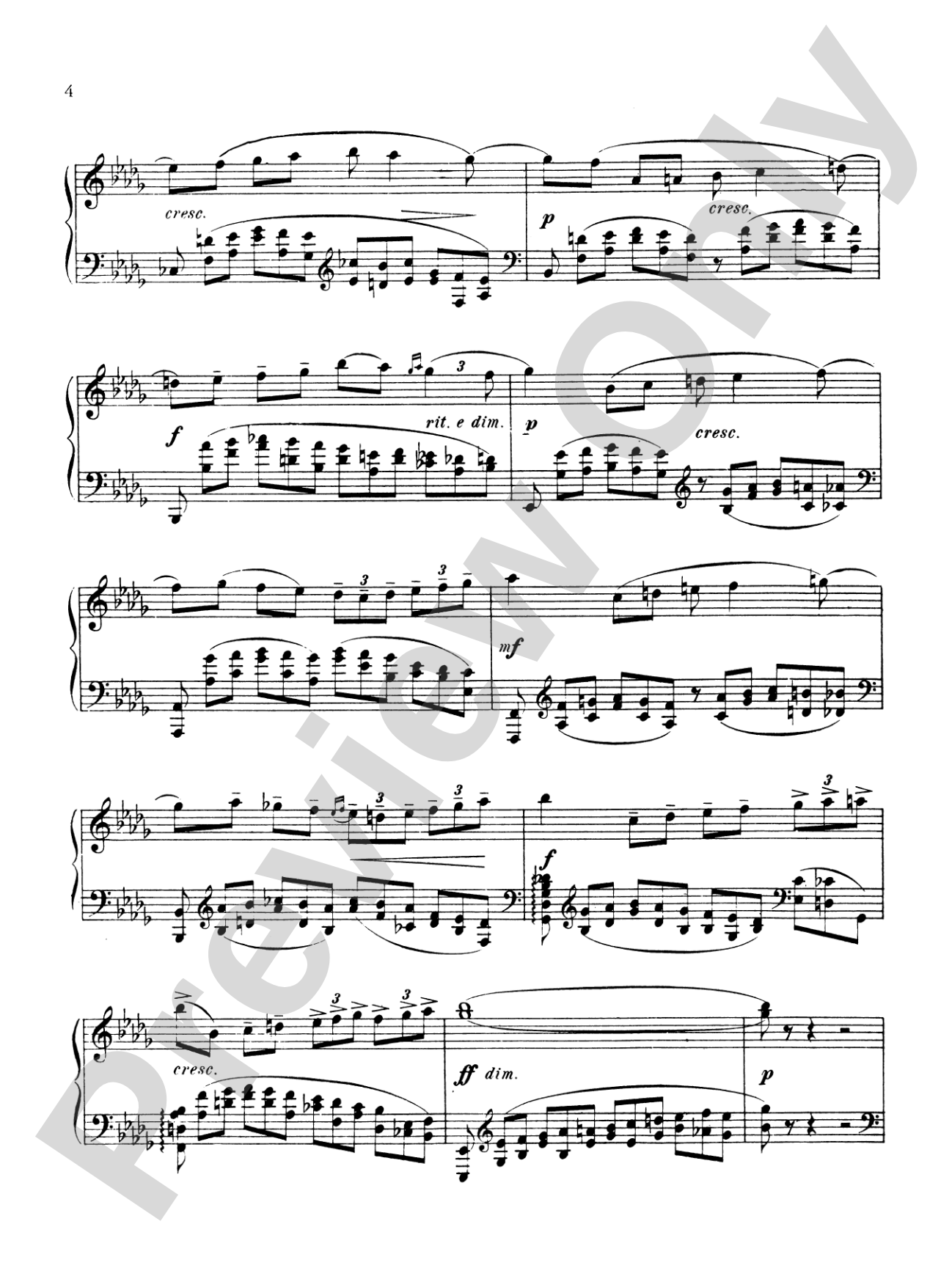
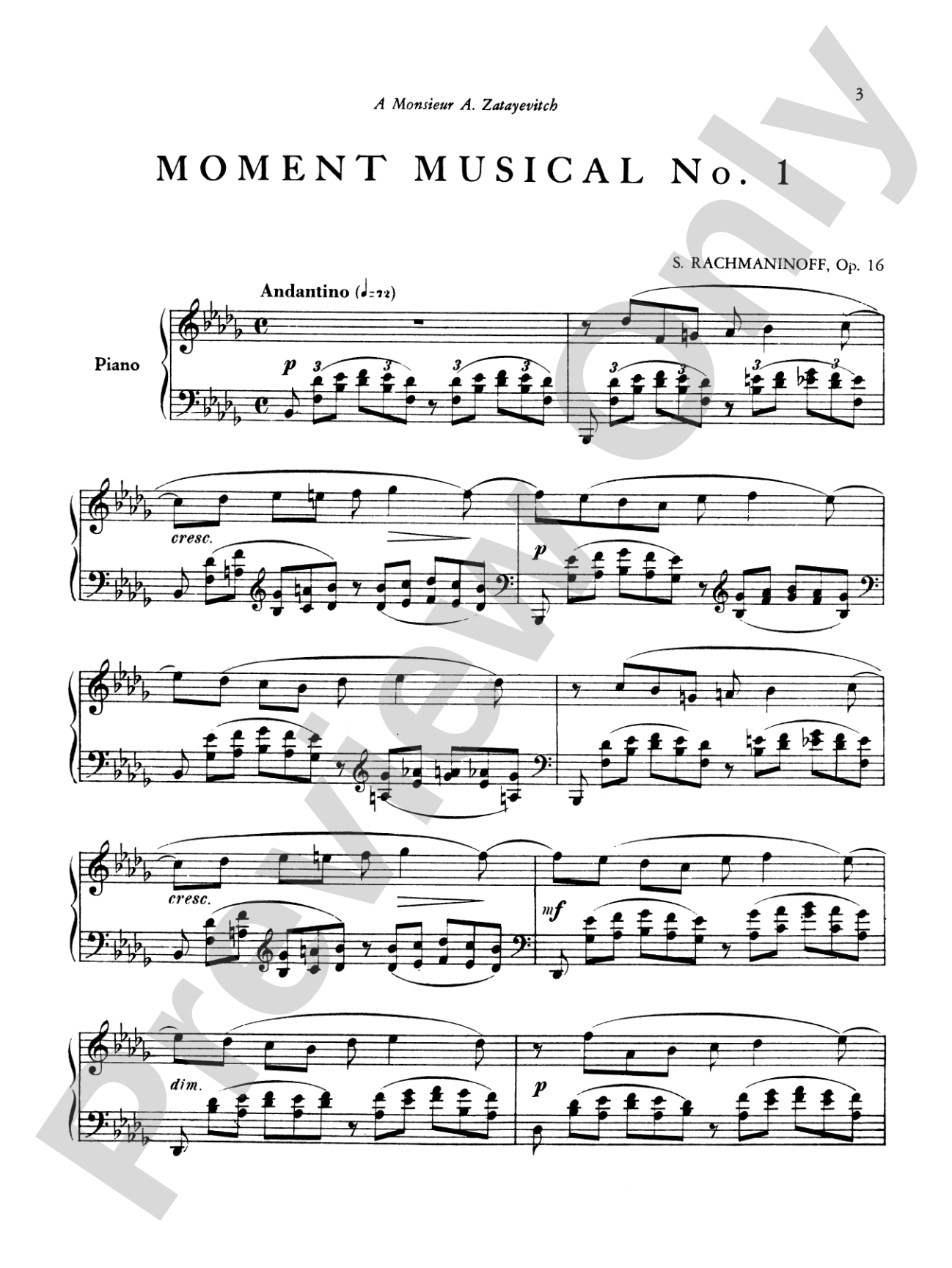
Rachmaninoff: Moments Musicaux, Op. 16 Sheet Music Preview

Rachmaninoff: Moments Musicaux, Op. 16

By Sergei Rachmaninoff

Item: 00-PC-0008985

Digital Download
$0.99
Description
The six "Musical Moments" Opus 16 are a set of separate solo works for piano composed by Rachmaninoff in 1896. They present forms characteristic of previous musical eras, such as nocturne, song without words, barcarolle, etude, and theme and variations. Titles: No. 1 in B-Flat Minor * No. 2 in E-Flat Minor * No. 3 in B Minor * No. 4 in E Minor * No. 5 in D-Flat Major * No. 6 in C Major.

Don't just read it, hear it, play along with it, and watch your students grow with it. In MakeMusic Cloud, Rachmaninoff: Moments Musicaux, Op. 16 comes alive with professional accompaniment, adjustable tempo, and built-in practice tools that turn solo practice into real progress.

Sample Audio
No sample audio found.
Sample Video
Additional Details
Series: Kalmus Edition
Publisher: Alfred Music
Page Count: 44
SKU: 00-PC-0008985

More about this title

About the Composer: Sergei Rachmaninoff

Sergei Rachmaninoff (1873-1943) stands as one of the great bridge figures between the Romantic tradition and modernism. A virtuoso pianist, conductor, and composer, he developed a musical language that combined sweeping lyricism with structural sophistication, creating works that demand both technical mastery and emotional depth from performers.

Rachmaninoff's compositional output reflects his deep connection to Russian musical culture and his engagement with European forms. His facility with melody, harmonic color, and pianistic texture made him one of the most admired composers for piano in the twentieth century. Moments Musicaux, Op. 16, written when he was 23, demonstrates the maturity of his voice and remains essential repertoire for pianists seeking to understand post-Romantic keyboard writing.

Why we love this

These six pieces work beautifully as a recital set or as individual studies in different Romantic and pre-Romantic forms. Each movement stands alone musically while contributing to a cohesive whole, giving pianists flexibility in programming without sacrificing depth. Rachmaninoff's writing here balances accessible lyricism with technical challenges that reward serious preparation.

What to expect

These pieces evoke a world of salon intimacy and introspection, where grand gestures give way to whispered confessions. Rachmaninoff's melodies linger and brood; his harmonies shift unexpectedly, creating moments of unexpected tenderness or mild unease. The collection feels like opening a personal diary of carefully crafted emotional snapshots.

Who it's for

This collection suits advanced piano students and recitalists who are comfortable with Romantic-era keyboard writing and ready to engage with Rachmaninoff's harmonic language. Teachers preparing students for competitions, college auditions, or substantial recital programs will find these pieces offer both musical substance and pedagogical value.

How to get the most out of it

  • Explore the harmonic language in the slow movements (particularly No. 2 and No. 5) without rushing; Rachmaninoff's chromaticism and voice leading become more transparent when each chord is fully voiced and sustained.
  • Work the right-hand figurations separately from the harmonic foundation in No. 4, building independence between the outer voices before integrating them at tempo.
  • Shape phrase arcs across substantial sections rather than treating Rachmaninoff's lyrical lines as short motifs; these pieces reward long-line planning and control of dynamic trajectory.
  • Use the contrasting middle sections of these forms (particularly the variations in No. 6) as structural anchors, ensuring listeners hear the architecture beneath the surface decoration.

How to use it

Program these as a unified suite in a formal recital, or select individual movements to contrast with contemporary or Baroque repertoire on the same concert. No. 3 in B Minor and No. 6 in C Major work particularly well as standalone pieces on mixed programs, while the full set creates a substantial closing statement for a solo recital.

Skills your students will build

  • Sustaining longer harmonic progressions while maintaining clarity in texture
  • Balancing lyrical melody with sophisticated accompaniment figures
  • Executing flowing scalar and arpeggiatic passages at various tempos
  • Interpreting varied formal structures (nocturne, barcarolle, theme and variations) through musical phrasing
  • Managing rubato and tempo flexibility within a Classical framework

You May Also Like