
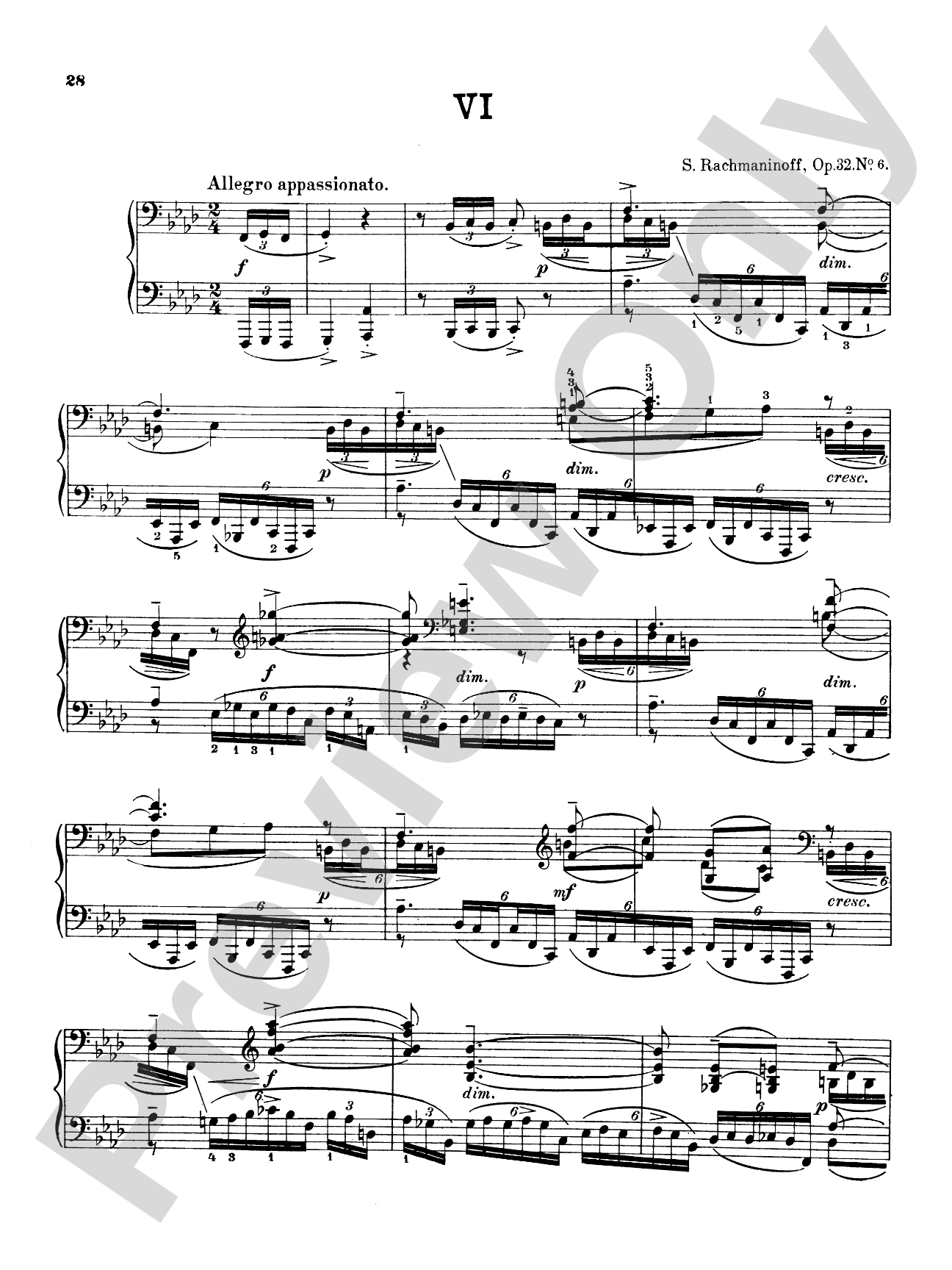

Rachmaninoff: Fourteen Preludes
Opus 3, No. 2 and Opus 32, Nos. 1-13
By Sergei Rachmaninoff
Item: 00-PC-0008976
$0.99
Pickup currently not available
Description
Contents: Opus 32, No. 1, C Major * No. 2, B-Flat Minor * No. 3, E Major * No. 4, E Minor * No. 5, G Major * No. 6, F Minor * No. 7, F Major * No. 8, A Minor * No. 9, A Major * No. 10, B Minor * No. 11, B Major * No. 12, G-sharp Minor * No. 13, D-Flat Major * Opus 3, No. 2, C-sharp Minor.


Don't just read it, hear it, play along with it, and watch your students grow with it. In MakeMusic Cloud, Rachmaninoff: Fourteen Preludes comes alive with professional accompaniment, adjustable tempo, and built-in practice tools that turn solo practice into real progress.
Open in the Player
Jump straight in and assign it today.
Start Your Free Trial
Open this title and explore the full library in minutes.
Sample Audio
No sample audio found.
Sample Video
No sample videos found.
Additional Details
Series:
Kalmus Edition
Publisher:
Alfred Music
Page Count:
64
SKU:
00-PC-0008976
More about this title
About the Composer: Sergei Rachmaninoff
Sergei Rachmaninoff (1873–1943) stands as one of the late Romantic era's most formidable pianists and composers. His output for the piano is vast and uncompromising, demanding technical command and emotional depth from performers who undertake it. The Preludes represent his distilled vision of the form, reshaping a genre inherited from Chopin into something entirely his own: introspective, virtuosic, and architecturally ambitious.
Rachmaninoff's compositional voice emerged from deep roots in Russian music and European Romanticism, yet he pushed both traditions toward new harmonic and structural frontiers. His preludes showcase the pianist's ability to sustain long melodic lines, navigate dense textures, and inhabit a world of rich chromatic harmony and emotional extremes. For music students, these works offer a window into early 20th-century keyboard writing at its most sophisticated.
Why we love this
These fourteen preludes span Opus 32 and the celebrated Opus 3, No. 2, giving advanced pianists a curated journey through Rachmaninoff's harmonic language and technical innovation. The collection balances accessibility with depth; while some pieces reward quick study, others reveal new layers through repeated rehearsal and live performance. Programming these works signals artistic maturity and offers recital programmers a rich menu of contrasts in mood, texture, and duration.
What to expect
Rachmaninoff's preludes inhabit a landscape of romantic yearning, harmonic ambiguity, and moments of crystalline clarity. The emotional temperature ranges from introspection and melancholy to passionate intensity, with textures that often feel both intimate and grand. Whether wrapped in nocturnal stillness or driven by urgent rhythmic propulsion, these works convey a distinctly Russian sensibility filtered through early modernist harmonic language.
Who it's for
Advanced pianists seeking substantial, reward-rich repertoire that demands technical security and musical maturity. Students preparing for competitions, upper-level conservatory study, or serious recital performance will find these preludes both a rigorous challenge and a vehicle for deep artistic expression. Teachers can use individual pieces as stepping stones toward the complete cycle or as standalone additions to advanced student recitals.
How to get the most out of it
- Attend to Rachmaninoff's pedal markings with precision. His use of the sustain pedal creates harmonic resonance that defines the sound world; treat it as compositional instruction, not interpretive suggestion.
- Build endurance gradually. Many preludes require sustained focus and technical stamina; approach the cycle as a long-term project rather than a collection of isolated pieces.
- Shape long lines without sacrificing clarity in the harmony. Rachmaninoff writes thick chords and multiple voices simultaneously; listen through the texture to ensure each layer sings.
- Explore recordings by Rachmaninoff himself and interpreters like Vladimir Ashkenazy and Zoltán Kocsis to hear how different pianists approach tempo and rubato in these introspective works.
How to use it
Individual preludes work well as recital openers or interludes between larger works; their varying lengths and moods offer natural programming flexibility. Pianists comfortable with the cycle might program a consecutive group of three to five pieces as a substantial single work, creating a complete arc for the audience. These pieces also serve as valuable teaching repertoire for students transitioning from Romantic-era standards into the harmonic complexity of the 20th century.
Skills your students will build
- Navigating chromatic harmony and extended tonality characteristic of early 20th-century composition
- Managing dense, multi-layered textures while maintaining melodic clarity
- Sustain pedal control in service of harmonic resonance and color
- Building long-term interpretive and technical stamina across a challenging cycle
- Expressive rubato and phrasing within Rachmaninoff's romantic idiom