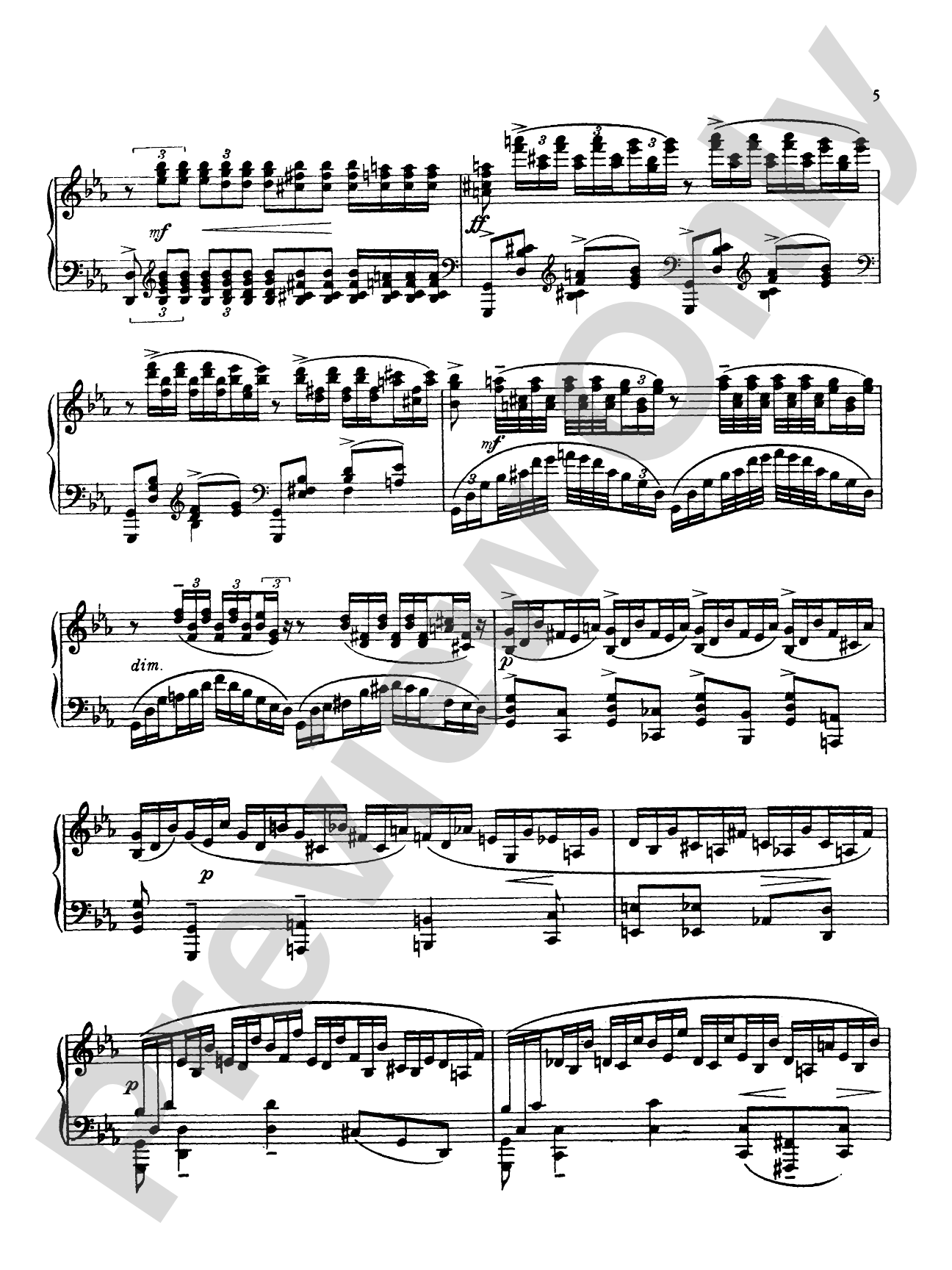
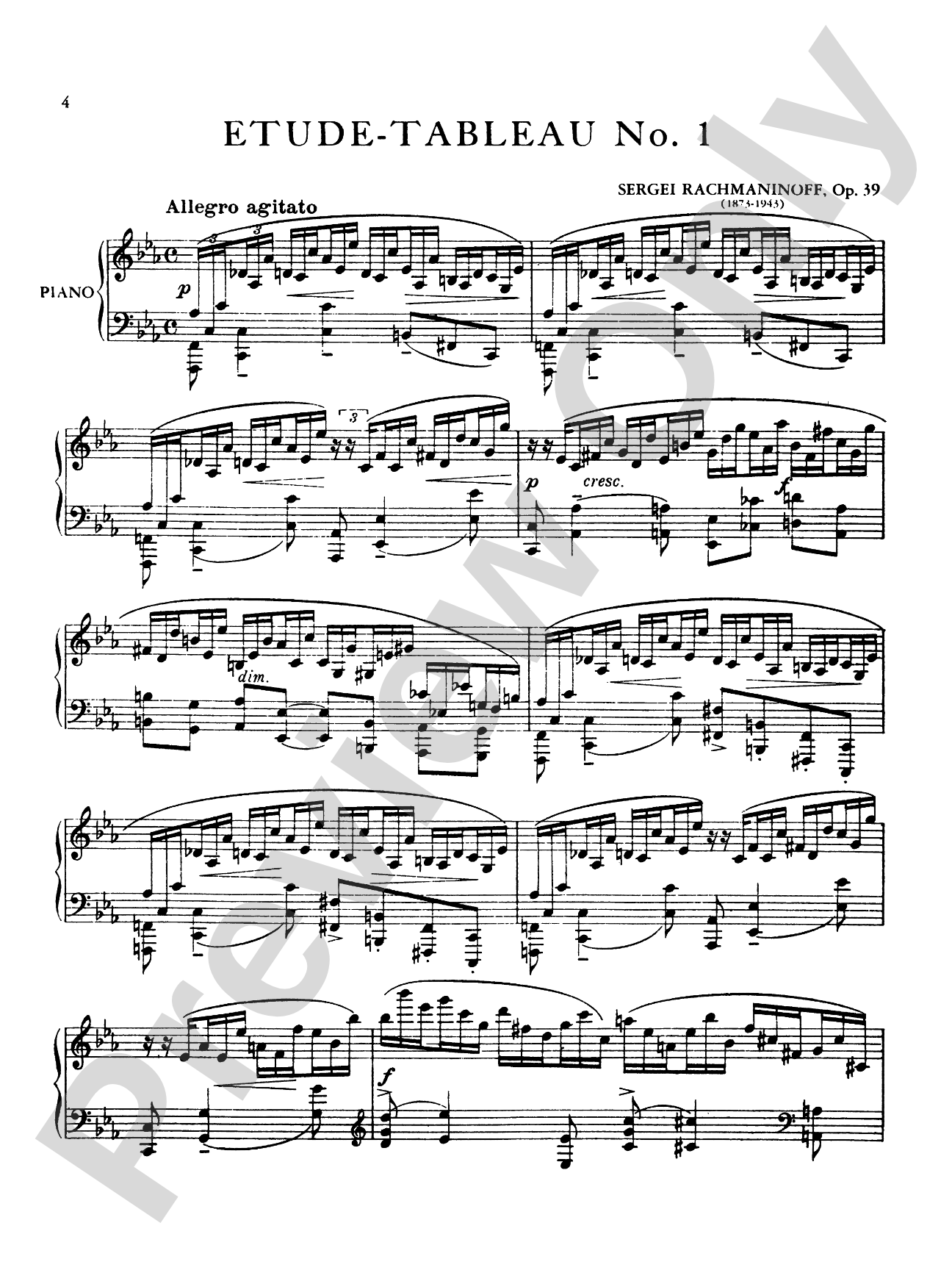
Rachmaninoff: Etudes Tableaux, Op. 39 Sheet Music Preview

Rachmaninoff: Etudes Tableaux, Op. 39

By Sergei Rachmaninoff

Level: Advanced

Item: 00-PC-0008991

Digital Download
$0.99
Description
(9)

Don't just read it, hear it, play along with it, and watch your students grow with it. In MakeMusic Cloud, Rachmaninoff: Etudes Tableaux, Op. 39 comes alive with professional accompaniment, adjustable tempo, and built-in practice tools that turn solo practice into real progress.

Sample Audio
No sample audio found.
Sample Video
Additional Details
Series: Kalmus Edition
Publisher: Alfred Music
Page Count: 68
SKU: 00-PC-0008991

More about this title

About the Composer: Sergei Rachmaninoff

Sergei Rachmaninoff (1873-1943) was a Russian composer, pianist, and conductor whose virtuosic writing for the piano remains unmatched in its technical and emotional demands. His works shaped the sound of late Romantic music and continue to challenge advanced pianists with their sweeping melodic lines, complex harmonic language, and physically demanding passagework. Rachmaninoff's career spanned two continents and two world wars; he left Russia after the Revolution and spent his later years composing and performing in the United States, establishing himself as one of the twentieth century's most recorded pianists.

Why we love this

These nine etudes showcase Rachmaninoff at his most uncompromising: each study isolates a specific technical or musical problem and develops it into a substantial, dramatically rich work. Unlike pedagogical studies that exist only to solve a single problem, the Etudes Tableaux succeed as both rigorous finger work and profound art music, making them essential repertoire for advanced students who need to understand how technique and expression merge at the highest level.

What to expect

These works pulse with the emotional intensity and harmonic richness that define Rachmaninoff's style. They move between moments of introspective lyricism and dramatic, virtuosic display, often within a single piece, creating a sense of emotional complexity that transcends simple technical display.

Who it's for

Advanced pianists preparing for conservatory auditions, competition repertoire, or mature recital programs will find these nine etudes essential. Teachers of advanced students use this collection to address technical refinement alongside interpretive depth, as each study demands both precision and musical maturity.

How to get the most out of it

  • Approach the opening pedal instruction as foundational to the harmonic language; these pieces often contain rich, complex sonorities that require careful management of damper pedal timing rather than continuous depression.
  • Study the hand position and finger strength required for Rachmaninoff's wide intervallic leaps and stretched chords; many editions include fingering suggestions that deserve careful evaluation against your own hand span.
  • Balance the technical figuration with the singing melody, which often emerges from accompanimental texture rather than sitting on top of it; listen for moments where the primary line transfers between registers.
  • Use the printed tempo markings as expressive guides, not strict metronomic measures; Rachmaninoff's music rewards judicious rubato, particularly in transitional passages and at phrase endings.

How to use it

Program individual etudes on solo recitals to demonstrate range: some are brief and explosive, others are extended meditations that anchor a program section. Advanced students might perform one as an opener or closer to showcase their technical prowess before or after larger-scale works.

Skills your students will build

  • Pedal management in complex harmonic contexts
  • Finger independence and precision across wide intervallic ranges
  • Integration of lyrical melody within dense accompaniment textures
  • Rubato and expressive timing in twentieth-century Romantic idiom
  • Sustained physical endurance over substantial technical passages

You May Also Like