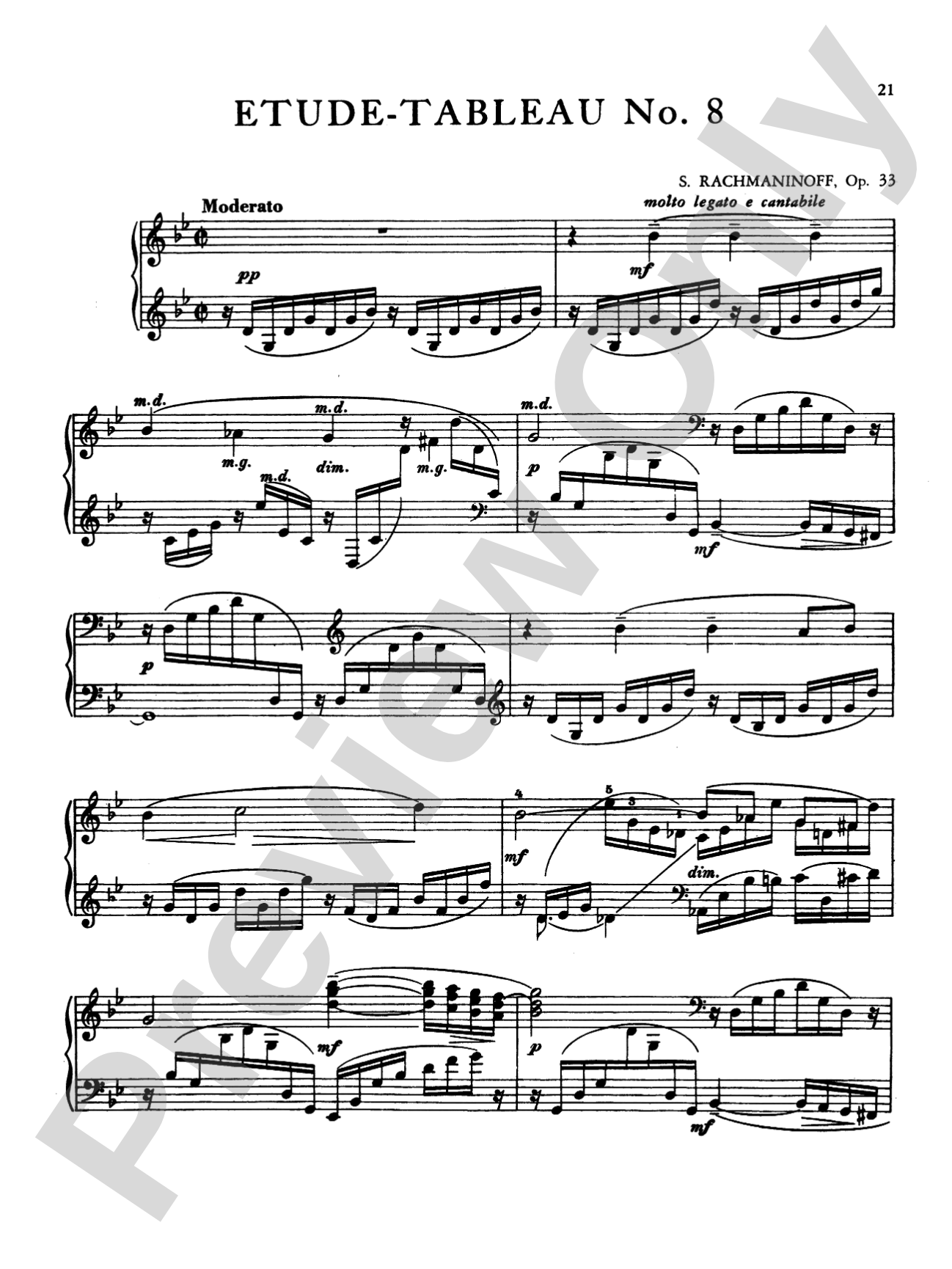
Rachmaninoff: Etudes Tableaux, Op. 33 Sheet Music Preview

Rachmaninoff: Etudes Tableaux, Op. 33

By Sergei Rachmaninoff

Item: 00-PC-0008959

Digital Download
$0.99
Description
(6)

Don't just read it, hear it, play along with it, and watch your students grow with it. In MakeMusic Cloud, Rachmaninoff: Etudes Tableaux, Op. 33 comes alive with professional accompaniment, adjustable tempo, and built-in practice tools that turn solo practice into real progress.

Sample Audio
No sample audio found.
Sample Video
Additional Details
Series: Kalmus Edition
Publisher: Alfred Music
Page Count: 32
SKU: 00-PC-0008959

More about this title

About the Composer: Sergei Rachmaninoff

Sergei Rachmaninoff (1873-1943) stands as one of the last great Romantic composers, bridging 19th-century virtuosity with 20th-century modernism. A pianist of legendary technique and interpretive depth, he composed with the instrument's physical and emotional capacities at the forefront, creating works that demand both technical command and profound musical maturity from performers.

Rachmaninoff's piano writing shaped how generations of pianists approached the repertoire. His understanding of sonority, pedal technique, and the marriage of lyrical melody with sophisticated harmony influenced conservatory curricula worldwide. The Etudes Tableaux represent the pinnacle of his mature style, combining pedagogical rigor with concert-hall ambition.

Why we love this

These six pieces distill everything essential about Rachmaninoff's approach to keyboard writing: sweeping arpeggios that test hand independence, rich harmonic textures that reward careful pedal work, and melodies that sing with the warmth of a vocal line. Each etude presents a distinct technical challenge embedded within genuine musical substance, making them ideal for pianists ready to engage with concert repertoire at an advanced level.

What to expect

These pieces unfold with the grandeur and emotional complexity of Rachmaninoff's symphonic writing translated to solo keyboard. Each etude possesses a distinct character: some lean into brooding introspection, others explode with virtuosic energy, and still others achieve an almost impressionistic shimmer through layered textures. Throughout, there is an insistent lyricism that prevents even the most technically demanding passages from becoming cold.

Who it's for

Advanced pianists preparing for recital repertoire, college-level piano students, and teachers seeking concert pieces that balance technical development with artistic reward. This collection suits pianists who have mastered fundamental technique and are ready for works that demand sophisticated musical judgment alongside virtuosic facility.

How to get the most out of it

  • Approach the arpeggios as musical gestures, not mechanical displays. Shape them with rubato and tonal color rather than uniform velocity.
  • Experiment with the sustain pedal as a compositional element. Rachmaninoff's harmonic progressions often depend on strategic pedal changes to avoid muddiness while maintaining resonance.
  • Listen closely to voice leading within the accompaniment figures. Secondary melodies often sit beneath the main line, and bringing them forward slightly transforms the texture's depth.
  • Consider the recorded tradition carefully. Pianists from Horowitz to Trifonov interpret these pieces differently; studying multiple approaches will deepen your understanding of interpretive choices available to you.

How to use it

Program individual etudes on student recitals to anchor the second half with substantial solo repertoire, or present several as a thematic recital focusing on early 20th-century piano writing. These pieces also work beautifully in master class settings where technique and interpretation can be explored in depth.

Skills your students will build

  • Managing sustained arpeggios across wide intervallic ranges
  • Coordinating complex rhythmic relationships between hands
  • Executing smooth voice leading across register shifts
  • Interpreting Romantic harmonic language with clarity and color
  • Applying pedal technique to enhance rather than obscure texture
  • Balancing lyrical phrasing with virtuosic passage work

You May Also Like