
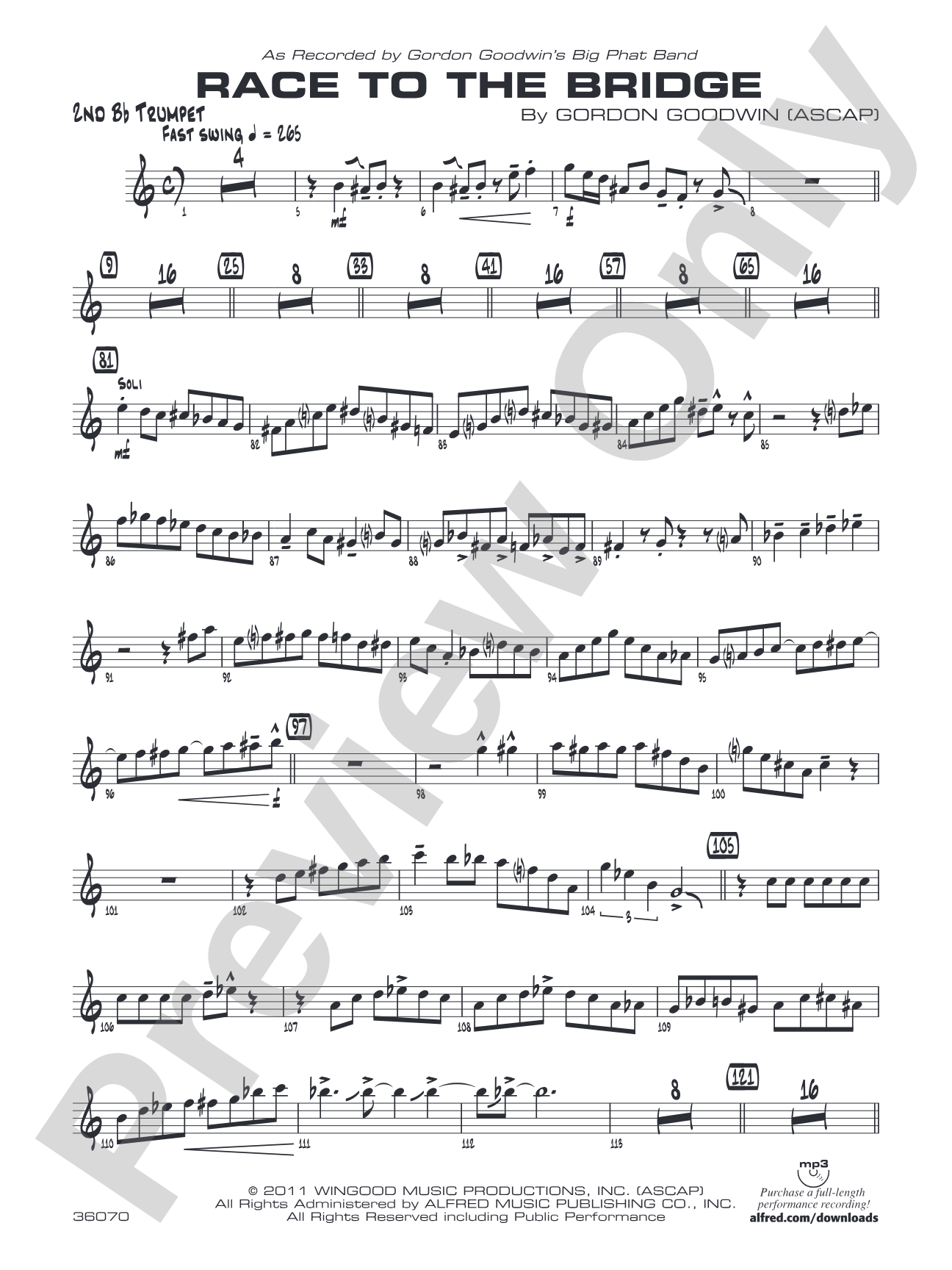

Race to the Bridge: 2nd B-flat Trumpet
By Gordon Goodwin
Grade: 6 (Professional / Very Advanced)
Item: 00-PC-0017206_T2
$5.99
Pickup currently not available
Description
If you're looking for a bright and challenging piece, look no further than this super swing chart. Solo space for all saxes, trumpet, and trombone. Includes an auxiliary percussion part. No woodwind doubles, lead trumpet range to written high F-sharp. As recorded by Gordon Goodwin's Big Phat Band on the CD That's How We Roll on Telarc International.


Don't just read it, hear it, play along with it, and watch your students grow with it. In MakeMusic Cloud, Race to the Bridge: 2nd B-flat Trumpet comes alive with professional accompaniment, adjustable tempo, and built-in practice tools that turn solo practice into real progress.
Open in the Player
Jump straight in and assign it today.
Start Your Free Trial
Open this title and explore the full library in minutes.
Sample Audio
1
Audio File
--:--
0:00
0:00
Sample Video
No sample videos found.
Additional Details
Series:
Gordon Goodwin Series
Publisher:
Alfred Music
Page Count:
110
SKU:
00-PC-0017206_T2
More about this title
About the Composer: Gordon Goodwin

Gordon Goodwin began composing at five years old, writing complete pieces rather than fragments. His first big band chart, Hang Loose, emerged when he was just thirteen. This early mastery of orchestration and form caught the attention of film and television producers, leading to Emmy wins and Grammy nominations for his work on films including Bad Boys II, Con Air, Remember the Titans, and Star Trek: Nemesis.
Beyond Hollywood scoring, Goodwin has written for and performed alongside major jazz and pop vocalists including Quincy Jones, Ray Charles, Christina Aguilera, and Mel Tormé. He has conducted symphony orchestras across North America and Europe. Since 2000, he has led Gordon Goodwin's Big Phat Band, a Los Angeles-based ensemble that has earned multiple Grammy nominations and redefined contemporary big band jazz with albums like Swingin' for the Fences and XXL.
Why we love this
Goodwin writes with the sophistication of a film composer and the instincts of a bandleader who knows exactly what drives an ensemble forward. Race to the Bridge showcases his trademark clarity: every voice counts, the harmonies crackle, and the soloists get genuine spotlight moments without sacrificing ensemble cohesion. This is professional-level writing that respects your players' abilities while pushing them genuinely forward.
What to expect
Race to the Bridge is exactly what its title suggests: a velocity chart with genuine swing, energy that never tips into aggression, and a sense of forward motion. The solos invite real risk-taking while the ensemble figures snap with precision. It feels like a band running at full capability.
Who it's for
This score and parts set is for advanced jazz ensembles, community big bands, and professional or semi-professional groups ready for Grade 6 difficulty. Conductors need solid interpreters across all sections, particularly in the trumpet and trombone sections, and players who can balance technical control with jazz phrasing.
How to get the most out of it
- Lock the rhythm section (bass and drums) into the groove before sectional rehearsals. Goodwin's charts demand that foundation be rock solid so soloists can stretch and still stay connected.
- Separate sax section work from the ensemble passages. The solos require individual attention; the ensemble figures require lock-step precision. Rehearse them as distinct challenges.
- Balance the lead trumpet range up to high F-sharp carefully. This isn't a range test; it's a design choice. Ensure the player approaches it as part of the musical phrase, not an endpoint.
- Use the recorded reference (That's How We Roll) sparingly during early rehearsals, then lean on it heavily once your players understand their parts. Goodwin's rhythmic feel is specific and worth capturing.
How to use it
Program this as a closer or climax moment on a concert that includes both straightforward standards and challenging contemporary writing. It works well after a vocalist feature or a ballad because it reestablishes ensemble power and showcases what your band can accomplish at the highest level. Its 110 pages signal serious repertoire to an audience.
Skills your students will build
- Reading and executing complex big band charts with independent sectional voicings
- Solo improvisation over changes in a professional recording context
- Rhythmic precision and groove pocket in swing and contemporary jazz feels
- Lead trumpet playing in the upper register while maintaining musicality
- Ensemble balance and blend across multiple solo statements
- Percussion coordination (auxiliary percussion part) with the main ensemble groove