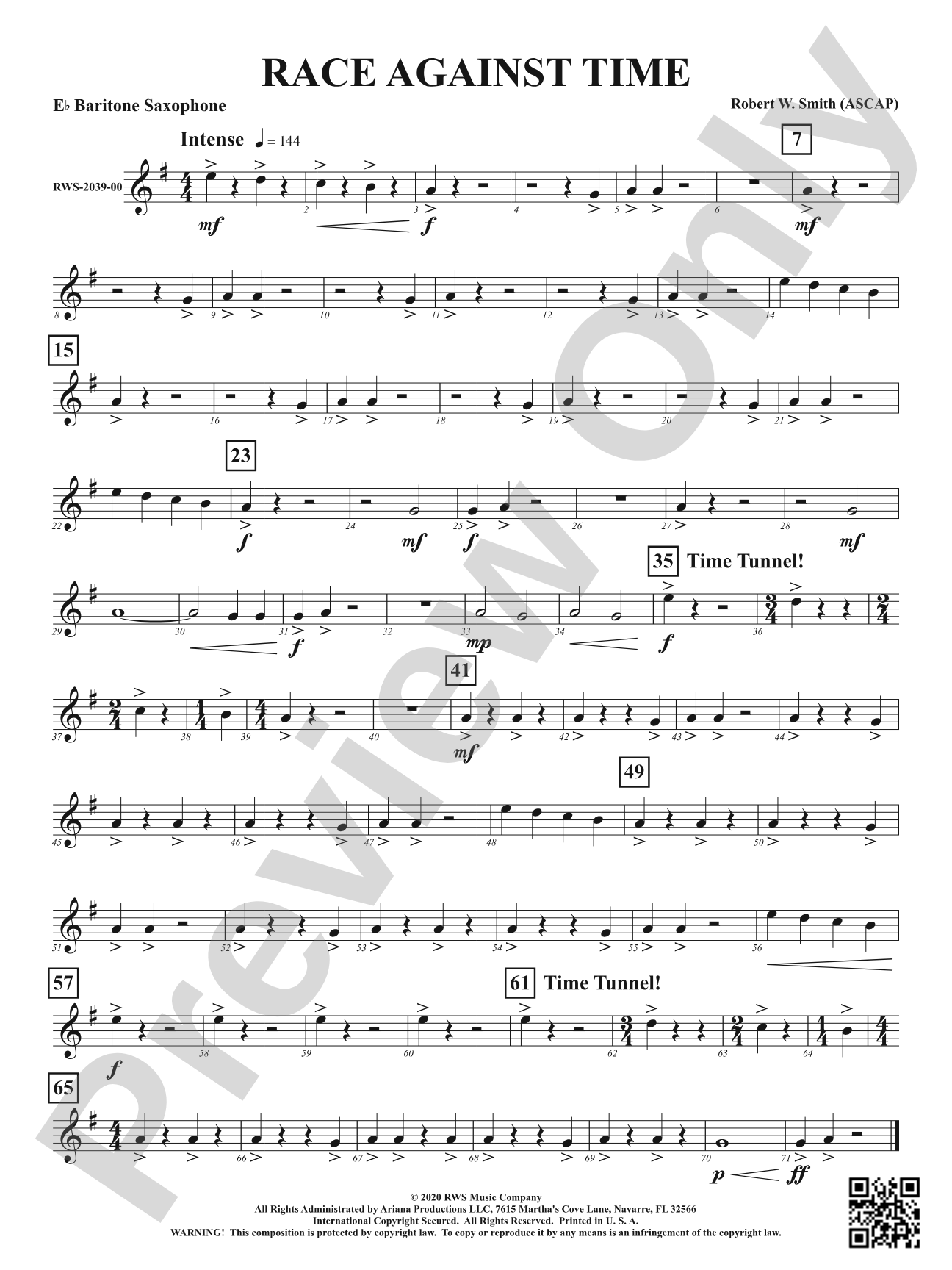
Race Against Time: E-flat Baritone Saxophone Sheet Music Preview

Race Against Time: E-flat Baritone Saxophone

By Robert W. Smith

Level:.5

Item: 98-PC-RWS2039_BTX

Digital Download
$3.99
Description
A thrilling musical adventure for your young band musicians, Race Against Time is a fast and furious journey with an educational focus on the time signature. Driving in 4/4 time, your students will like the intensity and strength of the musical race. However, they will love their journey through the "time tunnel" with simple yet effective meter changes. Master educator Robert W. Smith has provided a perfect vehicle to teach and reinforce the time signature in a musically relevant setting.

Original Item#: RWS-2039-00

Race Against Time: E-flat Baritone Saxophone isn't in MakeMusic Cloud just yet...but it could be. Let us know you'd like to see it, and you'll help shape what comes next. In the meantime, start a free trial and dive into thousands of interactive titles your students can play along with today.

Sample Audio
0:00
0:00
Sample Video
Additional Details
Series: RWS - Very Beginning Band
Publisher: RWS Music Company
SKU: 98-PC-RWS2039_BTX

More about this title

About the Composer: Robert W. Smith

Robert W. Smith

Robert W. Smith stands among America's most productive composers for concert band and orchestra, with over 400 published works to his credit. He holds degrees in music education from Troy State University and a master's degree from the University of Miami, and has built a career conducting and clinicianships across the United States, Canada, Japan, Australia, and Europe.

Smith's compositions span concert halls, Olympic ceremonies, television broadcasts, and major public events. His symphonies, including The Divine Comedy and The Odyssey, and works for developing ensembles like The Tempest have become core repertoire in band programs worldwide. His gift for writing musically engaging pieces that serve genuine pedagogical purposes has made him a trusted voice in music education.

Why we love this

Smith crafts the meter-change concept as a genuine narrative rather than a technical exercise. Your students experience the learning in context—they're racing through a musical landscape where the shifts in time feel like plot points, not flash cards. For early bands, that distinction matters enormously.

What to expect

Propulsive and playful. The opening drives forward with the confident energy of a race, but the meter changes arrive not as obstacles but as thrilling shifts in the journey. Smith balances urgency with accessibility, keeping the musical language direct and the emotional arc clear.

Who it's for

Developing concert bands in their first or second year, where foundational time signature understanding is an active learning goal. This works equally well for young musicians encountering mixed meters for the first time and for ensembles that need engaging reinforcement of these concepts.

How to get the most out of it

  • Establish the 4/4 groove firmly in the opening section before introducing the first meter shift. Lock the pulse with your conducting; your clarity will carry the ensemble through the transitions.
  • Rehearse each meter change independently first. Have students count and play the specific passage until the new time signature feels natural, then reconnect it to the surrounding material.
  • Bring energy and theatrical flair to the "time tunnel" section. This is where the piece communicates joy in discovery; if you conduct it as a problem to solve, the students will hear that hesitation.

How to use it

Program this as a fall concert opener or mid-season feature piece when your band is solid enough in fundamentals to focus on the meter exploration without struggling with basic ensemble skills. It also works well as a closing number for a young band concert, leaving audiences with a sense of momentum and accomplishment.

Skills your students will build

  • Reading and performing in multiple time signatures within a single piece
  • Tracking meter changes while maintaining ensemble cohesion
  • Responding to conducted beat patterns that shift from 4/4 to other meters
  • Building pulse and internal subdivision across different metric frameworks

You May Also Like