Rabbits in the Snow Sheet Music Preview

Rabbits in the Snow: Piano

By Mary K. Sallee

Item: 98-DS4137

Digital Download
$2.50
Description
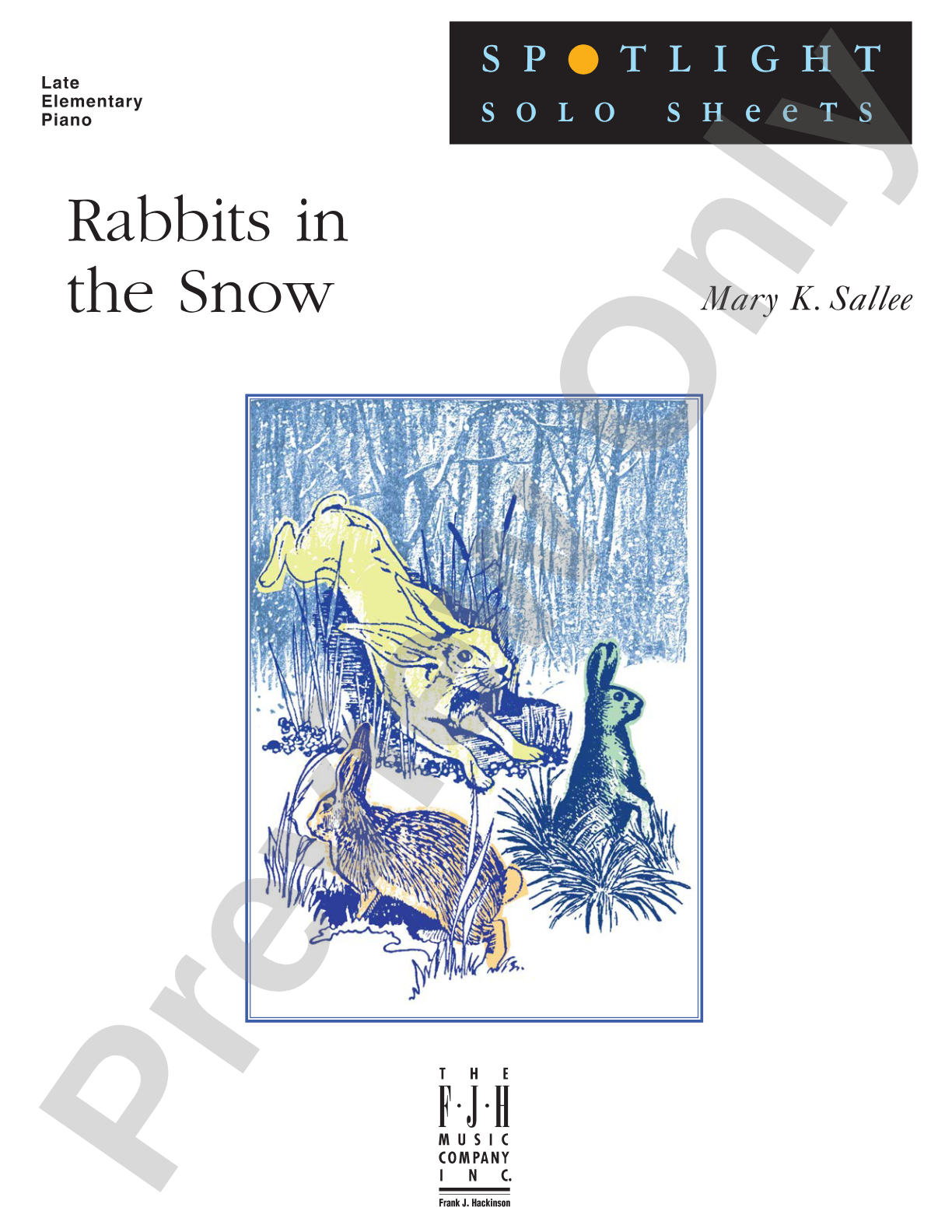
This musical narrative has a light, dreamy melody which follows the rabbits on their way. It uses a fun articulation where long notes hold while the other fingers sometimes "hop". Accelerating staccato triads depict a chase scene before the rabbits finally scurry home. Use this one as an introduction to Impressionism.

Rabbits in the Snow: Piano isn't in MakeMusic Cloud just yet...but it could be. Let us know you'd like to see it, and you'll help shape what comes next. In the meantime, start a free trial and dive into thousands of interactive titles your students can play along with today.

Sample Audio
No sample audio found.
Sample Video
Additional Details
Series: Spotlight Solo Sheets
Publisher: The FJH Music Company, Inc.
SKU: 98-DS4137

More about this title

About the Composer: Mary K. Sallee

Mary K. Sallee

Mary K. Sallee earned degrees in both piano and voice from the University of Oklahoma, followed by a master's degree in piano performance and pedagogy from the same institution. She spent a year at the Hochschule für Musik in Vienna as a Rotary Ambassadorial Scholar, an experience that deepened her understanding of European musical traditions and performance practice.

For nearly four decades, Sallee has maintained a private piano studio in Norman, Oklahoma, where she focuses on adult learners. She has served as adjunct faculty at Oklahoma Baptist University and held leadership roles in music education organizations, including OMTA state president and MTNA Director. Her catalog of over 60 published works reflects her dual commitment to composition and pedagogy; several pieces appear on National Federation of Music Clubs lists. Beyond her solo piano writing, she composes and arranges vocal and choral works, and remains active as a clinician, adjudicator, festival director, and jazz ensemble performer.

Why we love this

Sallee crafts pieces that teach through storytelling and kinesthetic discovery rather than abstract drills. The hopping articulation and chase sequence in this piece give students a memorable physical and musical image to anchor their technique, while the Impressionistic harmonic language opens their ears to color and texture beyond traditional tonal practices.

What to expect

A gentle journey through a snow-covered landscape, light-footed and whimsical. The opening floats with an almost impressionistic haze, then shifts into playful urgency as the chase begins, finally landing in a safe, satisfied conclusion as the rabbits reach home.

Who it's for

Late elementary pianists ready to explore beyond traditional major and minor tonality and interested in program music that rewards careful listening. This piece works well for students who respond to visual and narrative prompts and benefit from understanding the "why" behind musical choices.

How to get the most out of it

  • Shape the opening melody with gentle dynamic shaping to establish the dreamy character; avoid playing mechanically through the quiet passages.
  • Practice the hopping articulation separately, isolating one hand while the other holds the long notes, so the contrast reads clearly to listeners.
  • Build the accelerating staccato triads gradually, beginning slightly faster than the opening tempo and increasing the intensity as the chase unfolds.
  • Allow a brief breath or slight ritardando before the final scurry home to signal the narrative shift and give the rabbits' escape its own character.

How to use it

Perfect for a winter or holiday recital where you want something charming but substantive, or as part of a thematic program exploring nature in music. Place it early on a solo recital to establish a warm, accessible tone while introducing Impressionistic concepts to your audience.

Skills your students will build

  • Sustaining pedal control while articulating staccato notes with the opposite hand
  • Interpreting Impressionistic harmonic language and voicing
  • Executing accelerating tempo within a single passage
  • Connecting program content (narrative) to musical expression and phrasing
  • Reading and performing mixed articulations in both hands simultaneously

You May Also Like